powering productive workplaces
Front page
NewsWork Management1h · 09:01 BST · 14 min read

Workday Rising Verdict: The Latest Promises Tested

Workday's getting more ambitious about what its HR agents should handle. Sana coordinates the work, Work Intelligence looks at jobs task by task, and new safeguards keep agents in check. Rising 2026 gave buyers plenty to consider, although what shipped and what it's worth are different.

Workday Rising
Workday Rising

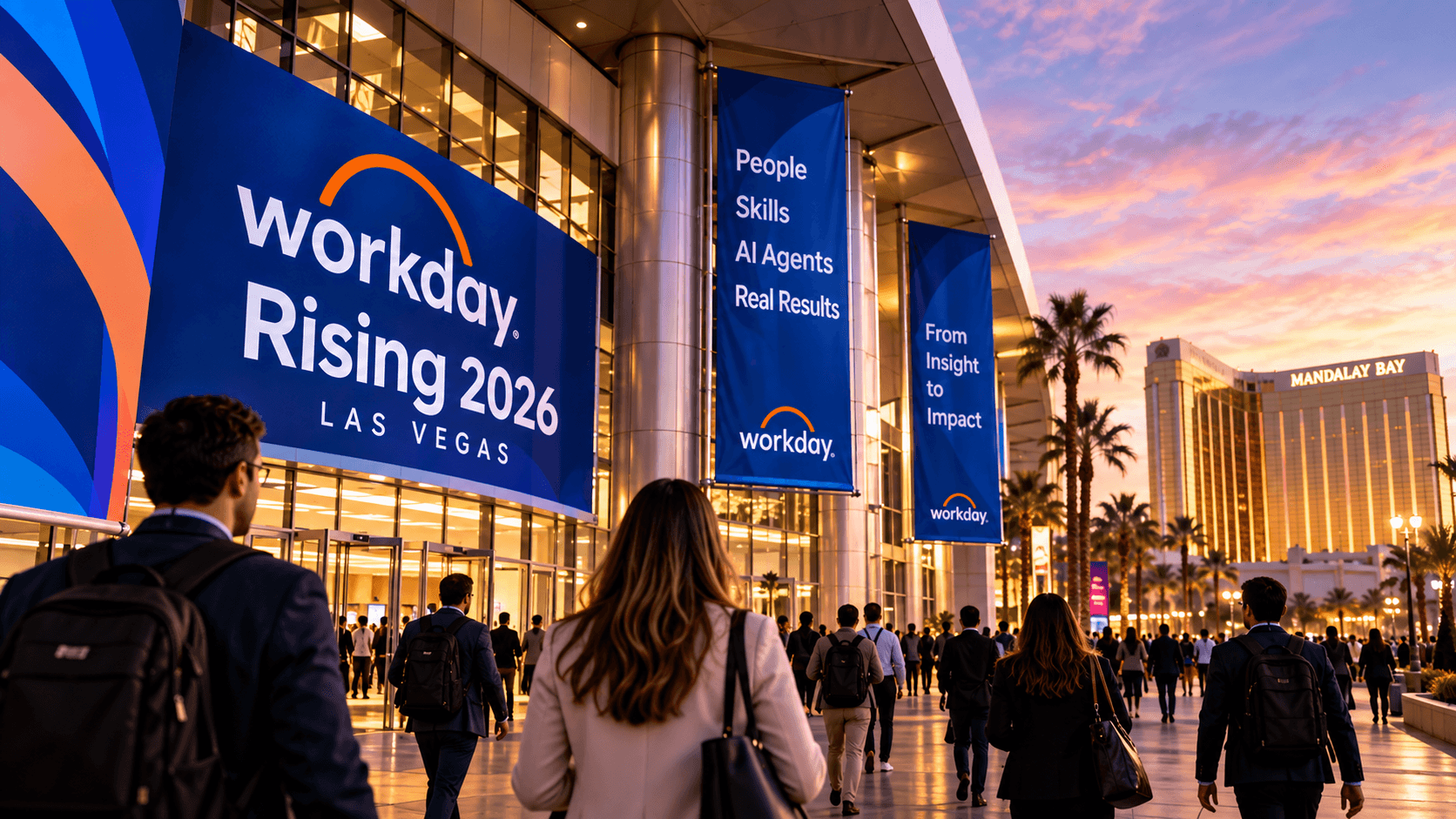
Workday gave us plenty to chew over on October 13th, after promising an event packed with “real rollouts, real results, and real ROI.” We got Agent-ready tools, Developer Agent, Custom Agents, Agent Harness, and Workday Data Cloud all in GA, while Sana became the new Workday Home.

That's a decent delivery, although the headline Talent Acquisition autopilot remains in early access, with wider availability planned for 2027.

During the Innovation Keynote, Gerrit Kazmaier argued that

“Real AI transformation is about driving growth faster, better. That's where you're really winning.”

That’s a nice quote, but we still need to know how much of that speedy growth comes from agents actually finishing work.

The bar was high before the keynote, with more than 5,500 customers using Workday-built agents, and the company also said AI SKUs generated nearly $600 million in annual recurring revenue in Q2. Yet fewer than 900 customers purchased an agent over the previous year, while around 300 had signed up for Flex Credits by Q2.

Workday further claims customers have automated 95% of frontline hiring and reduced time-to-hire by 70%. We'd be more impressed if those figures came with named customers and clearer baselines.

Workday has shipped some serious infrastructure. It still needs to prove what that infrastructure delivers when real people, deadlines, and budgets get involved.

What Did Workday Announce at Workday Rising 2026?

Workday came to Vegas with quite a hefty list of promises, and on October 13, it delivered several of them. Agent-Ready Tools, Developer Agent, Custom Agents, Agent Harness, and Workday Data Cloud all reached general availability. Sana became the new Workday Home, giving employees somewhere to see outstanding approvals, unfinished tasks, and what their agents have been doing.

Workday used a recruiter with 25 open positions to show what its Talent Acquisition Agent could handle. The agent keeps track of the vacancies that aren't moving, looks for suitable candidates, and helps with outreach and interview scheduling. Recruiters aren't handing over complete control, though. They still approve the messages before they're sent.

Joel Hellermark, Workday's chief AI officer, said:

“Our agents work like autopilots. They get the work done on their own, and bring people in exactly when their judgment makes the difference.”

Unfortunately, that hiring autopilot is still in early access, with GA planned for early 2027. The new payroll, deployment, and accountant autopilots won't reach early adopters until 2027 either.

Workday also introduced Work Intelligence, which breaks jobs into individual tasks to help businesses decide what AI should handle. It's in early access, while Decision Intelligence is already available to help teams weigh workforce decisions against financial plans.

Add the Anthropic partnership and planned C1.ai acquisition, and Workday clearly has its sights set high when it comes to work management.

Which Workday AI Agents Are Generally Available After Rising 2026?

I partially expected more specific AI agents from Rising, since several Workday AI agents were already commercially available before Vegas. Recruiting Agent, Talent Mobility Agent, Frontline Agent, Payroll Agent, BP Optimize Agent, and Self-Service Agent were all listed as GA, alongside Agent System of Record. Job Architecture Agent and Performance Management Agent remained Early Adopter, while Case Agent was still marked “Coming Soon.”

Workday did deliver a lot more on the developer and governance side. Developer Agent and Agent-Ready Tools reached GA on October 13, alongside Custom Agents, Agent Harness and Workday Data Cloud. That’s pretty handy for employers building agents that need to access sensitive people data and perform actions under company rules, although Agent Passport isn’t deemed GA yet.

Gabe Monroy’s Analyst Day demonstration was interesting too, showing an unofficial MCP connection letting an agent move an employee without triggering the required approval process. When Monroy repeated the action using Workday's newly available Agent-Ready Tools, the approval workflow kicked in, which backed up his astute claim of “Headless can’t be lawless.”

I think that’ll become an interesting topic worth discussing as more companies look for ways to enable AI agents to work across platforms and tools, alongside human staff.

Did Workday Show Agentic HR Delivering Real Business Results?

Workday had some decent evidence to bring to Vegas already. In September, Gartner named it a Leader in its first Workforce Management Technology Magic Quadrant. Early adopters of its Workforce Management Agent also reported up to 90% less time managing shift changes, 65% better process automation, and 75% fewer manual time-entry errors.

We all love numbers like that, but it’s worth saying Workday still hasn’t named the customers behind each result. Fortunately, there are stronger customer examples from its established workforce tools. Valvoline cut weekly schedule preparation from over two hours to roughly 15 minutes. Life Time reported 50,000 manager hours saved annually, $1 million in labor savings and 50% less overtime. Excellent results, although they came from Workday's scheduling suite, rather than the newer agent.

Then there's Accenture. Its October 13 Rising session described scaling more than 30 Workday agents across a 700,000-plus workforce. Bhusri also confirmed a Self-Service Agent rollout targeting 400,000 employees. Sanofi's session, meanwhile, tackled the awkward preparatory work involving legacy data and job architecture.

There’s an employee-side test, too. Workday and DailyPay found 45% of frontline workers rank scheduling among their top three reasons for taking their current job. If agents are improving workforce management, I’d eventually expect employee control over schedules to improve alongside the manager efficiency figures. Adoption numbers can’t answer that one.

Can Work Intelligence Improve Staffing and Skills Decisions?

That’s the big analytics test. Faster tasks are useful, but for workforce planning AI, the better evidence is what changes in labor cost, workforce capacity, accuracy or employee experience.

Gartner gave us a useful independent benchmark at HR Symposium/Xpo in London on October 6. It said almost 40% of companies are over budget on AI, while organizations redesigning work to change the cost of work are more than twice as likely to beat their cost goals. Still, it’s worth wondering where the capacity goes after AI makes it available.

Workday's October 5 workforce report adds another complication, showing that across more than 550 employers, demand for basic AI skills fell 25%, while demand for hands-on AI development and automation rose 51%. Internal movement also declined at 57% of employers. So who's getting retrained, and which roles are getting harder to fill?

Rising’s introduction of Work Intelligence might help. It breaks jobs into individual tasks and maps the skills behind them, helping employers decide which activities AI could handle. Workday has even said Work Intelligence can also measure how employees' time shifts as AI changes their tasks, which skills grow and whether people move into new roles. Workday Learning powered by Sana can then recommend training for those gaps, too.

Nikki Helmer, Workday's VP of Talent Management and Insights, said:

“The basic building block of work is shifting from the job to the task.”

Skills Cloud already serves more than 3,450 customers, but Work Intelligence is in early access. A task map can show a potential capacity gap; it doesn’t prove an employer has done anything about it.

Can Workday Turn Better Analysis Into Better Workforce Plans?

Workday has a more substantial planning story than another count of completed agent actions. Its October 13 expansion of Decision Intelligence gives HR and finance teams a shared view of hiring, internal mobility and budget scenarios. Managers can compare whether to recruit, develop existing employees or redirect capacity, using financial assumptions alongside the people data.

Unity Technologies offered a named example at Rising. James Choi, its global head of finance transformation and procurement, said Decision Intelligence was helping investigate revenue variances and prepare the monthly post-close outlook deck for the CFO: “It is already helping us close the gap between analysis and execution.” That identifies a real financial process. There’s still no public figure for time saved, greater accuracy, or a better financial outcome.

Workday’s existing analytics products have more concrete benchmarks. Adaptive from Workday models assumptions across revenue, costs, and workforce plans; TX Group says it cut a rolling forecast from two to three days to four hours. That’s a strong speed comparison. Workday also previewed an Adaptive Planning MCP Server intended to give supported agents permission-aware access to planning data.

We still need more information about what happens after a forecast changes. As BetterWorks pointed out on October 5, 84.8% of HR leaders surveyed were confident performance management improved business priorities, but only 43.9% could support that confidence with clear business metrics. Workday's planning tools will have to help managers explain the result of a decision, not simply produce the analysis faster.

How Open Is Workday’s Agentic HR Model?

Workday's approach to AI agents got considerably more interesting at Rising. It doesn't seem particularly bothered about which application employees start from, provided Workday still gets to enforce the rules when somebody wants something done.

Employees can already access Workday self-service through Gemini Enterprise, Microsoft Copilot, Teams and Slack. The fuller Sana experience is coming to those platforms later in 2026, while the new Claude integration is still in early access.

Joel Hellermark explained the thinking in Workday's October 13 announcement:

“People shouldn't have to leave a conversation to access HR or finance domain AI agents, or to get the work done.”

The Anthropic partnership allows Claude and Sana to exchange tasks and context through MCP. Workday’s Agent-Ready Tools let outside agents access HR and finance processes while retaining Workday permissions and approval rules. Workday Data Cloud gives AWS services access to governed data without copying it; Google’s October 8 Borderless Lakehouse announcement also discussed reading Workday data without duplication.

Of course, reading a staffing plan is rather different from approving a change to it. Sana brings unfinished requests, decisions, and agent activity into Workday Home; Workday still wants to retain authority when an outside assistant initiates the transaction. I’d judge the openness claim by whether an HR manager can trace the action, identify who approved it, and find out what happened when something was rejected.

Who’s Accountable When AI Agents Make Workforce Decisions?

This is a good question, since Workday isn’t the only vendor competing to control what happens when an AI answer becomes an action. Joel Hellermark was unusually direct at Analyst Day:

“The company that owns the workflows” would have the advantage in AI.

Workday holds the employment records and approval rules that can turn an agent’s recommendation into a personnel decision.

Gartner’s October 6 CHRO research found only 24% of leadership teams agreed on who should be accountable for AI agents, and that disagreement obviously gets expensive when something goes wrong. What happens if an agent recommends moving someone into a different role and the manager declines? Who can see why the recommendation was made, and who can reverse the change if it went ahead?

Workday’s planned C1.ai acquisition might address a related problem: granting and revoking access for employees and agents when responsibilities change, or work ends. C1.ai CEO Alex Bovee argued that:

“Enterprises can’t secure the AI era using yesterday’s IT tickets.”

The deal hasn’t closed, so the promised wider governance is still a future benefit, not a completed integration.

Workday says agents can be triggered by hires, role changes and departures, with administrators able to inspect execution histories and approvals. Sana’s longer multiplayer coordination remains a future experience. Microsoft’s Autopilot and Google’s latest Gemini agent are also moving toward sustained work, but that doesn’t settle who is accountable for a mistaken HR action. For workforce leaders, a readable audit trail and an actual human decision-maker are going to be essential.

Do Workday AI Agents Make Economic Sense at Scale?

For buyers wondering whether to deploy HR agents, there’s still a lot to work through. KPMG’s Q3 Global AI Pulse already showed that across 2,131 senior leaders in 20 countries, 34% report significant employee adoption of AI agents, up from 25% in Q1, yet only 12% consistently assess AI value against cost across the organization. Among organizations already reporting established ROI, that rises to 48%.

Workday’s own October 1 UAE research makes the same point from another angle: employees said AI saves 3.6 hours a week on average, but 3.4 hours go back into clarifying, correcting, or rewriting poor output. Gross time saved isn’t the same as net value, though.

With Workday's Flex Credits, the bill depends on what an agent does. Looking something up through Self-Service Agent uses one credit, while completing a task autonomously uses five. You're paying for activity rather than seats, which sounds appealing until agents start handling thousands of requests and somebody has to predict the bill.

Dow offers the customer objection missing from the marketing material. Sarah Jo Rowley, its HR Digital Product and AI leader, told diginomica the company hadn’t activated agents in its Workday tenant, partly because Flex Credits created a funding argument.

“Functionally, HR doesn’t pay the bill. IT pays the bill.”

Who watches consumption when HR triggers the work but IT receives the invoice? That’s a better buyer question than another chart of agent activity.

What Should Workforce Teams Demand Before Expanding Workday AI Agents?

The buying case gets much easier to judge if teams stop asking whether an agent is available and start asking what happens around it in production. Does it improve time-to-hire, schedule accuracy, forecast quality, or employee experience? Who signs off an exception? How much time goes into checking the output? And can somebody in finance explain what each completed, reviewed transaction cost?

October 13 Analyst Day filled in part of the commercial picture. Workday reported nearly 300 Flex Credit customers as of Q2, including almost 200 added that quarter, and just under 900 customers buying at least one agent over the preceding 12 months. It also said 125 customers had built 500 agents and 6,000 forms-based applications with Developer Agent since June. Still, those are just adoption and development measures.

There’s a human question to ask too, as always in the case of AI adoption. Dow’s Rowley raised concerns about employees losing skills as routine work moves to agents. Workday’s Work Intelligence could help employers identify what to automate and which capabilities people should develop instead, but someone has to measure whether that redesign actually works for everyone involved.

Workday doesn’t need to give every customer the same operating model. It does need to make approval ownership, usage limits, and ordinary implementation effort legible.

Has Workday Crossed the Harder Line?

Workday arrived in Las Vegas with adoption already moving fast. That meant Rising had to prove something tougher than demand. It had to show repeatable deployment, controlled execution, and economics that hold up once agents begin handling serious workforce activity.

It delivered more of the agent-building machinery, a better way to trace approvals and a more interesting analytics direction in Work Intelligence. Established scheduling customers have credible savings. What we’re still missing is enough comparable, named evidence that the newest agents improve staffing decisions or net workforce costs after human checking is counted.

Workday's getting pretty good at demonstrating what an agent should do. I'd like to see more evidence of what happened afterward, particularly whether employees had an easier time and the business got anything measurable back.

FAQs

What did Workday announce at Rising 2026?

Sana became Workday Home, Work Intelligence entered early access and Decision Intelligence expanded. Workday also generally released Agent-Ready Tools, Developer Agent, Custom Agents, Agent Harness and Workday Data Cloud, while announcing an Anthropic partnership and its proposed C1.ai acquisition.

Which Workday AI agents can companies use now?

Workday already offers Recruiting, Talent Mobility, Frontline, Payroll, BP Optimize and Self-Service Agents as GA. Talent Acquisition autopilot is a different story. It's still in early access, with broader availability expected in early 2027. And even GA agents aren't necessarily available to every customer without the right product licenses and tenant setup.

What is Workday Sana?

Sana is Workday’s AI experience layer for information, actions and longer workflows. As the new Workday Home, it brings requests, approvals and agent activity into one place. Sana Concierge is still early access, and some cross-platform experiences are planned for later in 2026.

How do Workday agents compare with Copilot and Gemini?

Workday self-service already operates through those platforms. Its broader Sana integrations are still rolling out. Workday wants its security and approval controls to govern the HR or finance transaction even when an external assistant initiates it.

How are Workday AI agents priced?

Eligible skills use usage-based Flex Credits. Workday examples range from one credit for Self-Service Agent information retrieval to five for autonomous task completion. Actual spend depends on contracts, transaction volume and the human checks involved.

rate this story
helps rank stories across uc today
The discussion0 takes · attributed & checked

Does this reflect your experience?

opening the room…
Read nextordered by techtelligence · every pick explained
picked for this story

If You Blinked, OpenAI Shipped Half a Work-Management Stack

3 Oct 2026
picked for this storyGoogle Just Wired Gemini Into Everyone Else's Stack8 Oct 2026picked for this storyOpenAI DevDay 2026 and the Agent Race in Task Management7 Oct 2026