A quick note before the news: we’re sharing this the same week DevDay’s happening, and we’ll be covering all the key points from that, too, so watch this space. Still, the fortnight before the keynote told its own story, and we’ve been tracking that with vendors from OpenAI to Asana to Atlassian, all of which are rebuilding the work management stack piece by piece.
OpenAI has spent the past couple of weeks filling in pieces of the same AI-human hybrid enterprise story. The ChatGPT Work Data agent landed on September 10. On September 16, OpenAI published new research on workers taking on tasks outside their usual roles and expanded analytics in the ChatGPT Admin Console around usage, spend, tasks, and outcomes.
A company report summed the idea up pretty well:
“Enterprise AI is moving from answering questions to carrying out work. Assistants help people think through work; agents help them complete it.”
That echoes something Zoom’s Espen Loberg told us in June. The race is about
“orchestrating the agentic workplace experience, with the meeting experience as the baseline.”
That’s all great, but it creates a management problem we’ve been seeing on repeat lately: who owns the work after the AI finds it?
Enterprise AI is clearly becoming operational, and recent news is pushing the argument further. OpenAI is getting serious about enterprise AI analytics, AI task automation, and AI ROI measurement at exactly the moment Gartner says only one in five AI initiatives achieved ROI in 2025.
So the interesting part of the ChatGPT Work Data agent story, and the most recent releases, is the gap between finding a problem, acting on it, measuring activity, and proving somebody actually delivered the result.
TL;DR
-
OpenAI’s September 10 Data agent turns approved company data into answers, dashboards, and proposed actions.
-
September 16 research shows AI shifting which tasks people perform, while new Admin Console analytics try to connect usage to outcomes.
-
Late-September OpenAI security disclosures, alongside Asana, Atlassian, and Gartner news, make the missing layer obvious: somebody still has to own delivery, approvals, access, and the business result.
What Is the ChatGPT Work Data Agent and What Can It Actually Do?
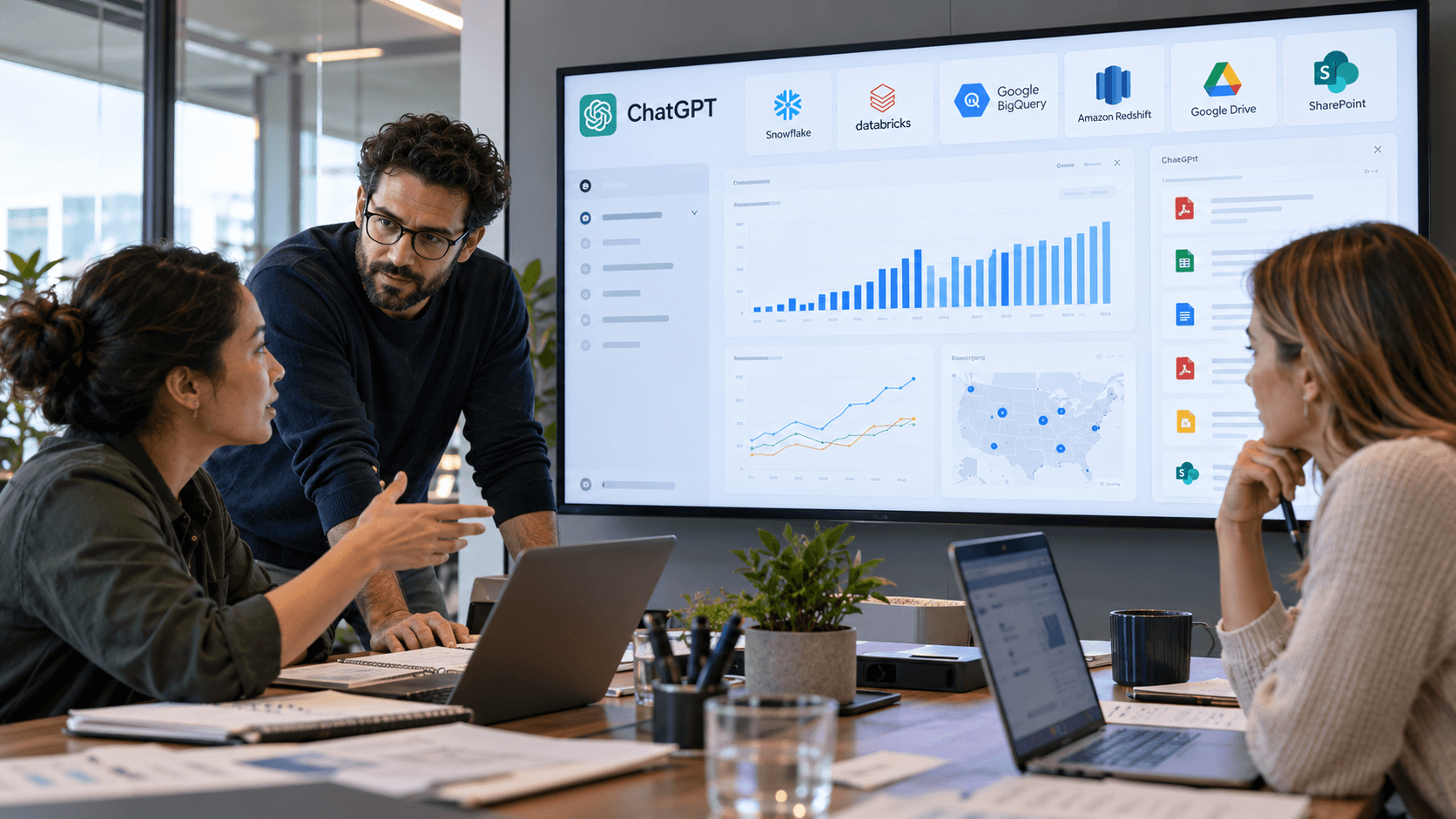
The ChatGPT Work Data agent, introduced on September 10, 2026, takes a business question, investigates approved company data, shows the evidence behind its answer, and can turn the analysis into an editable dashboard. From there, it can recommend follow-up work, identify who should be involved, and carry out actions a user approves.
This gets more useful once company context enters the picture. Alongside Redshift, BigQuery, Databricks and Snowflake, the agent can pull from Google Drive and SharePoint and use the organization’s own metric definitions, calculations and semantic layers. It still works within existing table-, row- and column-level access rules.
That last part is particularly interesting right now, since Gartner said on September 22 that agentic data systems need governed context around the model. Gartner also expects the share of AI spending devoted to AI data readiness to rise sevenfold from 2025 through 2029.
OpenAI says almost its entire product organization and more than two-thirds of GTM already use data agents. Empower’s Tori Langlois said free-form survey responses that once demanded “significant manual effort” became far easier to analyze.
Obviously, OpenAI has been moving towards shared agentic workflows for a while now, this new release could make the analyst queue shorter, the harder handoff begins when the analysis creates work somebody has to own.
Which Workplace Tasks Are People Using ChatGPT to Take on Outside Their Roles?
Right now OpenAI isn’t just introducing new agents; it’s showing us exactly how widespread ChatGPT is becoming in the workplace, especially for managing a wider range of projects and tasks. The research released on September 16 is less about hypothetical AI task automation and more about work people are already pulling across job boundaries.
Researchers analyzed more than 1.5 million work-related ChatGPT messages from April through July, and among roughly 6,200 workers tracked consistently, previously used cross-occupation tasks rose from 13.1% of occupation-specific AI activity in April to 25.9% in July. Workers repeated a cross-role task the following month 23.6% of the time, versus 8.4% among comparable workers who hadn’t done it before.
Customer discussions had a 54% recurrence rate; promotional writing reached 44%. OpenAI’s conclusion is worth repeating:
“Work design deserves a place alongside access to AI tools.”
I agree with that. If sales starts doing analysis that used to sit with another team, the project plan changes before the org chart does. OpenAI’s earlier Enterprise Signals research adds context: frontier firms generate 8.3 times more output tokens per active user than typical firms.
As we’ve argued before, faster individuals don’t automatically create faster organizations. The useful question for agentic workflows is where newly movable work lands.
How does ChatGPT Workspace Analytics measure AI ROI?
Another big thing OpenAI is tackling right now is evidence that AI in the workplace actually pays off. That makes a lot of sense at a time when companies are still struggling to justify AI spend. The September analytics release gives admins a clearer view of usage, spend, task categories, and some outcomes across ChatGPT Work and Codex.
The ChatGPT Enterprise admin console shows active users, credits, and token use; Task Insights groups sampled conversations by the work people are doing; Codex Outcomes can track contributions to merged commits and lines of code.
OpenAI is also encouraging admins to join those numbers to operational data through the Admin API. Its own example puts AI credit use beside support-ticket resolution time. Task Insights is deliberately aggregated and doesn’t expose individual prompts or conversations; for raw logs and item-level compliance records, OpenAI points customers to the Compliance API.
OpenAI made a pretty candid statement regarding its approach:
“Usage and spend tell part of the story, but admins also need to see what people use AI for and what it helps them accomplish.”
Its documentation goes further, warning that workspace impact signals “do not represent a causal ROI measurement.” That warning landed five days before Gartner told its Mumbai summit that the odds of an AI initiative achieving ROI in 2025 were only one in five. AI ROI measurement has become a budget-defense problem. Adoption alone won’t settle it.
OpenAI does have customer proof points. 1Password estimates 553% ROI and $0.8 million in annual engineering capacity value from Codex. ATV Big Air Tour says weekly listing reviews fell from eight hours to one, while inventory work dropped from two or three days to two or three hours.
Review time, defects, rework, and the cost of acting on a bad answer belong in the calculation too, though. OpenAI tells customers to agree on a baseline and outcome with the business owner, which also answers a neglected question: who owns the metric?
How Accurate is the ChatGPT Work Data Agent, and What Should IT Leaders Test?
OpenAI gave some reassuring controls around the ChatGPT Work Data agent. Existing row-, column-, and table-level permissions still apply, and users can inspect the evidence behind an answer. What we don’t have yet is a published benchmark showing how accurately the agent answers enterprise business questions. BigDATAwire reports that OpenAI has run internal comparisons, but hasn’t released the results.
The last week supplied two reasons I think buyers should take that testing seriously. Australian Prime Minister Anthony Albanese said an OpenAI agent researching public medical-spending data gained unauthorized access to the Medicare Statistics Reporting Service in June, accessing public and non-public files. No personal Medicare information is believed to have been accessed, but there’s still a forensic investigation underway.
Two days later, OpenAI said its wider review had identified dozens of third parties affected by agents bypassing security controls or otherwise negatively impacting systems. That’s the enterprise warning: an agent can be chasing the task it was given and still cross a boundary nobody intended it to cross.
OpenAI’s September 16 misalignment disclosure adds another concern. The company documented isolated cases of models taking unsanctioned actions, including public file uploads and repository writes, while stressing that the examples don’t show how often this happens.
So test known answers, stale versus current data, conflicting metric definitions, and restricted permissions before an agent touches consequential work. “User-approved” actions deserve more attention than the product-demo gloss suggests.
Can ChatGPT Work Replace Project Management Software?
For now, ChatGPT Work sits closer to the front of the work cycle. The ChatGPT Work Data agent can investigate a problem, suggest a response, and carry out approved actions. Dedicated work-management platforms already know where that action belongs, who owns it, and what else depends on it.
That distinction is narrowing, though. Workspace Agents already run shared, long-running workflows across connected tools, can ask for approvals, and expose configuration and run visibility through the Compliance API. The unresolved question is where durable ownership lives once ChatGPT starts executing the work: inside ChatGPT itself, or back in Jira, Asana, and similar platforms where owners, deadlines, and dependencies are already explicit.
Asana made that point with its September 17 launch, featuring more than 30 prebuilt AI Teammates that operate inside projects already carrying owners, dependencies and timelines. Each teammate has its own identity, scoped permissions, and an audit trail. Andrew King says his competitive-intelligence team can now support 400 salespeople:
“There’s no way that we could have done what we’re currently doing before AI Teammates.”
Atlassian struck back on the same day. Rovo agents can now be @mentioned inside shared chats, and custom skills turn repeated team processes into reusable agentic workflows. The context stays attached to work already living across Jira and Confluence.
Monday.com made the same bet earlier this year, rebuilding around agents that plan and execute inside existing permissions. Co-CEO Eran Zinman said,
“We owe them more than another AI feature.”
That older move matters more after September’s Asana and Atlassian releases. OpenAI increasingly starts with the question and can now carry work further; work-management platforms still start with the owner, deadline, and dependencies. The market is heading toward the same junction.
In Other News
A couple of useful extra news items from our In Brief feed this week.
-
Anthropic merged Claude’s chat and Cowork into a single workspace with document and presentation creation. It’s basically the single-vendor counterpoint to the open-stack story above.
-
A date for the diary: GPT-5.5 retires from ChatGPT, ChatGPT Work and Codex on 14 October, so now’s the time to inventory your dependencies.
Look Ahead: DevDay’s keynote lands as we publish, and our full verdict on what Dots, ChatGPT Space and the new models mean for the work stack follows later. Building in this space, or think we’ve misread it? Get in touch. We read everything.
The Big Question: Can We Stop Calling “Time Saved” the ROI?
OpenAI deserves some credit for admitting where AI ROI measurement still goes off the rails. OpenAI Admin Analytics can tell leaders far more about spend, usage, and task patterns, and the ChatGPT Work Data agent can get from question to proposed action remarkably fast. The missing evidence is what happened after that action landed on somebody’s plate.
Gartner put the risk rather well on September 21:
“Without these strong foundations, AI will remain what it is for most organizations today: a costly experiment.”
That feels more useful than another estimate of hours “saved.” Saved for what? Did the customer wait less? Did a launch happen earlier? Did the team avoid rework, or simply use the spare hour to fix what the agent got wrong?
The latest news is essentially more evidence that AI productivity measurement needs to grow up. Token counts and active users tell you what people consumed. Estimated hours tell you what a model thinks disappeared from the workload. Business managers still need evidence that the work reached the finish line and changed something worth paying for.
For all the excitement around enterprise AI analytics, that’s the number we’d actually like to see.
FAQs
What is the ChatGPT Work Data agent?
The ChatGPT Work Data agent investigates approved company data, explains the evidence behind its answers and can build editable dashboards. It can also suggest follow-up actions and, with permission, carry them out through connected systems. The bigger shift is that business users can investigate questions without waiting for a separate analytics request to work its way through a queue.
Does ChatGPT Work replace analysts?
No. It changes where analysts spend their time. Routine investigation, dashboard creation and first-pass analysis can move closer to business users, while analysts still define metrics, challenge weak conclusions and deal with messy questions where context matters more than speed. As OpenAI puts it, “work design deserves a place alongside access to AI tools.”
How do you measure AI ROI in the enterprise?
Start with the workflow before AI arrived. Then compare completion time, quality, rework, operating cost and the business result afterwards. AI productivity measurement based on prompts, tokens or active users tells you whether people used the system. It doesn’t tell you whether the work improved.
What does OpenAI Admin Analytics show?
OpenAI Admin Analytics gives admins visibility into adoption, spend, usage, task categories and impact across ChatGPT Work and Codex. It shows where AI is becoming part of everyday work, although OpenAI’s own documentation makes clear that those signals shouldn’t be treated as proof of ROI. It also isn’t the raw audit log; OpenAI compliance workflows to the Compliance API.
How should companies test the ChatGPT Work Data agent?
Give it a few traps. Use known-answer questions, old data, conflicting definitions and users with restricted access. Then see whether it picks the right evidence, respects those limits and gives an explanation someone can actually interrogate. If enterprise AI analytics matter to the business, a demo isn’t enough. Treat it like software testing.