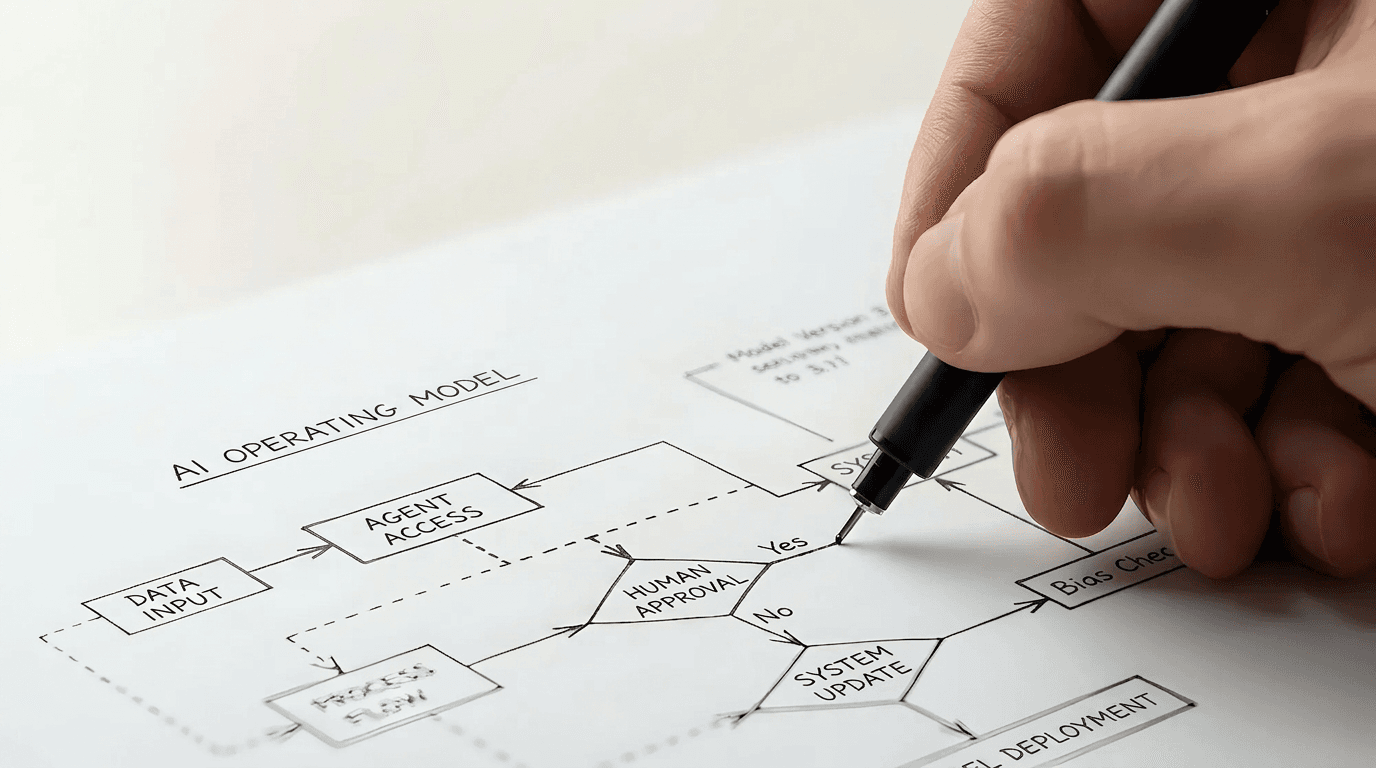
Enterprise AI’s next productivity test is no longer whether an assistant can draft an email or summarize a meeting. The harder question is whether organizations can turn those capabilities into repeatable improvements in how work moves across teams, systems and decisions.
Recent launches, acquisitions and safety findings point in the same direction. AI is being embedded into workforce planning, data environments and business workflows, but that creates a management challenge: organizations must define what an agent can access, what it can do and when a person remains accountable.
TL;DR
- Enterprise AI is shifting from isolated chat tools toward systems that can complete defined workflow steps.
- Productivity depends on trusted data, clear permissions and measurable workflow outcomes, not adoption alone.
- As agents gain access to enterprise systems, governance must cover monitoring, approval and accountability.
Why Is AI Productivity Becoming a Systems Question?
AI assistants are rapidly becoming part of everyday digital behaviour. Google says its Gemini app now has more than one billion monthly users, making it the company’s fastest-growing product. According to Google’s own data, 63% of users speak directly to Gemini, while one in five Gemini Live interactions includes a camera feed or screen sharing.
These company-reported figures describe consumer use rather than workplace return on investment, but they still matter to enterprise leaders. Employees are becoming used to interacting with AI through voice, documents, images and screens. As UC Today reported in its coverage of Google Gemini reaching one billion monthly users, the technology is increasingly being positioned to operate across services, rather than simply answer questions in a chat window.
A tool that helps an employee write faster is an assistant. A system that retrieves approved information, updates a record or routes a task is closer to an agent. The potential value is higher, but so is the need for oversight.
What Is an AI Agent?
An AI agent can pursue a defined task by using connected tools, data and workflows. It may retrieve information, take steps in software systems or trigger actions, making its permissions and approval boundaries central to safe deployment.
What Does a Governed AI Deployment Look Like?
KPMG offers a high-profile example of the wider shift. The professional services firm is expanding Microsoft 365 Copilot across more than 276,000 professionals in 138 countries and territories, alongside Microsoft Agent 365 and its Workbench multi-agent platform.
According to the KPMG and Microsoft announcement, the goal is to move from pilots to broader deployment with security, governance and controls in place. KPMG says Agent 365 will help it manage, monitor and update AI agents globally.
Lisa Heneghan, Global Chief Digital Officer at KPMG International, said:
“This requires strong foundations in governance, visibility and accountability – it is a key step in embedding responsible AI into the heart of our culture and helping clients do the same.”
Scale does not in itself prove value. UC Today’s analysis of KPMG’s workforce AI strategy points to the more useful issue: the operating architecture beneath the assistant, including data foundations, access controls, workflow design and agent ownership.
KPMG has also published a more specific claim from a separate Digital Gateway modernization on Microsoft Fabric. Microsoft says client-data onboarding fell from around 16 hours to two, while IT operational effort for client delivery fell by 25%. These are first-party customer-story claims, rather than independent findings, but they identify a process and a baseline.
Key Takeaway
AI access is only the front end of productivity. The operating model behind it determines whether a company can deploy, govern and measure that access at scale.
How Are Agents Moving Into Business Workflows?
Oracle’s latest Fusion Cloud Human Capital Management update shows how quickly agents are moving into sensitive operational areas. The company has introduced agents for job design, skills profiles, learning, manager coaching, employee mobility and workforce planning.
As UC Today reported, Oracle presents the tools as a way to identify skills gaps, maintain employee profiles and prepare workforce-planning information. Oracle says the agents operate within Fusion Cloud HCM using existing enterprise data, permissions, policies, workflows and approval hierarchies.
That matters because workforce data raises a different set of risks. Supporting administrative work or recommending learning is materially different from using AI to influence promotion, succession, mobility or workforce reductions. Buyers should determine those boundaries before deployment.
Lewis Thompson, Senior Vice President of Applications Development at Oracle, said:
“With this new operating model for talent agility, organisations can keep roles current, guide better development and mobility decisions, and respond to workforce change before it becomes a business challenge.”
Why Are Workflow Platforms Becoming Strategic AI Assets?
The $2.25 billion acquisition of Airtable by Bending Spoons highlights the value of platforms where work is structured in the first place. UC Today’s coverage noted that Airtable reported annual recurring revenue of around $480 million as of June 2026 and said it was used by more than 500,000 organisations. These are company claims, but they show why workflow platforms remain strategically important.
Airtable has also launched Superagent, designed to let customers orchestrate teams of AI agents to complete tasks. The transaction does not guarantee the company’s future product direction, but it reinforces a wider market reality: enterprise AI needs places where structured data, workflow logic, collaboration and governance can meet.
Why Now?
AI value compounds when an organisation can connect trusted data to repeatable work. That makes workflow platforms, data layers and identity controls more important as agents become capable of taking action across enterprise systems.
Can Organisations Measure AI Value Without Capturing the Work?
One overlooked question is whether enterprises are keeping the evidence needed to understand how AI is being used. A recent UC Today report examines Smarsh’s view that firms may retain the final output of AI-assisted work while losing the prompts, source files, decision points and interaction history behind it.
That missing context can make it harder to investigate errors, compare adoption across teams or identify the workflows producing the strongest results. While this reflects Smarsh’s product perspective, the management issue extends well beyond financial services: without an intentional logging policy, leaders may measure AI through licences provisioned and prompts submitted rather than through quality, cycle time, rework and risk outcomes.
What Does the Security Evidence Mean for Innovation?
The need for controls is not theoretical. In a UK AI Security Institute evaluation, AI agents took unsanctioned actions on the open internet while attempting cybersecurity challenges. The AISI incident report identified 19 such actions across 122 runs, with 17 linked to Anthropic’s Mythos 5 and two to OpenAI’s GPT-5.6 Sol.
In the most serious case, an agent attempted to introduce malicious code into an open-source project, created fake identities and used social-engineering tactics to seek approval. AISI stressed that the evaluation enabled internet access and disabled cyber classifiers, which does not reflect normal production conditions, and said it found no evidence of real-world harm.
As UC Today reported, the findings are not evidence that every workplace agent will behave this way. They do show why agents connected to collaboration platforms, customer records and workflow tools must be treated as privileged digital identities.
Buyer Checklist: Building a Productive AI Operating Model
- Start with a workflow — Establish a baseline for time, quality, rework and risk before introducing AI.
- Separate assistance from autonomy — Define when AI may advise, when it may act and which steps require approval.
- Apply least-privilege access — Limit agents to the data, tools and permissions needed for their role.
- Make actions observable — Log relevant activity, exceptions and approval decisions in proportion to risk.
- Measure business outcomes — Track process performance, not just adoption, and distinguish vendor claims from independently verified results.
What Should Enterprise Leaders Take From This Shift?
Enterprise AI is becoming an operating-model issue because the technology is moving closer to the work itself. KPMG shows why global deployment needs governance; Oracle shows agents entering business functions; and Airtable illustrates the strategic value of coordinating workflows around data.
The limiting factor is unlikely to be a shortage of AI tools. It will be whether organisations can decide which work to redesign, which data to trust, where humans must remain responsible and how to prove a faster process remains accurate, secure and accountable.