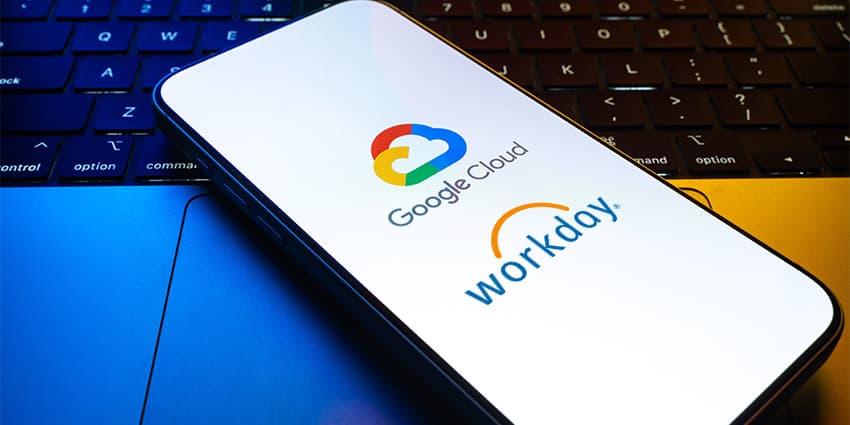
Workday and Google Cloud have expanded their strategic partnership to bring AI agents for HR and finance directly into employees’ daily workflows, integrating Workday’s Sana Self-Service Agent into Gemini Enterprise. For enterprise buyers evaluating HCM platforms, this is a practical marker that agentic HR is moving from roadmap talk to real workflow execution. It also raises the harder question procurement teams now have to ask: can these agents operate inside enterprise governance without creating compliance and workforce risk?
Gerrit Kazmaier, President of Product and Technology at Workday shares his thoughts on the partnership.
“Our customers want HR and finance at their fingertips, not scattered across a dozen applications. Together with Google Cloud, we're putting the answers and actions people need where they already work, backed by the security, rules, and approvals inherent to Workday.”
Workday says the partnership combines its Agent System of Record (ASOR) roadmap with Google Cloud’s enterprise agent platform and Gemini models to create a trusted foundation where agents from Workday, Google Cloud, and third parties can work together on real HR and finance workflows with built-in governance and security.
Related Articles
- Responsible AI in HR: Building Trust Through Governance and Transparency
- Shadow AI in HR: The Real Risk Is Unmanaged Work, Not Just Unapproved Tools
- How Do HCM Platforms Work?
What Workday And Google Cloud Are Actually Shipping
According to Workday, the Sana Self-Service Agent is integrated directly into Gemini Enterprise, allowing employees to ask questions and receive personalized answers pulled from Workday with the right policies and permissions applied. Workday also states Gemini is now the default model inside Sana for Workday, while customers retain the option to choose a different model when business requirements demand it.
The press release highlights practical use cases that sound simple but matter operationally: time-off balances, personal information updates, payslips, tax withholding, leave requests, manager actions like bulk timesheet approvals, and finance guidance on expense and travel policies. These are exactly the “low drama, high volume” workflows that create HR friction and manager frustration at scale.
Karthik Narain, Chief Product and Business Officer at Google Cloud also added context.
“From the model layer to the platform layer, Gemini and Google Cloud will now underpin some of the most critical and common workflows in human resources and finance departments globally, so employees can get faster, more accurate answers, streamline repetitive tasks, and ultimately focus on the work that matters most.”
The Operational Risk Question: What Happens When an Agent Gets It Wrong?
The leap from “assistant” to “agent” is not cosmetic. It changes the risk profile. An assistant can suggest. An agent can execute. In HR and finance, execution touches approvals, policy interpretation, and sensitive records. That is where agentic HR can create new failure modes: approval ambiguity, incorrect policy application, hallucinated “rules,” and actions that create HR liability or employee disputes.
Workday’s CEO Aneel Bhusri framed the governance line clearly in its Q1 FY2027 earnings call, describing lawful versus lawless agents.
“When I look at the world of agentic AI, in enterprise, we have this concept of lawful and lawless agents. Lawful being done the right way lawless going directly against the data, and getting results that bypass security or bypass a business process framework.”
For buyers, “lawless” failure is not theoretical. Imagine an agent misinterpreting an expense policy and approving spend that violates corporate rules, or applying the wrong leave policy for a worker in a specific state or country. Even when those errors are reversible, the damage is real: inconsistent treatment, audit exposure, and a trust gap that can derail adoption. That is why governance is not an add-on. It is the product.
Deployment Economics: Workday Is Positioning Agents as an Implementation Lever
The other buyer-relevant angle is cost and time-to-value. Workday’s earnings call ties its agent strategy to implementation reduction, which is a critical factor in enterprise HCM buying decisions. Kazmaier added: