If you planned a Q4 room refresh around Zoom Rooms landing natively on your Cisco estate this month, you’ve got a decision to make: deploy the signed-in interop mode that actually exists today, or hold out a little longer for native. That choice will decide who manages your rooms, whose dashboard measures them, and which admin team owns everything in between.
At InfoComm, Cisco and Zoom gave buyers a clear timetable: public beta in June, GA in September. As of now, that second date has officially slipped. Cisco’s current product page (if you dig into the FAQs) says native Zoom Rooms on select Cisco devices starts in Q4 2026.
Zoom Rooms 7.2.0 arrived on September 28 as a full cross-platform release, with My Notes on Rooms, six companion devices, smart name tags for external participants, and AI restrictions, but native Cisco GA is nowhere in the lineup. Zoom for Cisco Rooms already works in Room OS, and August even added sign-in mode on Cisco’s latest hardware. But what slipped is the native operating model. People aren’t waiting to join a Zoom meeting on Cisco hardware anymore; they’re waiting to find out who runs the room.
Neither vendor is standing still. In September, Zoom shipped a Workspace reservation setup wizard and ZoomMate booking actions, feeding automated coordination with facilities and IT. Then 7.2.0 put a Reserve a Room button in the Workplace client. Cisco hosted “One Device, Any Meeting: An Open Platform for Workplace Experience” on September 24. The GA slipped while the workplace layer kept moving.
We flagged in June that Control Hub and Zoom’s admin tools remain separate management layers. Zoom CFO Michelle Chang put the stakes neatly this month:
“There’s so much that happens in human-to-human conversations that just gets lost.”
Both vendors want more of that context to survive the meeting.
Is Zoom Rooms On Cisco Generally Available In 2026?
Not exactly. Cisco now says the native Zoom Rooms on Cisco experience will reach select devices from Q4 2026, pushing the Cisco devices Zoom GA beyond the September target announced at InfoComm. Really, the phrase “Cisco supports Zoom” hides quite a bit.
Zoom for Cisco Rooms already runs the Zoom meeting experience inside RoomOS. Users get one-button join, the familiar Zoom interface, breakout rooms, webinars, captions, Zoom AI, and up to 1080p video streams. Cisco still controls the device platform and firmware through Control Hub.
Native Zoom Rooms on Cisco goes further. The endpoint becomes a Zoom Room, with Zoom Admin handling the Zoom Rooms layer while Control Hub remains an additional Cisco management and workspace-telemetry layer. Zoom Rooms mode also brings access to features such as Digital Signage, Zoom Phone, and Zoom Workspace Reservation. Existing compatible Cisco hardware has to be factory-reset and enrolled in Zoom Rooms mode.
The reset detail is what stands out. Platform-agnostic meeting rooms sound wonderfully interchangeable on a procurement slide, but changing the room’s operating model still involves choices about firmware, management, booking, and support.
Zoom says the joined-meeting experience is broadly comparable between the two configurations. The gaps sit around everything IT has to run before and after the call. That is why the missed GA matters more than another compatibility badge.
Why Is the Meeting Room Getting Less Tied to One Platform?
Because mixed-platform estates have become pretty commonplace. Cisco still cites research suggesting up to 85% of enterprise IT teams support two or more meeting platforms, driven by business units, acquisitions, and external meeting invites, and that hasn’t changed much today.
Cisco’s Espen Løberg was direct about why Zoom Rooms on Cisco exists:
“It’s really been our joint customers that have brought us together.”
That customer pressure is changing what meeting room interoperability means. A guest join that technically connects isn't enough anymore. Users expect the camera, controls, AI features, sharing experience, and room interface to behave properly when they cross platforms. Logitech's Neil Fluester summed it up well:
“When the technology can blend away, people can come into a meeting and concentrate on their meeting.”
September has made that trend harder to overlook. Google’s August 27 Calendar update started turning Zoom, Teams, and Webex details from external invitations into structured Join buttons, and its September 2 Early Preview extended built-in Meet/Teams room interoperability to Android/AOSP hardware. Cisco, meanwhile, hosted a September 24 session called “One Device, Any Meeting.”
That tells me multi-platform meeting rooms have crossed an important line. Interoperability used to rescue the awkward external call. Vendors are now building around the assumption that those external calls are part of a normal workday.
Who Owns Workplace Analytics When Zoom Runs on Cisco Devices?
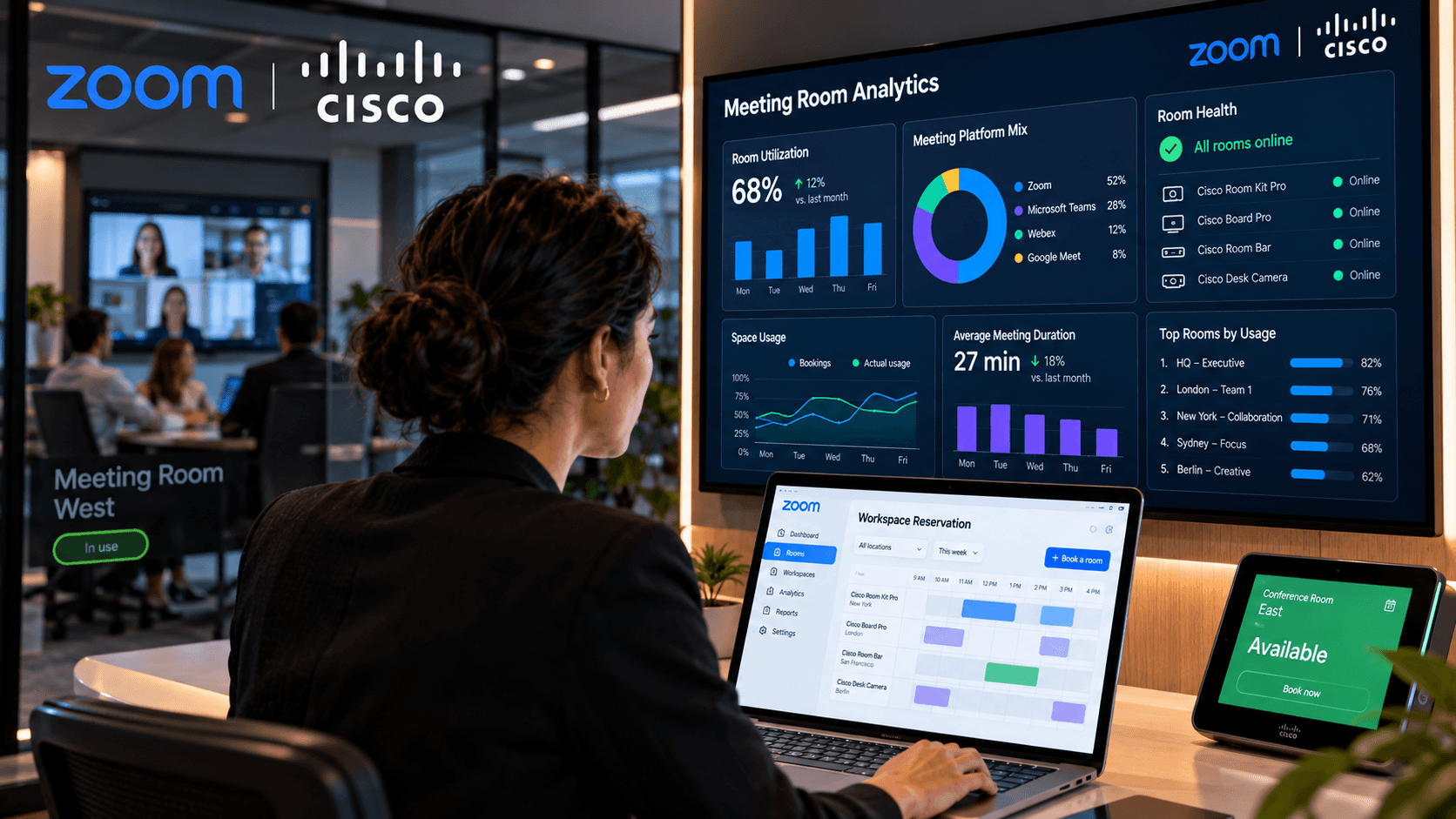
Nobody owns the whole picture. Cisco still sees the physical room. With Zoom Rooms on Cisco, Control Hub can retain workspace-level telemetry and device health data, while ThousandEyes can trace network problems and Workspace Advisor can create a digital model of the room for troubleshooting. Cisco’s Rich Bayes said:
“The agentic workplace travels with the device, not the meeting platform.”
Zoom sees a different slice of the same workplace. Its September 21 Workspace Reservation update added a setup wizard for bulk-mapping Zoom Rooms, creating desks, setting access rules, and configuring check-in behavior. Zoom also added AI-assisted floor-map placement, which can identify rooms and desks from an uploaded plan.
The same September 21 release cycle pushed that data further into workflows: ZoomMate gained Workspace Reservation actions for reserving spaces and finding people in the office, with workflow nodes that can coordinate facilities or IT based on booking activity.
That’s a pretty big clue about where Zoom Spaces is heading. Zoom wants room booking data and meeting context sitting much closer together. Jeff Smith, Zoom’s Head of Product for Workplace, said the company built Zoom Rooms with AI to
“capture the context created in conversations and carry it forward into action.”
The complicated bit for buyers is that the systems still answer different questions analytically. Logitech’s September 9 study of 1,700 workplace decision-makers found only 58% felt confident they had the right ROI data, while 32% continuously adjusted workplaces using what they learned. The same study put the median productivity loss from a meeting tech failure at 12.2 minutes per person.
Our VergeSense and Pointr coverage shows where the market is heading: layering real occupancy behavior onto spatial data instead of treating bookings as ground truth
That is the stake behind the delay. With RTO enforcement tightening, utilization numbers have become board-level justification material, and whichever dashboard wins the argument above effectively owns the room strategy.
A reservation records intent. Cisco can see parts of what happened physically. Zoom knows what happened inside the meeting. The useful buyer question is which measure gets trusted when those answers disagree.
What Does Platform-Agnostic Meeting Room Hardware Mean for IT Procurement and Support?
For procurement, platform-agnostic meeting rooms loosen the link between a collaboration contract and the hardware refresh. A Cisco Room Bar bought for Webex has a better chance of staying useful if the organization later moves deeper into Zoom.
Still, there’s a bit of a price for that freedom in operational work: Certification, firmware, and escalation paths still change with room mode.
Barco’s Gauthier Renard told us that vendors test software and firmware changes so “nothing gets broken.” He estimates native Teams Rooms cover around 90% of everyday meetings, leaving Zoom, BYOD and other edge cases in the harder remainder.
Cisco’s WebexOne agenda makes that support burden visible. On October 5, an expert class covers Cisco devices across Webex, Microsoft Teams Rooms, Zoom and WebRTC using TAC cases involving activation, scheduling and meeting quality.