Most large enterprises don't run one meeting platform. They run several, across an estate of rooms kitted out at different times, by different teams, with hardware chosen to match whatever the dominant platform was that year. For IT, the result is a support and management headache that's only grown as AI features have started to differentiate meaningfully between room setups.
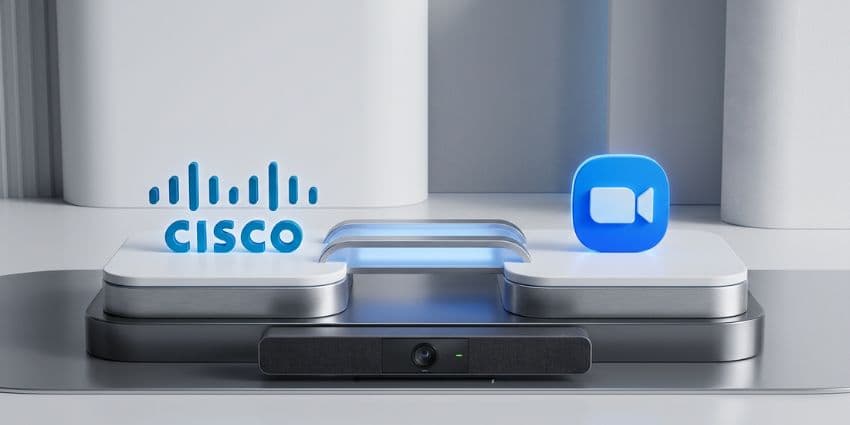
Cisco Devices for Zoom Rooms, announced at InfoComm 2026, is designed to address one significant part of that problem. For organisations that have standardised on Zoom but want Cisco hardware to match, it's a certified, native answer: Zoom home screen, Zoom Rooms workflow, Zoom Rooms licence, running on Cisco's device portfolio from the Desk Pro G2 to the Room Kit EQ.
It's also more than a product launch. It says something about where the room hardware market is heading, and how the companies that dominate it are choosing to compete.
The Market These Companies Are Actually Fighting Over
Cisco says the Webex Suite reaches 650 million monthly meeting participants across 8 billion calls. Webex Calling hit 18 million users in October 2025. Those aren't the numbers of a company that's given up on its software platform. Webex remains a serious enterprise product, particularly in regulated industries and government, where its security and compliance credentials carry weight that neither Zoom nor Teams can always match.
What Cisco has also understood is that Webex's software footprint isn't the same as its hardware footprint, and that the two don't need to be tied together. The room hardware market is a separate competition, and one where Cisco's position is considerably stronger. According to Frost & Sullivan, Cisco is the market share leader in conference room devices. That position is built on hardware quality and portfolio depth, but also on the management and network infrastructure that most large enterprises already run. The devices sit inside a Cisco environment whether or not the meeting platform running on them is Webex.
That's the distinction driving Cisco's device strategy: hardware as infrastructure, not as a Webex delivery mechanism. It's not a retreat from software. It's a recognition that the room is a stronger position than the platform.
What Came Before, and Why It Matters
The Zoom for Cisco Rooms launch at ISE 2026 was the first serious step. It brought a native Zoom Meetings experience to devices running the Cisco Rooms software stack, replacing the SIP-based interoperability that had existed before. In practice, SIP interop meant a stripped-back interface, limited AI features, and management that sat outside the Cisco environment. It worked technically. It didn't work well.
Cisco Devices for Zoom Rooms has a different emphasis. Where Zoom for Cisco Rooms puts Cisco at the centre with Zoom as one available experience, this puts Zoom at the centre. An organisation that's standardised on Zoom deploys these rooms as Zoom Rooms, with a Zoom home screen and Zoom-centric workflow. Cisco sits underneath, providing what Zoom alone can't: the Agentic Director camera intelligence system built on a decade of NVIDIA edge AI development, ThousandEyes network diagnostics running directly on the device, and Workspace Advisor generating a digital twin of each room in Collaboration Control Hub.
Jeff Smith, Head of Product, Workplace at Zoom, says the direction was clear from their shared customer base long before the announcement:
"What we saw was a lot of customer demand for a solution where we could have a full Zoom Meetings experience on Cisco devices. They wanted us to take the next step and really deliver that full Zoom Rooms experience on the highest quality hardware that we could provide."
Espen Løberg, VP and GM for the Collaboration Devices business at Cisco, makes the same point about what the partnership unlocks beyond the room itself: