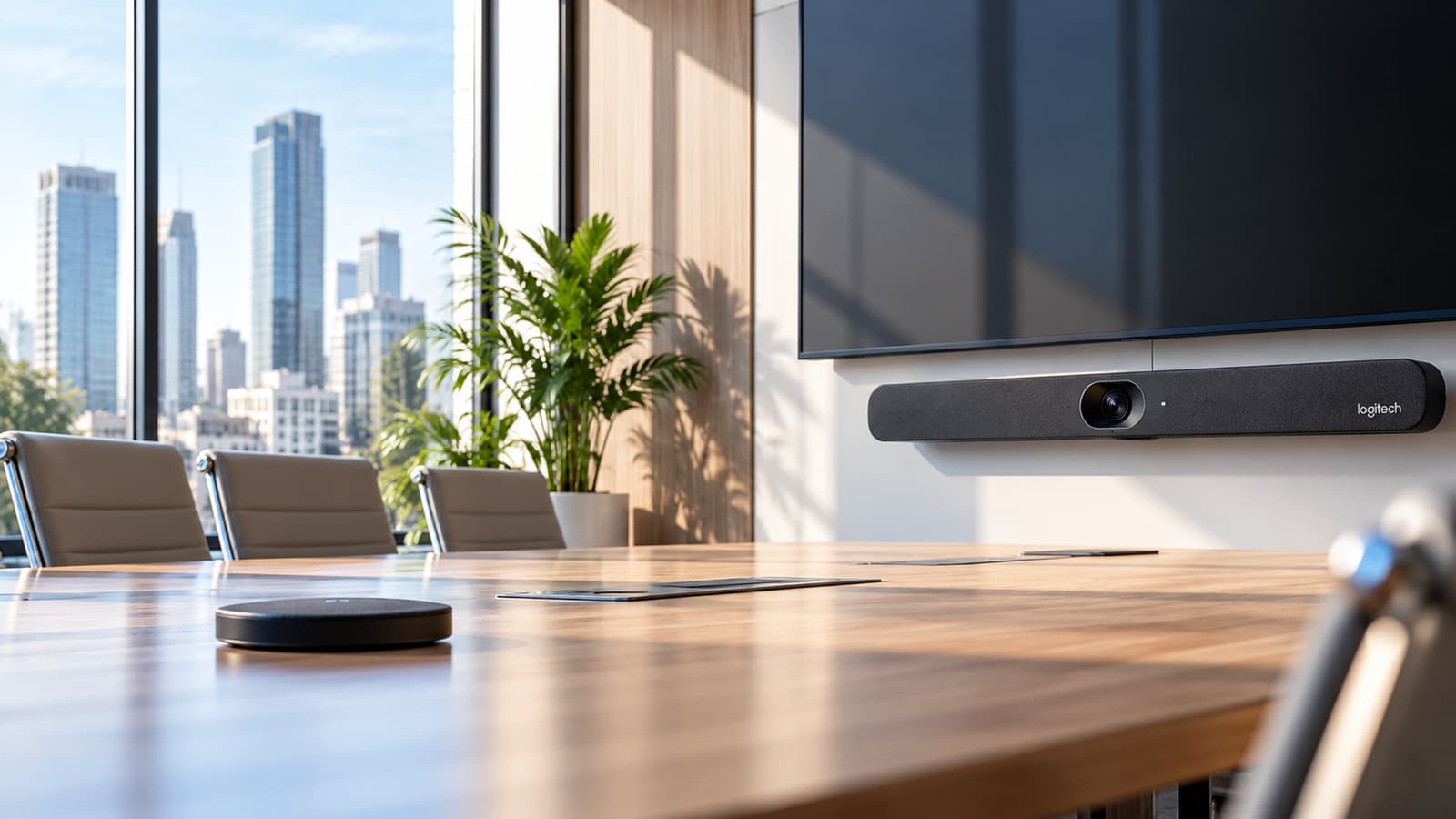
Logitech has just made a pretty expensive bet on the future of meeting rooms.
On October 8, it announced the biggest enterprise product launch in its history, including Rally Bar 2 and AI-powered room intelligence. Henry Levak, Logitech’s GM of Team Workspace Solutions, described the ambition as:
“Deliver exceptional meeting experiences today while preparing for an AI-powered tomorrow.”
Sounds pretty appealing to me, though I’d quite like to know who’s paying for tomorrow.
We’ve already covered Logitech’s new hardware and Cisco’s workplace push recently. Now the meeting room market in 2026 faces a more revealing test. Barco’s October 20 update showed uneven demand; Logitech’s Q2 FY2027 report also showed video collaboration sales growing 12%.
Microsoft and Alphabet report on October 28, bringing the software side into the argument. I’d be looking for room-specific evidence, rather than another headline about Copilot seats.
Personally, I’m most interested in what workplace technology demand actually means. Are enterprises equipping more rooms or getting better use from spaces they already own? There’s nothing wrong with refreshing old hardware, obviously. But that isn’t the expansion story vendors have been pitching.
Is Meeting Room Technology Demand Actually Growing in 2026?
I’d say so, although I’d be careful about declaring a comeback for the entire meeting room market in 2026 just yet.
Logitech’s Video Collaboration business generated $689.04 million in FY2026, up 10%. Its annual filing attributes the increase primarily to conference-room camera sales. That’s encouraging for workplace technology demand, although it doesn’t tell us how many new rooms customers equipped.
Barco’s numbers are a bit less cheerful. Its October 20 update reported €228.6 million in group sales, up 1% including VerVent, while orders fell 3% to €215.7 million. Meeting Experience demand remained weak, particularly in platform-agnostic conferencing. Barco said:
“In a challenging market environment, we see mixed sales patterns across divisions,”
Those group figures include businesses outside meeting rooms, and Barco didn’t disclose standalone Q3 Meeting Experience revenue. Its full-year sales outlook was also lowered to slightly below 2025, which hardly suggests a universal boom.
Still, Barco’s investing in the category. September brought another Microsoft Teams-certified ClickShare Hub Pro bundle, pairing its system with Huddly cameras and Shure audio.
“Our customers expect meetings and devices to be intelligent,”
said Barco’s Jan van Houtte.
Well, apparently they’re being choosier about buying them.
Logitech’s October 27 results confirmed that Video Collaboration sales kept growing while Barco struggled. We’re looking at a split market rather than a uniform comeback.
What Did Logitech’s Q2 FY2027 Earnings Show About Video Collaboration Demand?
Logitech’s October 27 Q2 results put Video Collaboration sales at $188.45 million, up 12% from $167.68 million a year earlier. That suggests healthy demand, although revenue alone can't tell us whether customers are equipping additional rooms or replacing older systems.
CEO Hanneke Faber has pinpointed three demand drivers: new offices, relatively low video-conferencing penetration, and the replacement of pandemic-era equipment. Logitech raised Video Collaboration prices in May, and its CFO confirmed that both prices and unit sales increased in Q2. Still, that doesn’t tell us how many new rooms were equipped.
There's a workplace analytics opportunity here, too. In October, Henry Levak described cameras and microphones becoming sources of contextual data for workplace AI agents. Logitech Spot already shares occupancy and environmental information with partners including Robin and Zoom. If that intelligence helps companies reduce unused bookings or adjust building services to actual demand, the business case extends considerably beyond replacing cameras. The missing evidence is how often customers achieve those improvements.
Supply remains a bit of a complication. Logitech now expects a $70 million–$80 million company-wide Q3 sales impact from the semiconductor supplier disruption, down from its earlier estimate of as much as $200 million. It hasn’t isolated the impact on Video Collaboration.
What Do Microsoft and Alphabet Earnings Reveal About Workplace Analytics Demand?
Microsoft and Alphabet have a problem for anyone trying to follow the money into workplace analytics. Copilot can sell millions of subscriptions without telling us whether a single additional Teams Room has been equipped. Google Cloud revenue is even harder to connect to what happens inside an office.
The more exciting developments are buried in their management tools. Microsoft’s Teams Rooms Pro reports now combine reservations with occupancy signals, giving facilities teams a better chance of catching rooms that look busy on the calendar but aren't. Desk analytics arrive in November, although participating desks need connected peripherals and Shared Space licenses. That could become quite a bill across a large estate.
Google's October update is interesting for the opposite reason. Older Logitech Gen 1 devices can now supply occupancy counts through CollabOS 2.2. Administrators have to enable the feature, but companies can get additional information from cameras they've already bought.
There are limits to how much faith we should put in those numbers, though. In an October 21 interview with Inavate, XY Sense's Jane Watson raised a problem with relying on AV equipment to detect occupancy:
“Imagine an HR meeting where the camera isn’t being used. Is that meeting actually being detected?”
That's definitely a possibility if software starts releasing supposedly empty rooms automatically. Microsoft’s building-level recommendations also identify BYOD spaces that might warrant upgrades, but those suggestions still need someone checking the underlying evidence.
JLL found in September that 74% of organizations hadn't moved beyond researching AI for occupancy planning, if they'd explored it at all. There's certainly business to be won here. The question for buyers is whether the information is reliable enough to make decisions they'll have to pay for.
Which Meeting Room Renaissance Claims Do the Earnings Actually Support?
The trouble with declaring a meeting-room renaissance is deciding what counts as proof of genuine change. A manufacturer selling more cameras is encouraging, particularly for that manufacturer's shareholders, but that doesn't tell a facilities manager whether another floor needs equipping.
Looking at the claims individually gives us a rather less flattering picture.
-
Hardware demand is recovering: In some corners. Logitech's Video Collaboration sales rose 12% in Q2 FY2027, reaching $188.45 million. Barco's Enterprise sales and orders both fell 3% in Q3, with Meeting Experience performing worse than Control Rooms. Buyers clearly aren't rushing back to every supplier.
-
AI workplace intelligence is attracting investment: There's interest, but where's the revenue? Microsoft and Google have more sophisticated occupancy tools, and integrators are seeing customer demand. AVI-SPL's John Richards told CRN in October that Logitech's environmental sensing was an early sign of the company moving beyond meeting rooms: “There's a lot to learn for integrators around how to leverage that.” Interest is one thing. Paid adoption is another.
-
Businesses are equipping more rooms: Nobody's proved it. Logitech’s CFO attributed roughly 60% of Q2 Video Collaboration growth to price and 40% to units, without specifying how many new rooms were equipped. Refreshing a five-year-old installation doesn't add another meeting space either.
-
Workplace analytics improve operations: We've got something more concrete here. The US Small Business Administration told GAO that occupancy data partly informed decisions to reduce 25 spaces, covering almost 38,000 square feet. Expected annual savings were approximately $885,000. That's a projected return, admittedly, and ordinary occupancy measurement rather than AI magic.
So far, the better evidence of workplace value comes from organizations using the information, rather than the vendors selling the technology. That's a rather awkward result for an industry pitching intelligence as its next big growth opportunity.
What Does Measured Occupancy Say About Meeting Room Expansion?
CBRE puts average office utilization at 53%, up from 38% in 2024. We've already picked that apart in The 53% Utilization Trap. October's sensor data gives us something rather more awkward for vendors hoping to sell another round of meeting-room installations.
Occuspace's October 21 Index tracked more than 50 million square feet across 100-plus corporate clients. Weekly peak utilization averaged 52.3%, but the room figures are where things get interesting. Some 78% of occupied conference-room time involved two people or fewer. Even rooms built for 13 or more people spent 62% of their occupied time accommodating one or two.
More than half of occupied conference-room time also came from stays lasting at least two hours. That's an awful lot of expensive space tied up by small groups.
Occuspace CEO Nic Halverson called the wider occupancy plateau “the new baseline.” His numbers suggest companies should probably investigate who's using which rooms, and for how long, before ordering another fleet of cameras. The CBRE and Occuspace portfolios aren't directly comparable, of course.
The October 16 GAO report gives another interesting angle. Twenty of 23 responding federal agencies collected occupancy information through badge systems, with 16 supplementing those records. Reported data-collection costs reached $16 million in 2025. Yet none reported using occupancy sensors or video analytics for this reporting requirement.
Some agencies have already made consolidation decisions using the information, with millions in annual savings anticipated. GAO also found missing vacant-space records and inconsistent reporting, so those projections deserve scrutiny.
Apparently, there's still plenty to accomplish with ordinary occupancy data before AI gets to take the credit.
Can AI Workplace Analytics Improve Operations Without More Hardware?
One broken meeting-room camera can cause an extraordinary amount of stress. Someone reports it, IT opens a ticket, and the next three groups turn up expecting a room that still doesn't work. That's a problem worth handing to AI, assuming it can actually sort things out.
Robin's October 20 Workplace Services update tackles exactly that. Its agent can identify affected bookings, route repair tickets, and suggest another room. With administrator approval, it can also move upcoming meetings and warn attendees. Robin's survey found 56% of respondents had switched rooms or troubleshot equipment more than ten times in the previous month.
Ciara Peter, Robin's SVP of Product, described the familiar situation:
“Something breaks, and the workplace team scrambles to contain it.”
Yep. Although Robin still needs to show how much time its new system saves. An automated ticket isn't much consolation if employees spend another twenty minutes hunting for somewhere to meet.
Freespace's October 21 Space Manager addresses a different headache. It combines occupancy data with employee preferences, then carries approved workplace plans into employee apps. That could save facilities teams from constantly correcting arrangements that looked perfectly sensible on a planning dashboard.
XY Sense's Jane Watson offered an even more practical example in an October 21 interview. One customer uses an 11 a.m. occupancy alert to help catering staff prepare for lunch demand. She also described using room traffic to schedule cleaning and occupancy changes to adjust ventilation.
There's potentially more value in those everyday decisions than another fleet-wide equipment upgrade. The interesting savings might turn up in catering budgets and maintenance schedules, rather than IT's meeting-room spending.
What Should October’s Earnings Mean for 2027 Workplace Budgets?
I’d be nervous about using rising video collaboration revenue as an excuse to replace every camera in the building. Strong sales are encouraging for Logitech, but they don't tell a facilities manager whether another installation will solve anything. Barco's weaker results make the case for a broad meeting-room comeback harder to defend, too.
There's a reasonable argument for getting more from equipment companies already own, too. UMA's October 12 Neat integration uses existing sensors to measure occupancy and help release empty room reservations. That's potentially more useful than installing another display in a room nobody's using.
We've also covered the complications of keeping Cisco hardware when switching to Zoom Rooms. Reuse isn't always straightforward, particularly when management and support arrangements change. Still, replacing working equipment deserves a better explanation than an attractive new feature.
Logitech's Henry Levak recently said:
“We’re making sure the products are built for what’s coming next.”
That’s fine, although workplace teams have to deal with what's going wrong right now, and an AI-ready camera won't automatically fix unreliable bookings or rooms that regularly fail halfway through meetings.
For 2027 procurement, I’d keep replacement purchases separate from new room installations. I’d also ask vendors to show what their analytics have actually fixed. Are people still booking rooms they never use? Can IT get a failed meeting running again faster? And can facilities teams do something useful with the data without spending months on another integration project?
FAQs
Is Meeting Room Hardware Demand Growing in 2026?
Logitech has had a decent run: Video Collaboration sales were up 10% in FY2026 and 12% in Q2 FY2027. Barco’s October update was rather less cheerful about platform-agnostic conferencing. So yes, some suppliers are selling more. Whether that’s because businesses need additional rooms or are replacing tired equipment is harder to establish.
What Did Logitech’s October 2026 Earnings Reveal About Video Collaboration Sales?
Logitech reported $188.45 million in Video Collaboration sales for Q2 FY2027, up 12% year over year. Its CFO attributed roughly 60% of that growth to price and 40% to units. A camera replacement still generates revenue just as surely as fitting out another room.
Not on their own. A company can buy thousands of Copilot licenses without touching its meeting-room estate. Teams Rooms demand needs a different set of numbers: systems deployed, management subscriptions sold, and what happens to reliability after installation. Otherwise, you’re comparing office technology purchasing with a software bill that may have nothing to do with the office.
Can AI Workplace Analytics Improve Office Operations Without Buying New Hardware?
They can, and that’s where the argument gets interesting. Google’s latest update lets older Logitech Gen 1 room devices count occupants, while UMA can draw on compatible Neat sensors to help free reservations nobody uses. An IT team might get more useful data without another hardware order. Of course, somebody still needs to act on it.