September gave workplace teams something they haven’t had much of lately: numbers that could make a CFO stop and think.
Eight days before CBRE’s APAC release, Logitech gave the budget argument a brand new number. Its September 9 Workplace Equation study of 1,700 workplace decision-makers found only 24% involve IT or AV before space planning begins. In other words, the teams expected to make the rooms work are often arriving after the design decisions have already been made.
On September 17, CBRE reported that half of the 650-plus corporate real estate executives in its latest Asia Pacific survey expect to expand office space over the next three years. Eighty-eight percent said employees are already in the office at least three days a week, while 85% think attendance has settled into a steady pattern. Tom Gaffney, CBRE’s Head of Leasing for Asia Pacific, said:
“The workplace conversation in Asia Pacific has fundamentally shifted.”
Six days later, CBRE was back with another report, this time describing India as entering a fresh office-growth cycle as corporate expansion and record leasing activity push demand higher.
That makes the office utilization conversation more interesting right now, while bringing the spending question back into the spotlight. We’ve spent months seeing workplace vendors talk about smarter rooms, AI features, and better experiences. The evidence bar now needs to rise with the market.
What Do the Latest Office Utilization 2026 Numbers Show?
Office use is climbing, but the weekly average is starting to look like a pretty poor tool for deciding what to buy next. CBRE’s 2026 workplace research puts average global utilization at 53% for 2025, up from 38% a year earlier. The more revealing figure is 80% peak utilization.
JLL’s separate 2026 benchmark puts average utilization at 56%, against a 74% target. The datasets cover different portfolios, which is exactly why finance should ask how “utilization” was measured before approving anything on one percentage.
September’s APAC data is pretty compelling, too. CBRE says 66% of occupiers report average utilization above 60%, while 54% report peak utilization above 80%. HubStar data found Tuesday occupancy at 58.6%, compared with 34.5% on Friday. CBRE’s Dutch benchmark similarly found offices can be fuller on their busiest days than before the pandemic.
The room mix is changing too, and HubStar says 80% of meetings happen in rooms for six people or fewer, while 17-plus boardrooms average just 12% utilization. A “room shortage” means little until buyers know which rooms are short. JLL’s Dr. Paul Morgan says the
“structured hybrid model has moved from experiment to expectation.”
That still doesn’t make the investment decision simple. Buyers need the busiest hour, the room type under strain, and the actual failure point before reaching for the 53% headline. Uneven demand is pushing offices toward a system of record connecting bookings, presence, space and equipment.
Google is getting closer to measuring what’s happening inside the room, too. Since September 28, Google Meet has been rolling out occupancy counting on Logitech Gen 2 Android room hardware.
Are Companies Expanding or Shrinking Office Space in 2026?
Both, although the most recent data seems to suggest a focus on selective growth and better space rather than another round of blanket downsizing.
CBRE’s September 23 report says India has entered a new office growth cycle, while its 2026 occupier survey found 77% of companies expect their India portfolios to expand over the next two years. CBRE’s October 1 Q3 figures also found office absorption reached roughly 21 million sq ft in the quarter, taking the first nine months of 2026 to a record 66.4 million sq ft.
There’s more stability in the Americas. Sixty-six percent of occupiers plan to keep or increase space over the next three years, with 38% expecting outright expansion. Technology companies are especially bullish, jumping from 41% planning growth in 2025 to 64% now.
Europe looks different. Sixty-five percent expect to move within three years, while the supply of modern office space is forecast to drop to 6.8% by 2028. Eighty-eight percent would walk away from a building missing a key amenity, but only a third plan CapEx to reposition what they already have.
So the CBRE occupier survey 2026 story isn’t simply “bigger offices are back.” Companies are becoming less willing to pay for space that doesn’t work.
That changes the conversation around both office expansion and meeting room ROI. In APAC, 52% expect to add small meeting rooms and 53% want more collaborative space, while 19% are planning to cut large rooms. Among companies expecting to grow, 60% point to organic expansion and 85% want Grade A or better buildings. The question isn’t simply how much space to buy. It’s which space will actually get used.
Which Meeting Room ROI Metrics Will a CFO Actually Trust?
The strongest meeting room ROI numbers are the ones somebody else can reproduce later. Unfortunately, September’s research suggests plenty of workplace teams still aren’t there.
Logitech’s Workplace Equation study found only 58% of workplace decision-makers feel confident they have the right ROI data to justify workplace and technology investments. It also found meeting-technology failures cost a median 12.2 minutes per person when they happen.
Logitech has previously said 87% believe a strong workplace experience improves productivity and collaboration, but that’s sentiment, not measured productivity uplift. Logitech commissioned the Harris Poll research, so I’d treat the 12.2-minute meeting-technology failure figure as a much more usable input for an ROI model than the 87% belief figure.
Henry Levak, Logitech’s GM of Team Workspace Solutions, argued that
"Strong workplace experiences start when IT, HR, and Real Estate teams work from the same playbook.”
The ownership problem is obvious once the numbers have to reach finance. Facilities may own the room. IT owns the technology. Someone else still has to prove whether either one is paying off. JLL says 92% of organizations rely heavily on badge swipes, but only 7% believe their workplace-data capability is excellent. Wakefield Research found just 19% of 400 US CRE, workplace, and facilities leaders primarily use data to make space-planning decisions.
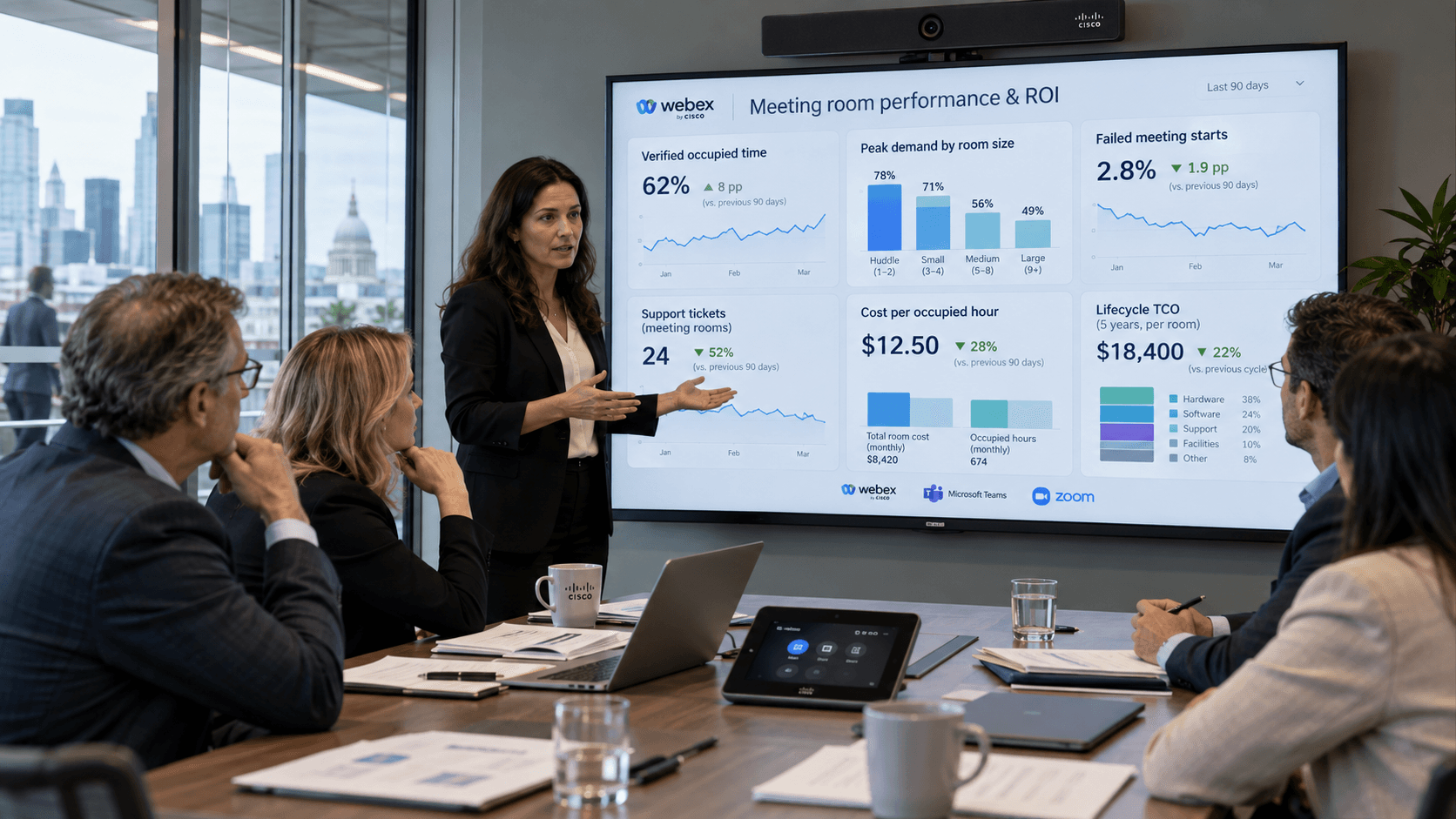
More tellingly, 52% said uncertainty about usage had delayed or killed expansion plans. That’s why CFO-grade workplace data needs to move past raw attendance. Verified room use, support failures, lifecycle cost, and avoided space expense are much harder to wave away.
Bookings alone just aren’t enough.
How Do You Build a Business Case for Meeting Room Technology?
Start with the failure you’re paying for now. If the problem can’t be named, costed, and measured again after deployment, the workplace technology business case won’t hold up.
Trouble is, a lot of meeting room ROI pitches begin with the device or platform and work backward toward a benefit. A CFO is going to ask a much plainer question: what exactly improves if we approve this?