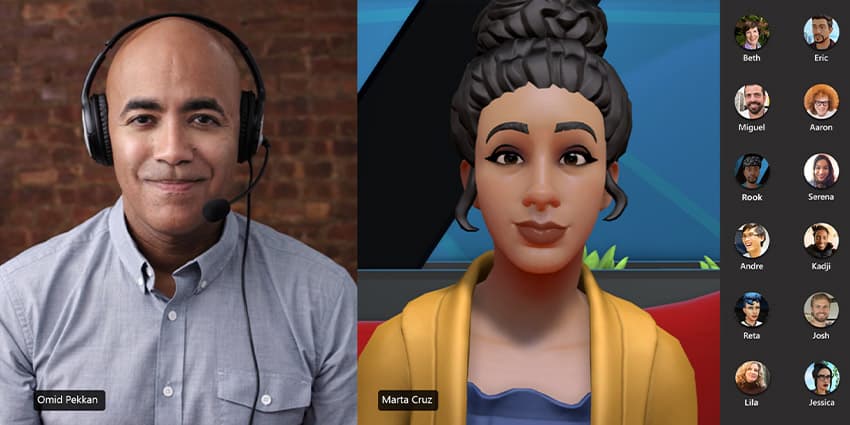
Virtual reality (VR) and augmented reality (AR) have the potential to completely transform how we work and collaborate. Early applications are already in place, from remote AR assistants for field workers to virtual events in VR worlds. Now, Microsoft has announced that it will take this idea one step forward with an ambitious project called Mesh for Teams. Microsoft Mesh has been in the works for several years now, and in November 2021, Microsoft announced that it will be tightly integrated with the Teams platform to drive VR-based collaboration. Following close on the heels of Facebook’s rebranding to Meta, Mesh for Teams promises a similar experience at a fast-tracked timeline and with an entirely collaboration-first perspective. Here’s all you need to know about Mesh for Teams.
What Is Microsoft Mesh?
Microsoft first announced its Mesh offering in March, during Ignite 2021. Mesh is a complete virtual world that can be accessed through various devices, containing multiple sub-worlds and digital assets to provide a lifelike experience. In theory, it is almost like the metaverse, but it doesn’t try to bring together all virtual worlds in existence to create a unified and universal space. Rather, Mesh is quite clearly a Microsoft offering and will continue to provide a Microsoft and Teams-first experience, without any attempt at decentralisation. In April when we reported on Microsoft Mesh, we noted that it seemed to be designed for collaboration use cases. Now, on November 2, 2021, Microsoft has announced that Mesh for Teams is ready to roll out.
What Is Mesh for Teams?
Mesh for Teams can be defined as a mixed reality overlay that allows Teams users to collaborate in virtual spaces, work with persistent 3D content, and access Teams from their mixed reality glasses and VR headsets. It isn’t just another VR app where you can put on a headset to communicate with co-workers. It brings together a number of key features and capabilities that together provide you with an immersive collaboration experience. Mesh for Teams is built on three things:
- Microsoft’s acquisition of AltspaceVR - This 2013-founded social VR platform was acquired by Microsoft in 2017, with the explicit purpose of using its IP for Mesh.
- Immersive Teams features like Together mode - Together mode and Presenter mode extend Teams’ meeting and conferencing capabilities beyond a single screen and 2D display. Mesh for Teams will work as a further extension.
- A vision for the metaverse - Microsoft has been working on mixed reality technologies for over a decade, and this is expected to culminate in a full-fledged metaverse sometime in the future. Mesh for Teams is an important stepping stone towards this vision.
5 Key Features of Mesh for Teams
While the metaverse may be several years away, Mesh for Teams is ready for adoption. It will enable and improve collaboration through the following features:
- Holoportation
Holoportation recreates a holographic image of you (the user) in a different location, and you can control this image to interact with your surroundings in that location. In other words, a co-worker sitting in a different location can “see” you without the need to commute, and you will be able to communicate via audio, facial expressions, body language, and gestures.
- 3D Avatars
In addition to holoportation, you can create a 3D image of yourself that is as true-to-life or as customised as you prefer. For instance, you may choose to recreate your visual appearance exactly as is, down to every last detail to maintain consistency and personal branding. Or, you may alter elements like hair colour and accessories, as a form of personal expression. Some of this technology is already in use, in Together mode and also the Mesh overlay for Teams. If a user doesn’t want to use their webcam, Mesh creates a 3D avatar to replace them in Teams meetings.