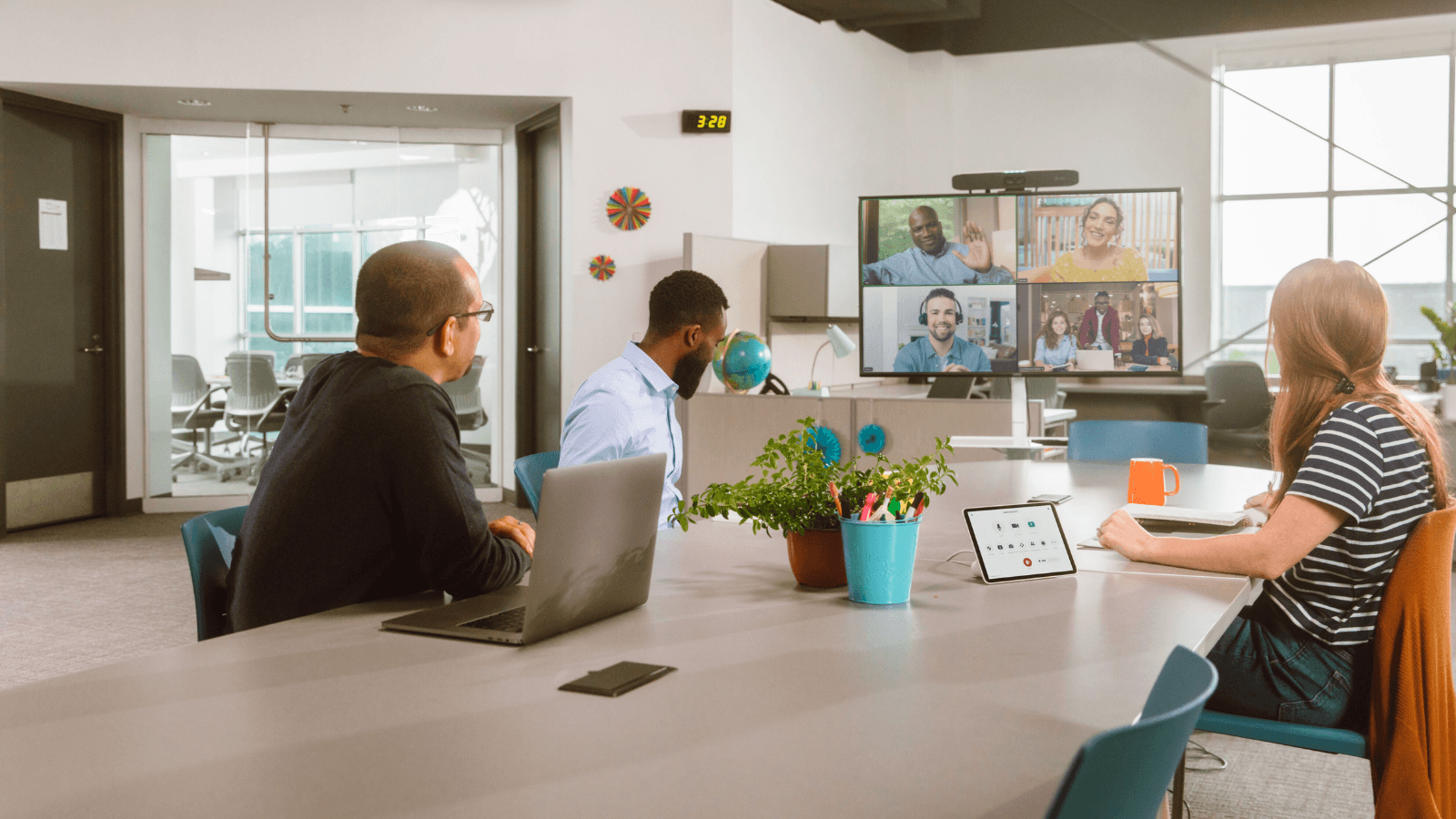
As organisations adapt to the growing need for flexible work environments, innovative hybrid meeting rooms bridge the gap between in-person and remote participants, fostering seamless collaboration. These spaces have become a cornerstone of modern business communication in the hybrid and remote work era.
For our latest Round Table topic, “Hybrid Meeting Rooms,” we spoke with experts and executives from Logitech, Jabra, and Q-SYS about the key trends impacting hybrid meeting rooms in 2024, recommended technologies and strategic best practices for addressing unequal participation in hybrid meetings, the role of AI and automation in the space, and the major future trends that will impact meeting rooms.
In a constantly evolving space, what are the key trends impacting hybrid meeting rooms in 2024?
Nigel Dunn, MD EMEA North at Jabra
Dunn noted the increase in workers returning to the office, which is subsequently driving a return to meeting rooms. Despite this, Dunn said while highlighting Jabra research, hybrid working continues to be a dominant trend, and 80 percent of meetings include at least one remote participant.
"Businesses are looking at how office space is used, how to optimise meeting rooms and whether they have the right technology and room systems in place," Dunn expanded. "In fact, 31 percent of employees say they’re hesitant to take meetings from a meeting room because they aren’t comfortable with the technology. So we’re seeing demand for reliable, easy-to-use video conferencing solutions like the Jabra PanaCast 50 video bar that’s plug and play."
However, Dunn added the reality is that many organisations are still figuring out what the hybrid workplace looks like. "The overriding trend is a desire for flexibility and choice and to create a hybrid meeting experience that enables everyone to collaborate and be their most productive," he said.
Vivek Sekar, Sr. Director, Product Management at Logitech
Sekar observed that while spaces are evolving, so are the expectations from employees who use those hybrid meeting rooms.
"Flexibility is no longer a 'nice to have' but an imperative for hybrid environments," Sekar continued. "People want choice in what tech to use, when, and how, and for it to be fast and simple, whether they’re using Microsoft Teams, Zoom, or Google Meet. That calls for having video conferencing tech that fits multiple scenarios, including those who prefer a dedicated PC-based deployment or using their laptop in a BYOD setup."
Sekar affirmed that achieving that level of versatility presents challenges for IT to deploy and manage, so a key trend this year is "companies investing more in tools and platforms, like Logitech Sync, to help standardise, scale, monitor and troubleshoot their deployments remotely".
TJ Adams, Vice President, Systems Product Strategy and Development at Q-SYS
For Adams, ongoing investment in AV technology is enhancing user experiences. A rising share is allocated to AI-powered camera systems that enrich the experience for remote attendees and streamline operations for participants in physical meeting spaces.
"With the permanence of hybrid work setups, in-person meetings are often larger, requiring more scalable AV solutions," Adams said.
What technologies or strategic best practices address the challenge of unequal participation and engagement between in-person and remote attendees?
TJ Adams, Vice President, Systems Product Strategy and Development at Q-SYS
Adams argued that the advancement of AI-assisted camera technology will remain crucial by streamlining video conferencing for on-site participants and enhancing the experience for those attending remotely.
"AI's role in facilitating meeting summaries is a key asset for elevating productivity and ensuring equitable information distribution regardless of physical attendance," Adams explained. "Moving forward, AV advancements aimed at refining the precision of meeting recaps, particularly with accurate speaker identification in transcriptions, will offer heightened benefits."
Nigel Dunn, MD EMEA North at Jabra
Dunn outlined that consideration should be given to the physical layout of the room, the position of the table and where the conferencing camera is placed so everyone fits comfortably in the picture.
"The size and shape of the table can also make the most of the space, for example, by pushing a table against a wall with the camera mounted on the wall at eye level when people are seated," Dunn elaborated. "Video conferencing solutions like Jabra’s PanaCast 50, with a 180-degree field of view, capture the entire room so everyone can be seen and heard. This makes meetings more inclusive, maximising engagement between those in the room and remote attendees."
Dunn also suggested intelligent video bars that automatically adjust the picture to zoom in and follow the flow of the meeting, making everyone feel more engaged. "Features like Virtual Director automatically detect who is speaking and focus on them, so participants who aren’t in the room can see everything and keep track of what’s happening," Dunn added.
Vivek Sekar, Sr. Director, Product Management at Logitech
Sekar stated that Logitech has taken crucial steps toward solving the problem of unequal participation and engagement in hybrid environments.
"When companies began adopting hybrid work, employers recognised that providing hybrid-friendly experiences was a key differentiator for their hybrid employees," Sekar expanded. "Logitech Sight, a centre-of-table camera, was one of those differentiators. This camera works with the Rally Bar front-of-room camera to automatically frame the active speaker, allowing remote viewers to get a close-up view of the speaker’s face and follow the conversation naturally as it moves around the room."
Sekar said that, in 2024, Logitech elevated that multicamera auto framing innovation with an advanced AI-driven feature called Smart Switching. It uses intelligence between the two devices to choose the best frame of the meeting room participants between Sight and Rally Bar, tracking conversations as they move between participants and consistently maintaining the best angle of in-person interactions as the conversation flows between in-room and remote participants.
"When the in-room meeting participants face and engage with the remote participants, the front-of-the-room camera springs into action to frame, and when the conversation shifts to within the meeting room, Sight captures the participant’s best angle in that interaction," Sekar continued.
"Up to four participants can be framed at once. And it’s all done without participants needing to do anything–no remote control or camera crew with manual intervention required–leaving the meeting attendees free to be fully immersed and engaged in their collaboration."