powering productive workplaces
Front page
InterviewUC&C26 Nov 2025 · 3 min read

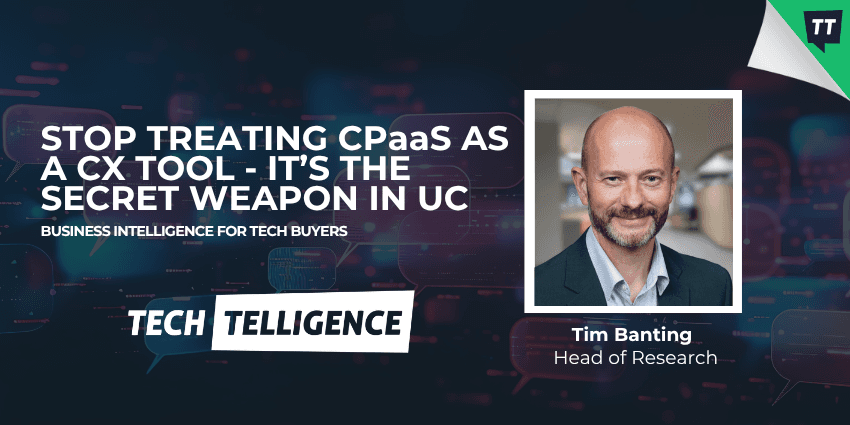
Stop Treating CPaaS as a CX Tool - It’s the Secret Weapon in UC

Discover how CPaaS UC can enhance communication strategies and integrate with modern messaging tools for better customer engagement.

CPaaS as UC's secret weapon, not just CX

Why CPaaS is more than a CX tool

Enterprises are rethinking their communication strategies as legacy UC systems struggle to keep pace with customer expectations. Once prized for simplifying voice, chat, and conferencing, these platforms now lag behind how customers prefer to engage - through channels like WhatsApp, WeChat, and other messaging tools.

Many decision makers still view Communications Platform as a Service (CPaaS) as a customer experience (CX) technology. It’s often marketed as a way to enhance contact center interactions and automate engagement.

But as Tim Banting, Head of Research at Techtelligence, points out, that view is too narrow. “A lot of CPaaS vendors really position themselves in the CX camp,” he says. “They haven’t really thought about how to make this integrate with all the different unified communications platforms out there, because that’s where the true value is.”

In reality, CPaaS can sit at the heart of UC. It connects front-office engagement with back-office collaboration, linking the right people and data the moment customers reach out. By layering CPaaS into UC stacks, organizations can unify customer-facing and internal workflows, creating the agility and responsiveness modern enterprises need.

The Agility Layer: How CPaaS Supercharges UC

Traditional UC systems promised to unify communication but often ended up limiting innovation. “Integration isn’t the same as unification,” Banting explains. Best-of-suite platforms simplify procurement but tie buyers to one vendor’s release cycle and roadmap—slowing progress when agility matters most.

CPaaS breaks that dependency. Acting as an architectural layer, it lets enterprises add or change channels - voice, SMS, WhatsApp, chat - without replacing core systems. “CPaaS adoption allows you to do that very, very quickly,” says Banting. Instead of waiting for a vendor to release new features, organizations can use APIs or low-code tools to evolve in real time.

This composable approach turns UC into a living system - flexible, scalable, and ready for whatever communication channels customers prefer next.

Bridging the UC – CPaaS Gap

True agility depends on integration. Many UC platforms were not built for open APIs or dynamic routing, creating friction when connecting new workflows. “Enterprises can end up with two separate systems doing similar things badly,” Banting warns.

The fix starts with people, not platforms. Organizations need teams who understand both customer journeys and internal processes. These are ‘citizen developers’ - business users who can design workflows using drag-and-drop studio tools instead of writing code. He says:


“CPaaS is no longer the domain of developers"

“Many platforms now offer visual environments where non-coders can build automated workflows.”

Crucially, Banting advises treating CPaaS as middleware, not another product. Positioned as the connective layer between systems, it ensures consistent data flow, simplifies compliance, and prevents the costly “rip-and-replace” cycles that have long defined UC upgrades.

Making CPaaS Deliver Real ROI

Beyond flexibility, CPaaS delivers measurable business outcomes. Banting points to repeatable, high-value use cases in industries such as banking, retail, and healthcare.

Banks can use CPaaS to streamline fraud alerts or two-factor authentication. Retailers can automate order notifications and tracking. Healthcare providers can simplify appointment reminders and follow-ups. Banting says:

“These are predictable and repeatable scenarios where CPaaS brings measurable ROI"

Not only that, but UC Today has explored how CPaaS can reduce employee burnout and improve workflows.

The Takeaway: Why UC Needs CPaaS Now

The message for buyers is simple: stop treating CPaaS as a CX bolt-on. It can act as a missing agility layer that makes unified communications more interconnected.

As customer behavior evolves, organizations that treat CPaaS as an architectural layer - linking people, data, and workflows - will stay ahead. The result is a communication strategy built for continuous change: agile, composable, and ready for whatever comes next.

Find more thought-provoking industry perspectives

Find Tim's full analysis on Techtelligence.com.

If you’re an enterprise buyer and want to stay ahead, follow Techtelligence on LinkedIn for weekly insights, analysis, and expert advice to help you make smarter technology choices. You can also join its growing LinkedIn Community Group to discuss trends, share experiences, and connect with like-minded business professionals driving digital transformation in their industries.

rate this story
helps rank stories across uc today
The discussion0 takes · attributed & checked

Does this reflect your experience?

opening the room…
Read nextordered by techtelligence · every pick explained
same beat · UC&C

GoTo CX Complete: Is GoTo Building the SMB AI-Powered UC+CC Layer Before Rivals Catch Up?

13 Aug 2026
matches this topicVonage Gets a New CEO as Ericsson's Own Chief Admits the Business "Has Not Been Contributing"4 Aug 2026matches this topicVonage's Integration Bet: How Deep Does “CPaaS Everywhere” Actually Run?18 Jul 2026