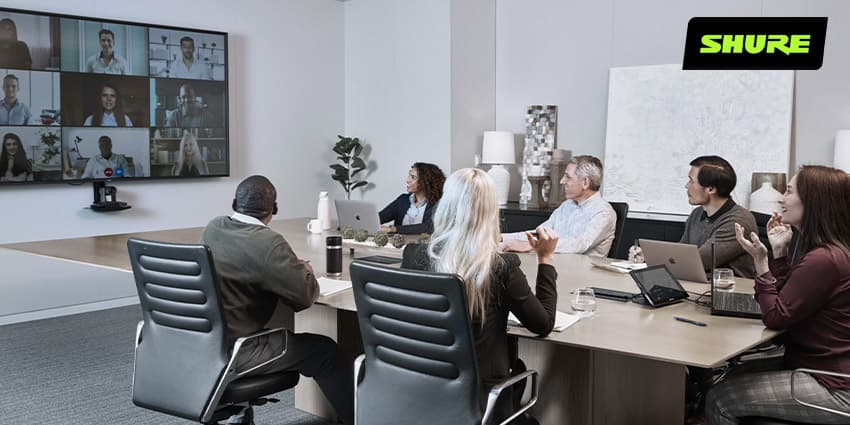
Continuing changes in workplace habits are driving demand for products that can be simply installed into any space and offer easy compatibility with existing platforms. Traditional large conference spaces require greater flexibility and traditional offices are being reconfigured to offer smaller meeting or break-out and huddle rooms to accommodate the needs of modern workers. However, these new spaces still need to enable communications that offer excellent quality in terms of audio, visual and information technology.
Simplified and intuitive technology is a baseline requirement for effective workplace collaboration and Shure has added to this with the launch of its new MXA920 Ceiling Array Microphone. Featuring the company’s Automatic Coverage technology, the array provides pre-configured audio capture with minimal set-up required. This is an important benefit because it dramatically reduces the time and cost of deployments for integrators, AV and IT professionals.
“AV conferencing is only as good as the quality of participants’ audio,” confirms Doug Daube, the Director of Microphone Systems at Shure.
“Now more than ever, we’re seeing our customers require solutions that capture the voice naturally, fitting beautifully into a room’s aesthetic, and making it effortless to connect participants - no matter where they are. These modern and evolving demands are met by the MXA920, ensuring easy deployment and unmatched voice capture.”
The MXA920, which builds on the success of Shure’s MXA910 ceiling array, that was launched in 2016 2016, employs Shure’s Next Generation Array Architecture for enhanced directional pick-up and more natural speech. In addition, the onboard IntelliMix digital signal processing (DSP) delivers noise and echo-free performance with new levels of audio clarity and intelligibility for AV conferencing across all room types. These encompass executive boardrooms, higher education hybrid classrooms, corporate and government meeting spaces. To address this variety of spaces, Shure offers the MXA920 in two form factors, square and round, to support design integration into even the most complicated facilities and meeting spaces.