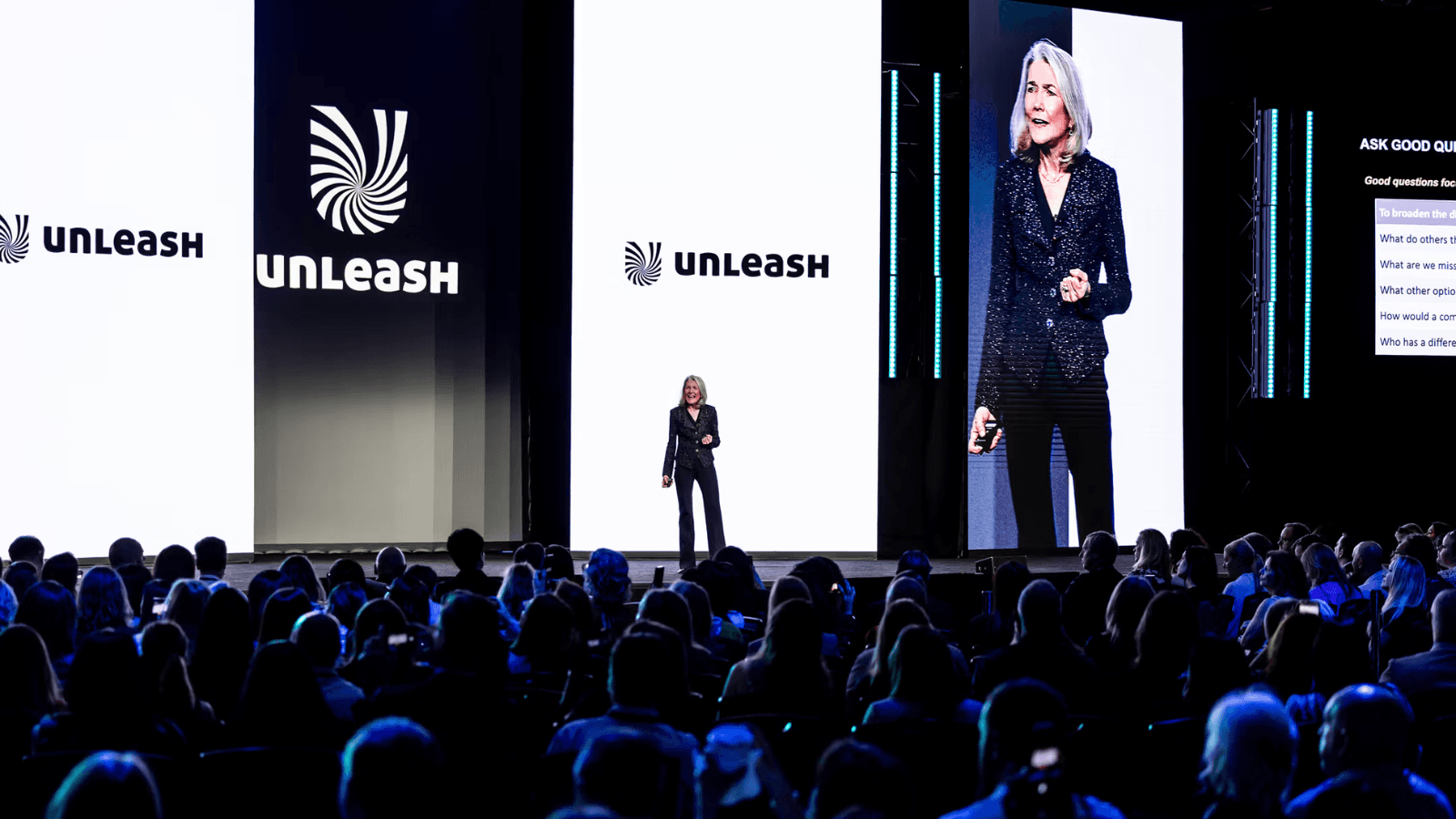
At an event themed Repurposing Humanity in the Age of Machines, artificial intelligence was never going to be a side note. Across UNLEASH Paris, the conversation spanned agentic AI, skills, learning, workforce strategy and HR operating models.
But the most valuable message was less about what AI can do than what organisations need to do around it. Technology can accelerate a process. It cannot decide whether that process is worth preserving, whether employees are ready for it, or whether the benefits will reach beyond the already confident early adopters.
TL;DR
-
HiBob’s Salesforce investment highlights why connected business data and organisational context will matter more than another isolated AI tool.
-
PwC’s research points to a two-speed workforce risk, with unequal access to AI skills, opportunity and confidence.
-
HR and L&D need to redesign work and build measurable capability, rather than treating AI as a content or automation shortcut.
Why Is Context Becoming HR’s Most Valuable AI Asset?
We dug deeper into Salesforce’s $166 million investment in HiBob at the event. In a conversation with UC Today, Ronni Zehavi, Co-Founder and CEO of HiBob, said the relationship reflected a shared view that AI will require organisations to rethink not only systems, but workforce structures, skills and how data is connected.
“We agree about the following: number one is AI is here to stay, number two that humans and agents will work side by side... Organisations, management, they have to figure out how they’re going to redesign the way they work because of AI.”
The customer impact, Zehavi argued, will depend on moving beyond siloed HR systems. HiBob already offers a Slack integration, while the Salesforce relationship should help the company understand innovation across functions including finance, sales, marketing and customer success.
“It’s no longer about siloed systems... It’s all about connecting data and understanding the organisational context.”
That context is the part of the AI discussion that is easiest to gloss over. Zehavi’s point was that a record containing an employee’s name, title and number is merely data. Context is knowing which people have the relevant experience to advise on a market expansion, a product decision or a business challenge.
Zehavi said:
“The new scarcity is not AI, it is the context. Data by itself is not enough, the context is relevant.”
What Is Organisational Context?
Organisational context is the information that turns isolated data into a useful business answer: relationships between people, teams, roles, skills, priorities and workflows.
The implication is that AI workforce strategy will increasingly include digital workers. Looking ahead, Zehavi said:
“Humans and agents will work side by side. There will be a person and department in the organisation that will manage people and will manage agents.”
Soon, workforce planning may mean deciding whether a task belongs with a person, an agent or both - and then assigning budgets, skills and performance expectations accordingly.
What Does Deloitte’s Reimagined HR Model Require?
The technology market can make transformation look deceptively simple: choose a platform, launch a pilot and measure adoption. Pieter-Bas van der Linden, Digital HR and AI Lead at Deloitte, offered a necessary corrective at UNLEASH.
Van der Linden said in a conversation with UC Today:
“Reimagined HR, it’s a broad saying, but what it’s really about is it’s not only about technology these days."
His argument was that HR leaders need to think beyond the function’s own tools. The central questions concern how HR services are delivered, how roles change, what data is needed and how the workforce should be prepared for a new way of working.
“Think about the operating model of HR, think about the service delivery model, but also think about how the work changes. How should the work be re-architected? What should the workforce of the future look like?”
An AI assistant can reduce the time employees spend searching for HR support, but it only improves the experience if the response is accurate, personalised and trustworthy. Faster service is not automatically better service.
Van der Linden said leaders must consider “the adaptiveness of the people”, not only technical adoption. That means giving employees the AI fluency and literacy to understand which tools are available, how to use them in their work and when human judgement still needs to take the lead.
He also set out a more practical standard for AI ROI. Organisations can look at whether HR service tickets fall as self-service improves, whether employee NPS rises and, over time,whether productivity, revenue or gross margin change.
Watch the full interview with Pieter-Bas van der Linden below.
How Is PwC’s Two-Speed Workforce Taking Shape?
If HiBob’s message was about connected context, and Deloitte’s was about redesign, PwC’s was a warning about distribution. The benefits of AI will not necessarily reach every worker at the same pace, or in the same form.
In a conversation with UC Today, Peter Brown, Global Workforce Leader at PwC, discussed the 2026 AI Jobs Barometer. The research analysed nearly one billion job adverts globally to understand what employers are hiring for as AI changes the shape of work.
PwC’s recent findings state:
-
Jobs that AI “professionalises” are growing twice as fast as jobs it “democratises”, with 42% faster wage growth since 2021.
-
Skills needed for the most AI-exposed jobs are changing more than twice as fast as those needed for the least AI-exposed roles.
-
The new tasks added to AI-exposed jobs are 2.5 times more likely to require empathy, judgement and creativity.
-
AI-exposed junior roles are seven times more likely to demand traditionally senior skills, such as leadership and strategic thinking.
-
Productivity growth is 40% higher at companies most exposed to AI than at the least exposed companies.
The figures explain PwC’s distinction between “professionalised” and “democratised” work. In professionalised roles, AI removes routine activity and leaves employees with more time for higher-value, more expert work. In democratised roles, it makes more routine, less differentiated tasks easier for non-experts to perform.
Brown said:
“In professionalised roles, it’s where AI is taking on some of the more routine aspects of jobs… freeing up time for the people to spend more time on more value-add kind of opportunities,”
The implication is not that AI exposure alone determines a role’s future. The more important question is how an employer redesigns that role. Does AI give people greater scope to apply expertise, judgement and creativity? Or does it turn work into something more standardised and easier to commoditise?
PwC’s Hopes and Fears research shows the related danger of a two-speed workforce. Brown said the “front runners” - around 14% of employees - have scarce, in-demand skills and are getting opportunities to experiment with AI, build capability and innovate. They report more positive outcomes across productivity, job satisfaction, job security and trust in leadership.
By contrast, PwC’s “engine room” represents around 56% of the workforce: people leading customer services, running operations and keeping organisations moving.
“They get less access to being equipped and training. They don’t understand quite as much what AI is going to do for them and their role.”
That is the risk beneath the headline productivity gains. AI could widen existing gaps between workers who have confidence, access and time to experiment, and those expected to adapt without the same support.
Brown’s advice to leaders was to start with a clear business problem, redesign the work around it and recognise that employees do not start from the same level of AI familiarity. Communication is equally important.
“We don’t expect leaders to have all the answers or to sugarcoat things, but what we do expect is clarity and transparency."
For Brown, that clarity should extend to younger employees, too. AI may remove some of the routine work through which graduates and apprentices once learned informally, but organisations should not allow that to close off routes into expertise.
“Those organisations that get ahead are actually redesigning those workflows and making sure they’re deliberately putting in the opportunities for people to develop those human skills."
Can Learning Teams Turn AI Into Workforce Capability?
That need for deliberate development leads directly to L&D. In a conversation with UC Today, David James, Chief Learning Officer at 360Learning, warned that generative AI could lead teams to produce more learning content without addressing the workforce capability issues that matter.
James said:
“AI will contribute to the oceans of content that’s already available there if we don’t do that analysis."
360Learning’s L&D Maturity Model Report, based on more than 1,000 self-assessments, found that 85% of L&D teams sit between the second and third levels of maturity. Just under 10% are strategically aligned with their organisation’s objectives.
“If it’s not aligned with what the organisation is trying to do, then it’s going to make it difficult to demonstrate impact."
The problem is not content quality alone. James said 52% of respondents were not properly analysing learning needs, meaning teams may be responding to assumptions or requests from leaders removed from day-to-day work.
“It’s a strategy based on hope rather than actual knowing."
Instead, L&D teams should use AI to build skills intelligence: identify critical skills, assess current capability and offer targeted development that supports both individuals and business priorities.
That is the route to a genuine strategic role for L&D. As AI changes entry-level work and raises demand for empathy, critical thinking and judgement, learning leaders need to prove how they build those capabilities - not wait to be asked.
“Waiting for the permission means that you’ll be waiting forever... You have to craft it, you have to earn it.”
Watch the full interview with David James below:
What Are the Key Takeaways From UNLEASH Paris 2026?
-
AI’s value depends on context, not access alone. HiBob’s Ronni Zehavi argued that connected business data, and the organisational context around it, will determine whether AI produces meaningful insight or simply scales existing silos.
-
HR transformation requires work redesign, not just technology adoption. Organisations need to revisit their HR operating model, service delivery and job architecture as AI changes how work gets done.
-
A two-speed workforce is emerging. PwC’s research shows AI is creating different outcomes across roles, while unequal access to training and experimentation risks widening the gap between workforce “front runners” and the operational “engine room”.
-
Human skills are becoming more valuable, not less. Empathy, judgement, critical thinking and leadership are increasingly important as AI takes on routine tasks. The challenge is ensuring people have opportunities to build them.
-
L&D needs to demonstrate capability, not content volume. Learning leaders should use skills intelligence to show where the business is strong, where it is weak and how development supports strategy.