
Productivity AI is leaving the lonely chat window behind. Atlassian, Sanas and Ringover are betting that agents earn their place in enterprise workflows not by acting alone, but by making their work visible, supervised and accountable.
The agentic AI conversation has spent rather too long stuck on a binary question: will AI assist workers, or replace them? This week’s announcements suggest the more useful question is considerably less dramatic and far more operational: who is in charge when the agent gets to work?
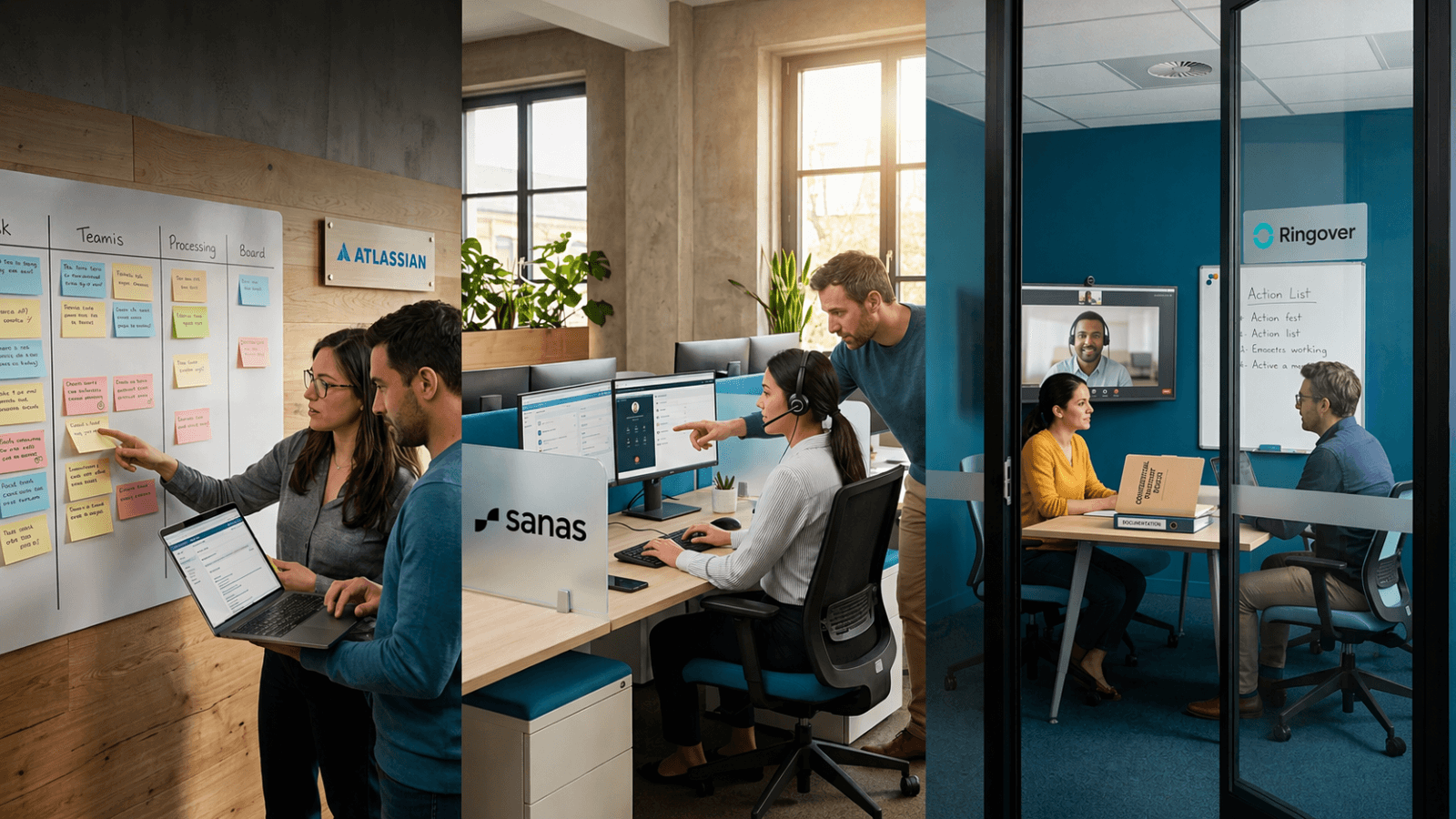
Atlassian wants agents to become visible colleagues in the flow of work. Sanas wants people to supervise several AI-led customer calls at once. Ringover wants sellers to stop juggling notes, coaching prompts and CRM admin while they try to sell. Different workflows, same emerging design principle: productivity AI needs a manager.
TL;DR
Atlassian is making agent identity, context and auditability part of the work-management fabric - not a compliance afterthought.
Sanas shows “human in the loop” only means something when that human can intervene before a customer experience breaks.
Ringover’s sovereign meeting platform makes a blunt point: eliminating admin is useful, but data control remains part of the productivity equation.
Atlassian Makes The Agent A Visible Teammate
At Team ’26 Europe in Amsterdam, Atlassian launched its Agentic Multiplayer Protocol, or AMP: a framework for humans and agents to work across its platform with an identity, scoped authority, shared context and reviewable output.
That sounds abstract until you consider the alternative. A worker asks an AI tool to update a project plan, prepare a brief or resolve a ticket; the result appears, but the wider team cannot easily see what happened, which information was accessed or who owns the outcome. That is not collaboration. It is a very fast version of “who changed this?”
AMP is Atlassian’s attempt to put agents into the normal social and administrative machinery of work. Agents can be brought into Jira workflows and Confluence documents, while Agent Sessions are designed to link local and cloud agent activity back to the appropriate work items. Agent accounts and a non-human identity inventory are also planned to give administrators a clearer view of what autonomous actors can access and do.
Atlassian says humans and agents now collaborate more than 10 million times each month on its platform, while its Teamwork Graph maps more than 250 billion connections. Its updated MCP server, meanwhile, uses up to 25% fewer tokens for equivalent Jira and Confluence tasks in internal Claude benchmarking.
The efficiency claim is welcome, but it is not the headline. As UC Today previously explored when Jira made AI agents assignable resources, the enterprise issue is not merely whether an agent can take a ticket. It is whether teams can assign, trace, challenge and ultimately trust the work it does.
As Atlassian Co-Founder and CEO Mike Cannon-Brookes put it:
“The biggest shift ahead is moving from single-player AI to multiplayer teamwork with agents working alongside your people, in the flow, the way great teams already do.”
The implication is simple: the agent is no longer an application feature. It is becoming an operational participant - and participants need names, roles and guardrails.
The Story In A Quote: “Nobody Wants A Plane Without A Pilot”
Sanas brought that argument into the contact centre with the launch of Supervised AI, a platform where AI agents conduct customer calls while one human supervisor oversees up to four conversations from a single console.