powering productive workplaces
Front page
FeatureUC&C21m · 21:21 BST · 9 min read

Dreamforce Roundup: 5 Takeaways on AIforce, Slack, and Agent Trust

As Dreamforce 2026 comes to a close in San Francisco, five announcements stand out for showing just how far Salesforce is willing to push CRM beyond its own interface, from a new Slack workspace strategy to a fresh governance framework built to keep it all in check.

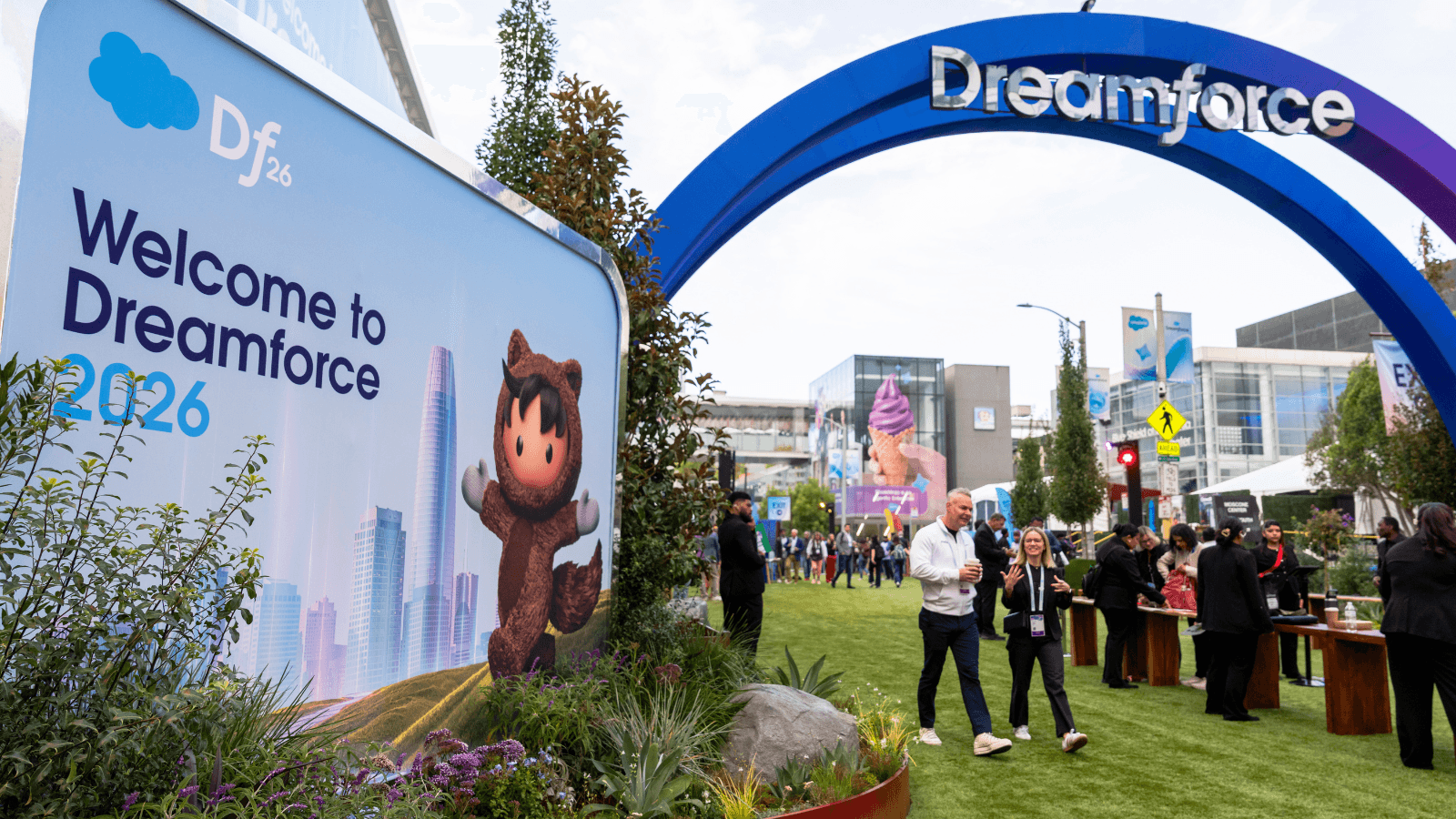
Dreamforce 2026

Dreamforce 2026 is wrapping up in San Francisco, and after three days of keynotes, demos, and product launches, a clear message emerged. Salesforce wants its value to sit beneath the apps, AI tools, and collaboration platforms people already use.

The big announcements all pointed the same direction. Salesforce doesn't want workers logging into a CRM, digging through records and dashboards, and manually stitching together context before they can actually get anything done.

It wants its business logic sitting behind Slack, Claude, Amazon Quick, Google Cloud's Gemini Enterprise, and its own Agentforce Coworker.

That's a big shift for a CRM giant. Here are 5 key takeaways from the week to explore these shifts further:

1. AIforce: Salesforce Wants CRM to Work Beyond the CRM

AIforce is Salesforce's clearest statement yet that the traditional CRM interface matters less than it used to.

The new launch is a live interface layer that enables people to pull Salesforce's underlying intelligence into other AI and workplace tools. The core idea: the system of record doesn't have to be the system where the work starts.

A rep could open Claude and ask it to prep a customer meeting. An account team could use Amazon Quick to pull together a briefing from live pipeline data, recent activity, and open cases. Someone in Gemini Enterprise could dig into an account or a deal. A team in Slack could spin up a shared dashboard, update a record, or ask an agent to spot a problem and suggest a fix.

Salesforce's job in every one of those scenarios is the same: sit underneath, and supply the context, logic, permissions, and governed actions that make it all work.

Marc Benioff called this an "interface revolution" during the Day 1 keynote. His argument: applications were never really the screen. The real value was always the metadata, relationships, workflows, data model, and business logic underneath it. Speaking in a Dreamforce media Q&A, Benioff said:

"I think this will be the year of interfaces."

For UC and collaboration leaders, the immediate payoff is fewer tabs. Instead of copying data from Salesforce into Slack just to ask a colleague for help, employees could bring the Salesforce context and the action itself straight into the conversation.

Irwin Lazar, President and Principal Analyst at Metrigy, agrees, telling UC Today:

"It reduces task switching."

Lazar said Slack is particularly well-suited to become a primary interface for Salesforce's headless strategy, since it's already where employees go to ask questions and coordinate next steps.

"Slack is really ideal as a primary user interface for that."

2. Slack's Evolution: From Collaboration App to a Shared AI Workspace

Slack wasn't a side note at Dreamforce, it was front and center, and not just as Salesforce's messaging product. It's being pitched as a shared 'multiplayer' space where people, AI agents, business data, and live interfaces all work in the same room.

The Slackforce announcements covered Slack CRM, Slackbot, Slackforce Surfaces, and Slack Code. Together, they're Salesforce's attempt to turn Slack into a working environment for the business, not just a place to send messages.

Slack CRM lets people create accounts, log call notes, and update records with a natural-language prompt. Slackbot is being positioned as an assistant that reasons across both the conversation and the Salesforce data behind it.

Slackforce Surfaces can generate shared dashboards, reports, presentations, and calculators from a prompt inside a channel, pulling from Salesforce and connected systems.

The cultural pitch mattered just as much as the product. In the "How Slack Turns AI Into a Team Sport" session, Ryan Gavin, EVP and CMO at Slack, argued AI gets more valuable once teams can see and build on each other's work in shared spaces:

"... you actually run in the open. And you build in the open, and that creates compounding advantage."

That showed up clearly in Slack Code, a collaborative space where teams work alongside coding agents on projects, reviews, prototypes, and docs, all inside dedicated Slack conversations.

Gavin said the goal isn't just faster individuals. It's more collaborative innovation, with researchers, designers, salespeople, engineers, and agents all working in the same space:

"It's like innovation at light speed. But it's happening with the organization collectively, not one individual trying to get it right."

Salesforce is also using its own sellers as proof of concept. Gavin stated:

"At Salesforce, 90 percent of our sellers access Salesforce through Slackbot."

What we'll be continuing to monitor is whether that collaboration layer becomes a new governance headache once agents start touching more systems, more data, and more workflows from inside a shared channel.

3. The Safety Layer: Salesforce's Trusted Enterprise AI Harness

Speaking of governance & safety, Salesforce made sure to highlight how it's tying trust into its new suite of tools.

That responsibility lies on the new Trusted Enterprise AI Harness, one of the more consequential announcements of the week. Salesforce is positioning it as a control and trust layer for AI work across the whole enterprise, not a framework built for a single agent.

It has six pieces: Trusted Context, Trusted Agency, Trusted Action, Trusted Governance, Trusted Security, and Trusted Models.

Trusted Context pulls together customer data, metadata, business semantics, knowledge, real-time signals, and memory. Trusted Agency covers reasoning, planning, and the balance between flexible AI behavior and hard controls. Trusted Action connects agents to applications, APIs, workflows, and business processes. Governance, security, and model choice surround it all, controlling how agents access data, take action, and choose the right model for the job.

In a LinkedIn post following the announcement, Benioff argued the real challenge for enterprises isn't access to smart models anymore. It's whether AI understands the business well enough to act on it safely:

"The hard part is trust: can AI actually understand your business, and can it act on it safely, inside your governance, your security, your rules?"

Benioff drew a clear line between making one agent work and making AI work at enterprise scale:

"The agent harness makes an agent work. The Trusted Enterprise AI Harness makes AI work for the enterprise."

This is also where Salesforce's emphasis on deterministic execution comes from. AI models are probabilistic. They interpret a fuzzy request, spot patterns, and propose a plan. But financial approvals, customer entitlements, service escalations, and supplier onboarding usually need to follow fixed rules, not a best guess.

Salesforce's pitch is that agents should reason where flexibility helps, but fall back to governed workflows, permissions, and approvals the moment an action carries real risk.

4. Industry-Specific Agents: From Building Agents to Deploying Digital Workers

The fourth piece of Salesforce's Dreamforce strategy is its growing lineup of job-ready agents. These include Hunter for sales, Casey for service, Paige for employee support, Carter for commerce, Marshall for supply chain, Piper for inbound pipeline, and Fin for CX.

Salesforce is trying to reduce the barrier between an enterprise deciding it wants AI agents and actually deploying one. Rather than build from scratch, customers can begin with an agent designed around a specific role, workflow, and set of actions.

Hunter is the clearest example. Salesforce says its sales agent can work toward a pipeline goal over days or weeks, researching accounts, planning outreach, adapting to new information, and seeking seller approval when needed. Marshall applies the same idea to structured back-office work, with deterministic execution and an audit trail.

Koa, Salesforce's new NVIDIA-built CRM reasoning model, is intended to support this strategy with models tailored to sales, service, and marketing rather than general-purpose AI.

It's important to note that the model is trained on simulated enterprise scenarios, not customer data. Jayesh Govindarajan, EVP of Software Engineering at Salesforce, explained:

"It would be easy if we could lean on customers' data, but we do not train on our customer data."

Overall, these prebuilt agents and specialized models aim to help companies move beyond pilots faster, but they do not eliminate the work required to make AI reliable. Enterprises still need clean data, trusted workflows, clear human escalation, and accountability for every agent action.

5. Overheard at Dreamforce

As we made our way through Dreamforce's Campground, here are some of the conversations that floated to the top:

Moving away from AI slop

At Gamma's booth, the conversation kept circling back to a problem more employees are running into with generative AI: it's easy to make more content, harder to make something worth putting your name on.

Rohit, Creative Lead at Gamma, told UC Today quality and taste still matter even as AI speeds up content creation:

"It's very easy to spin up a lot of things right now, but it's hard to spin up things that have good quality and good taste."

Navigating AI consumers

Salesforce CEO Marc Benioff had one of the stranger lines of the event. When asked about his perspective on AI agents as consumers, he provided evidence that this shift was old news. As owner of Time Magazine, he shared:

"We have more readers of Time magazine today that are agents than humans."

He explained that this has become the case as AI adoption grows, and as AI becomes the single source of truth.

From a commerce & consumer perspective, this analogy underscores the importance of how brands accommodate AI agents acting on behalf of a potential customer.

The importance of metadata

Not every Dreamforce conversation was about what AI can do next. Yoav Kolodner, CEO and Co-Founder of Tribal and a former Salesforce engineering VP, offered a reminder that Salesforce's headless vision depends on the quality of the underlying system. Kolodner told UC Today:

"The metadata is the layer that really describes the business in the best way."

His point is that giving agents and external interfaces access to Salesforce does not erase years of technical debt, inconsistent data, or overcomplicated configurations. Before organizations layer agents on top, they need an environment that is ready for them.

What Next

As we monitor how these new launches and tools roll out across real enterprise deployments, it will be essential to see how workplaces adopt them efficiently and securely.

What This Means for Customer Experience

Salesforce’s Dreamforce strategy is not just reshaping how employees work. It is also changing what customers will expect when they contact a business.

The same ingredients behind Salesforce’s agentic-enterprise pitch—trusted context, AI agents, governed actions, model choice, and human escalation—will determine whether AI improves a customer journey or simply adds another automated layer.

CX Today’s Dreamforce coverage examines that question from the customer side:

The next test for Salesforce is not whether agents can access more systems or produce more fluent interactions. It is whether they can help businesses resolve customer problems safely, preserve the right route to a human, and make the customer operation more accountable—not just more automated.

rate this story
helps rank stories across uc today
The discussion0 takes · attributed & checked

Does this reflect your experience?

opening the room…
Read nextordered by techtelligence · every pick explained
picked for this story

Dreamforce 2026 Keynote: AIforce & The End of the Interface?

16 Sept 2026
picked for this storyDreamforce 2026 Guide: What Enterprise Leaders Need to Know Before Salesforce’s Biggest Event4 Aug 2026picked for this storyDreamforce 2026: 5 Productivity & Automation Topics to Watch10 Sept 2026