As Unified Communications becomes ever more unified in terms of functionality, it’s fair to say that the key differentiating factor of user experience becomes increasingly important, for determining satisfaction. This applies at any time of course, but never more so than during the present state of flux when many end customers are being forced to transition to cloud-based UC at unexpected speed.
Whatever technology is provided for the actual communications tools what matters to the user is what they want to achieve with it. And what that looks like will be unique to each customer. With Kurmi Software recently recognised by the American research firm Nemertes as the most innovative solution producing real cost reductions in the management and operation of UC and collaboration tools, I spoke to Head of Product Management, Bruno Guirardel, to explore what distinguishes their self-service user portal, and how it makes life easier for the end customer.
“Right now speed matters more than ever, so for example if I want to onboard a new employee; in a traditional solution that might mean opening a ticket, and waiting for someone to read it and perhaps ask questions after a few hours or days, then finally email me once its all resolved and done.” With typical setups involving at least 2 tech vendors with different provisioning and management requirements, automating and simplifying deployment brings exponential value at scale.
Designed for the end customer’s experience
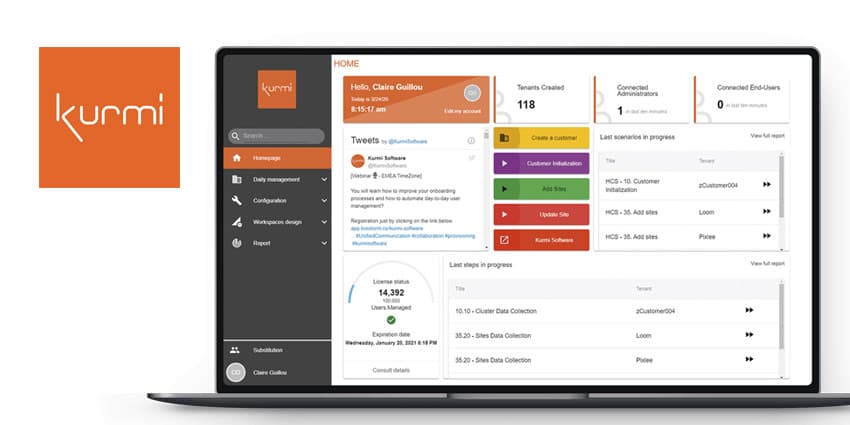
Kurmi provides a different approach, through their powerfully customisable portal, which channels can white-label and specify to suit the needs of customers (including non-technical users) with great specificity: “So you might have a form with a few very specific questions. Like the new employee’s first and last names, confirming they are a sales person, and to be based in New York. That’s it, because everything else is already preconfigured."
"You can have that user account available within a few minutes, ready to start making calls”
Kurmi’s provisioning portal simplifies the deployment for the end user, by specifying the underlying tool which will provide the required service, which can be locked down in advance by the supplier - reducing risk and expediting provisioning choices. For example, a user won’t have to specify a software programme or vendor at the point of onboarding - they can simply check a box to say, yes this new guy does require recording capabilities - and that will be enabled.