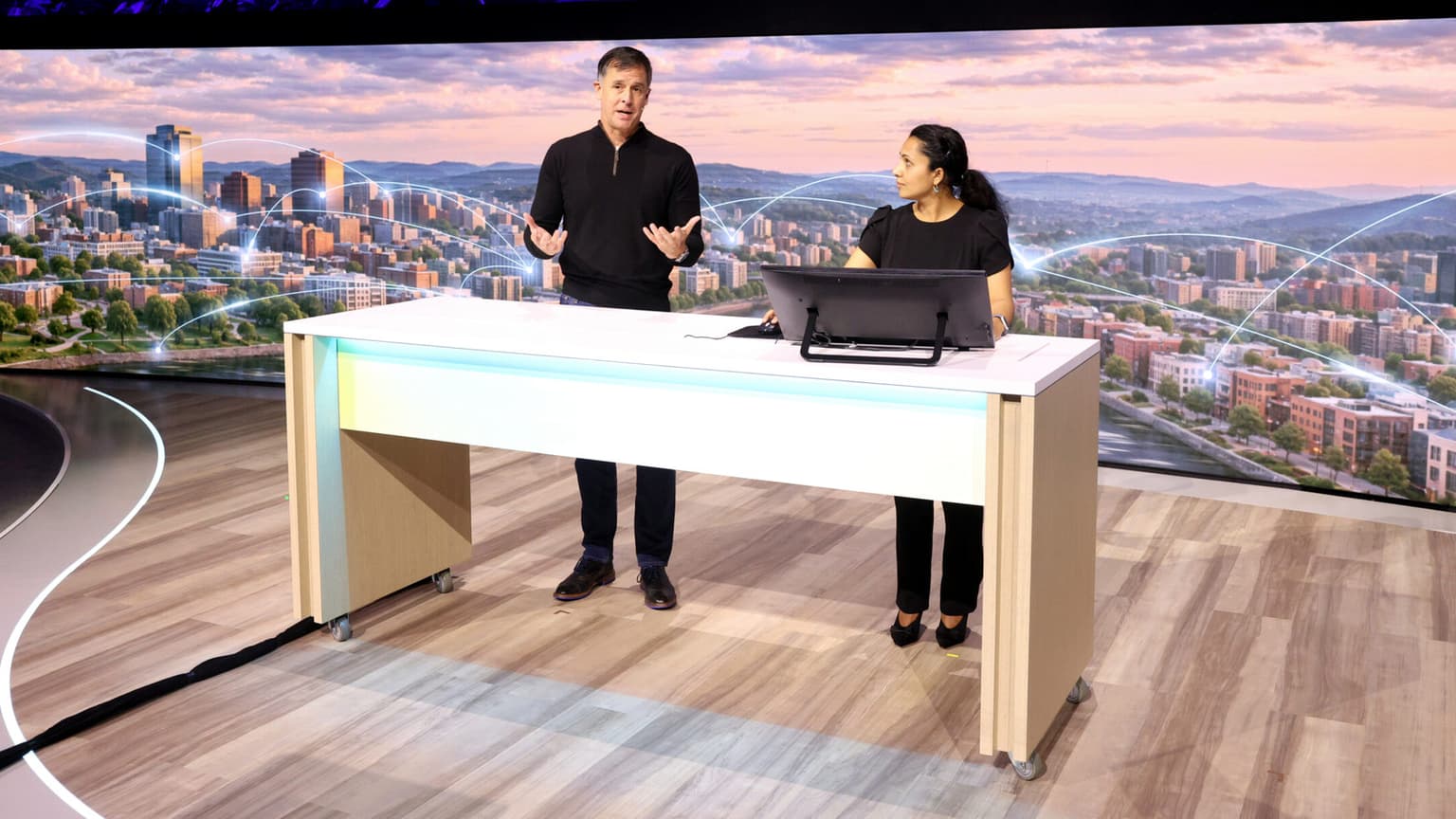
A week ago, Microsoft was still explaining why Outlook and Exchange Online had gone down for around a day. On Tuesday in San Francisco, Satya Nadella opened Microsoft Ignite by acknowledging that, then spent most of his keynote giving AI agents their own names and a seat in Teams. Once agents are sitting in your chats and meeting rooms, the questions get practical quickly, starting with who controls them and where their data goes.
In this week's roundup I look at what Ignite means for Teams, my interview with ALE's Moussa Zaghdoud on sovereign AI, and Neat's move to let agents run meeting rooms, plus my take on paying for AI by the call. I've also picked out news from Jabra, Google and Microsoft.
Editor's Pick: Microsoft Gives AI Agents Their Own Identity in Teams
Microsoft used its Ignite keynote on November 17 to give AI agents a place on the team. Agentic Users, now in public preview, get their own Microsoft Entra accounts, so people can find an agent by name, add it to chats, channels and meetings, and @mention it like a colleague, Microsoft told developers. Each agent's profile names the person who owns it, and admins approve the agent, decide what it can reach and can switch it off.
Autopilot, Microsoft's long-running personal agent, is rolling out through the Frontier program, and colleagues will be able to @mention a person's Autopilot in a Teams channel to ask for information or request supported actions, the company said. Meetings are part of the plan as well. Teams real-time transcripts make meeting content available to agents while the meeting is still going on, Microsoft added.
Before any of that, Nadella dealt with last week's outage, which Microsoft's preliminary account traced to a bug first deployed in July, as I reported on Tuesday. He told the audience:
I know we have work to do to provide that resilience that you can count on, the world can count on, and we are committed to ensuring that we learn and we continuously improve.
The rest of the keynote turned to what all this AI is worth. In my Ignite preview I said the big question was whether Microsoft would put numbers on Copilot's value. What it brought instead was a way for customers to work out those numbers themselves. Agent 365 Business Analytics, which Nadella called "your ERP system for AI usage," links AI spend to outcomes, but for now it sits in the Frontier program. Rob Scott, who covered day one for us, summed it up well in his verdict:
Microsoft has built the meter. It hasn't yet shown the receipts.
Rob also noted that the Book of News had nothing on Teams Phone or Teams Rooms, and at the time of writing that hadn't changed. For now, the Teams story at Ignite is about agents, and the first job for anyone running Teams is deciding who in the business is allowed to own one.
ALE's Moussa Zaghdoud on Keeping Meeting AI in Europe
All that meeting data has to live somewhere, and Moussa Zaghdoud, Chief Technology Officer at Alcatel-Lucent Enterprise, told me in this week's video interview that a much wider group of European buyers now care where. The demand used to come from governments, but that has changed:
In the past only governmental organisations were looking at sovereignty. Nowadays you see it from the private sector as well.
ALE's answer is Rainbow Premium, which it announced in October. It adds meeting transcription and summaries, live captions and translation to Rainbow, hosted and governed in Europe, and it works whether a customer runs Rainbow in its own data center, on ALE's cloud or in a hybrid setup.
Zaghdoud was open about positioning ALE as an alternative to Copilot and Zoom's AI, and his argument rests on US law. For European customers using tools that fall under the CLOUD Act, he said, "there is a small chance, but there is a chance, that your data will be managed differently." He added that buyers now expect third-party certification to back up what a vendor tells them.
That is a fair test to apply to every vendor, Microsoft included, now that agents can read a meeting while it happens. You can watch the full video interview to hear why he thinks accuracy decides whether people keep using these tools.
Neat Lets AI Agents Manage the Meeting Room
Neat took agents into the room itself on November 18, when it made Neat Pulse MCP generally available to paid Neat Pulse customers at no extra cost. Compatible AI agents can now read device status, configuration and sensor data across a Neat estate and carry out supported actions, such as rebooting a device, the company said. Neat first showed the tool in beta at InfoComm 2026.
Admins decide how far those agents go. Neat Pulse MCP runs locally, admins choose between read-only and read-write access, and every action an agent takes is recorded in the audit logs. With read-only access, an agent can check whether rooms are healthy before an important meeting and recommend fixes without changing anything.
That is where I'd start. Last week Neat was rolling out a security fix for a flaw on CISA's exploited list, and finding the rooms that haven't updated is exactly the kind of routine check an agent should be able to take off an admin's desk.
Talking Point: Who Pays When AI Answers Your Phone?
Microsoft has moved intelligent call delegation, the Teams feature that uses AI to screen incoming calls, into public preview from as early as November 17, and it now runs on usage-based billing through Copilot Credits, the company told admins. Billing only starts once an admin sets up a spending policy, and Frontier tenants that don't create one will stop having their calls screened.
It's a small feature, but it shows where the pricing is heading. Last month I wrote that AI at work was moving from seats to meters, and the cost management tools Microsoft showed at Ignite, which let admins set spending limits and alerts across Cowork, Autopilot and Copilot Studio, point the same way.
If I were running Teams Phone, I'd set up the spending policy for a small pilot group first and watch the credits for a month before going wider, because the notice to admins doesn't say what a screened call will cost.
Poll: Would you pay per call for AI call screening in Teams?
- Yes, if it saves our people time on the phone
- Only for a few roles, such as executives or sales
- Not until Microsoft publishes clear per-call pricing
- No, call screening should be part of the license
In Other News: Jabra, Google and Microsoft
A few other UC&C stories I picked out from this week's In Brief feed.
- Jabra's Evolve3 headsets are certified for Teams over native Bluetooth. The Evolve3 75 and 85 are among the first headsets certified over Bluetooth LE Audio, so they connect to supported Windows 11 PCs without a USB dongle, Jabra said. Every headset still ships with a dongle, which helps on mixed PC fleets.
- Google Calendar is adding a default five-minute meeting buffer. New meetings can start five minutes late or end five minutes early, and admins get an organization-wide default from December 11, Google said.
- Microsoft is resetting cloud prices in five currencies. From January 1, prices rise 15.7% in Indian rupees and 10% in New Zealand dollars and fall in Australian dollars, Norwegian krone and Chinese yuan, Microsoft told partners, so renewals billed in those currencies need a second look.
Looking Ahead: Zoom's Results and Microsoft's Outage Review
Ignite wraps up on Friday, and at the time of writing Microsoft's final review of the November 12 outage is still to come. On Monday, Zoom reports its third-quarter results, and I'll be listening for whether Zoom's own AI agents are starting to show up in revenue. If you're weighing up agents in Teams, or how far to let them into your meetings, get in touch.