powering productive workplaces
latest
Front pagesponsored · Akkadian
UC&C18m · 13:31 GMT · 5 min read

How Migration Projects Can Create Lifecycle Advantage

Migration projects can be hard to scope, difficult to standardise and expensive to repeat. Ron Rosansky, CEO of Akkadian Labs, explains how a more consistent delivery model can help enterprise teams and partners reduce uncertainty and create longer-term value after go-live.

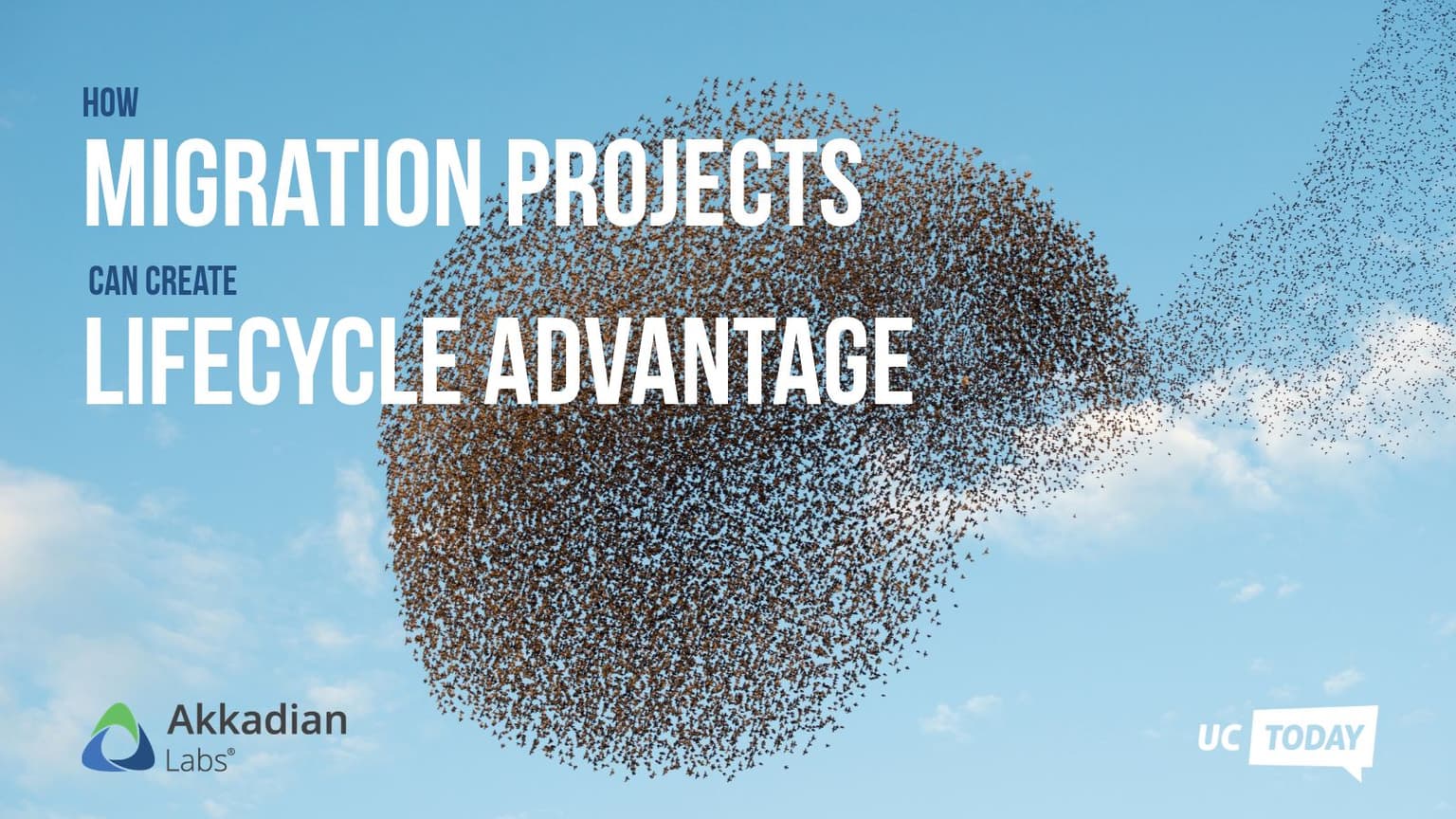
Flock of migrating birds with the article title overlaid

Enterprise collaboration migrations are often treated as finite delivery exercises. A customer selects a destination platform, a project team develops a plan, users are moved in phases and the engagement closes once the agreed work is complete.

For large organisations and the partners serving them, that approach can leave value on the table.

A major migration is also a chance to establish a more repeatable operating model that translates into improved governance and increased adoption: how users are provisioned, how access is controlled, how policies are applied and how changes are managed once the project team has stepped back.

For Ron Rosansky, CEO of Akkadian Labs, consistency in those user changes is central to whether an organisation gets the value it expected from its technology investment.

“One of the most basic things our lifecycle collaboration platform does is provisioning,” Rosansky says.

“And that provisioning needs to be controlled and standardised.”

The immediate task may be to move users. The longer-term opportunity is to make the environment easier to manage afterwards, while giving systems integrators and managed service providers a more repeatable model for delivery and support.

Planning for Predictable Delivery

Migration work becomes difficult to scale when every engagement must be planned from scratch.

Large enterprises rarely present a uniform environment. They may have different collaboration platforms across regions or business units, varying policy requirements and a mix of specialist and non-specialist administrators. A project can appear straightforward at the point of sale, then become more complex once the delivery team uncovers how the environment operates in practice.

That creates challenges for both sides. Customers want confidence that the program can be delivered within a realistic timeframe and budget. Partners need enough visibility to define the work accurately, resource it appropriately and avoid rework once delivery has started.

A structured readiness and migration process gives both partners and clients a firmer basis for the engagement. It helps identify the factors likely to affect delivery before teams commit to a migration model, showing where specialist expertise is needed and where a repeatable process can be applied.

The objective is not to make every enterprise migration identical. Each organisation has its own platform history, operational needs and compliance obligations. It is to avoid treating every project as entirely bespoke when many lifecycle tasks can be delivered through a consistent framework.

For partners, that can make complex migration work easier to scope and repeat. Rather than relying solely on the experience of a small number of engineers, they can create a delivery methodology that can be applied across a broader portfolio of customers.

Standardising the Work Across Teams

A major migration may involve internal IT teams, external partners, specialist engineers and business stakeholders. Users may move in several phases, while multiple administrators provision accounts, assign access and apply policies throughout the program.

Rosansky says consistency in those routine actions impacts how effectively the platform can be managed and is ultimately adopted.

“Consistent naming conventions, consistent configurations,” he says. “And what that does is that improves overall adoption.”

If people perform the same task in different ways, delivery teams can find it harder to understand previous changes, apply policies consistently or maintain a clear administrative record. Standardised workflows reduce that variation across recurring tasks, including user provisioning, access management and policy application.

They can also make it easier for a partner to increase delivery capacity without requiring every administrator to become an expert in every vendor platform.

That matters because enterprise customers increasingly operate multi-vendor collaboration estates. They may support Cisco, Webex, Microsoft Teams and Zoom simultaneously, alongside wider business systems with their own rules and dependencies.

Rosansky recently spoke with an organisation that illustrates the scale of the challenge.

“They’re supporting four different vendors in their environment,” he says. “Now, policies are different, compliance is different, administrative interfaces are different. That allows for a lot more discontinuity when rolling out features.”

For a partner, the risk is that each platform becomes its own isolated delivery and support model. A common management platform can provide more consistency across the estate while allowing specialist knowledge to be used where it adds the most value.

Moving From Migration to Managed Lifecycle Automation

The work does not end when the final planned user group has moved.

After go-live, customers still need to manage joiners, movers and leavers. They need to apply policy changes, control access, validate configuration and respond to organisational change. These are continuous responsibilities, rather than one-time migration tasks.

For systems integrators and MSPs, that creates a path from project delivery to ongoing lifecycle services. Instead of supporting a customer only through a point-in-time transition, they can help manage the environment created by that transition over the longer term.

Rosansky says the model can also reduce dependency on individual platform specialists for routine work.

“We’re providing a single pane of glass, often to non-specialised administrators or business lines themselves, so they do not need to understand Cisco’s, Microsoft’s, or Zoom’s backend,” he says.

A lifecycle approach does not remove the need for technical expertise. It gives organisations and their partners a way to reserve that expertise for higher-value work, while scaling that expertise to make regular administration more consistent and auditable.

“You have one pane of glass with roles-based access, with auditability, that you could manage and govern all of those environments,” Rosansky says.

For customers, that continuity can help ensure the new collaboration platform remains manageable as the organisation changes. For partners, it creates the basis for a more durable relationship built around ongoing operational needs rather than a single migration event.

Building Value After Go-Live

The strongest migration programs do more than move an organisation from one platform to another. They establish the standards and service model needed to operate the environment after go-live in a way that optimises overall return on investment.

That benefits enterprise IT teams by creating greater consistency across administrators, platforms and business units. It also gives delivery partners a more reliable framework for planning work, delivering projects and extending support into managed lifecycle services.

Rosanky says:

"The easier it is for them to manage their user lifecycle, the higher the probability that they’re going to see the adoption, return on investment, and get to the outcomes that they’re looking to get"

Migration may be the immediate project, but the greater value lies in the operating model that continues long after the move is complete.

Join the conversation

Does this reflect your experience?

opening the room…