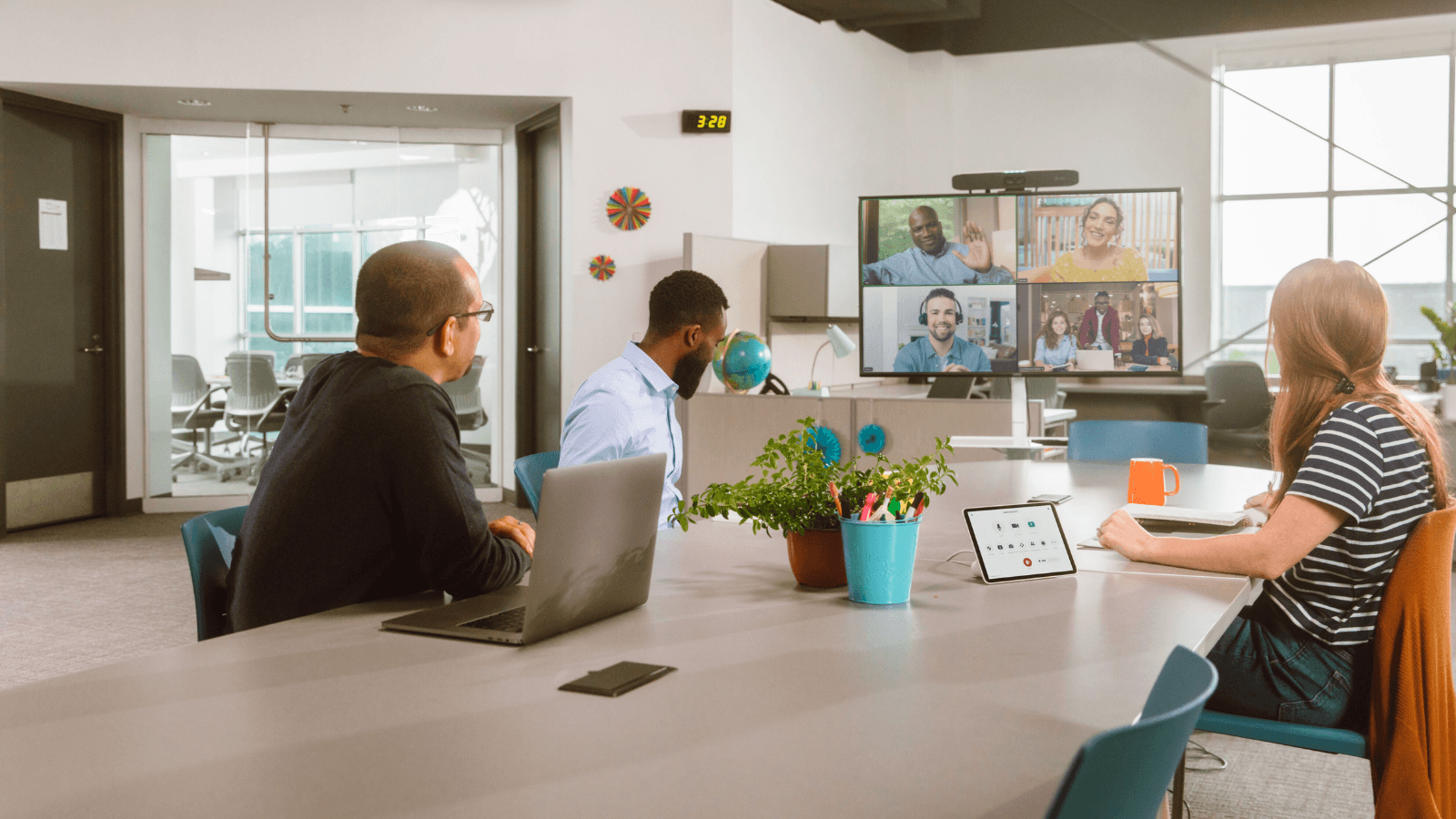
Many organizations have already standardized on collaboration platforms and are now accelerating investment in platform licenses that include AI Assistants and Agents and some of their features include transcription, meeting summaries, action items, and speaker attribution. Yet in many meeting spaces, the experience still falls short. The challenge is no longer just the collaboration platform itself. It is whether the meeting environment is equipped to support productive communication and reliable AI-enabled workflows.
IDC Research notes that 60% of remote meeting participants find it difficult to interact, participate, or lead meetings as effectively as their in-office colleagues. That gap is more than a user experience issue. It affects how decisions are made, how confidently people contribute, and how much value organizations can extract from the AI tools layered on top of those conversations.
When meeting rooms fail to support natural conversation between people in the room and those joining remotely, collaboration slows down. Participants repeat themselves, miss cues, struggle to interject, and leave with incomplete takeaways. As AI-enabled collaboration, these issues matter even more because when communication breaks down, both collaboration and AI-supported outcomes suffer.
Why Modern Meetings Still Break Down
Walk into many shared meeting spaces today and the technology is still inconsistent. Some rooms rely on basic USB cameras and speakerphones, while others are running legacy systems that were never designed for the demands of modern collaboration platforms and AI-assisted meeting workflows. As a result, the user experience can vary sharply from room to room.
When microphones do not capture voices clearly, cameras miss key participants, or room systems fail to reflect the flow of discussion, people joining remotely are placed at an immediate disadvantage. They may hear less clearly, miss non-verbal cues, or hesitate to participate. The result is not just a poorer meeting. It is a less effective collaboration environment overall.
AI involvement raises the stakes. In those same situations, Transcripts, recaps, action items, and speaker attribution are only as accurate as the audio and video signals feeding them. If a room cannot reliably capture who is speaking and what is being said, the outputs become less dependable. Instead of reducing effort, AI risks introducing more rework and uncertainty.
Employees already spend significant time preparing for meetings, participating in them, and following up afterwards. When meeting technology adds friction at every stage, that time investment becomes harder to justify. Organizations do not simply need more meetings. They need better environments for the meetings that matter.
As Josh Blalock, Collaboration Ecosystem and Engagement Director at Shure, puts it:
“Employees should be focused on the business outcomes, but so much of their effort currently goes into facilitating that communication that it eats into the outcomes they should be focused on.”
What AI-Ready Collaboration Spaces Require
Solving this challenge means thinking beyond basic room hardware. Organizations need meeting spaces that support equitable participation, generate cleaner inputs for AI tools, and can be deployed consistently across a range of room types. That is where enterprise-grade AV becomes strategic. It is no longer only about being heard. It is about creating a dependable foundation for collaboration and AI performance.