This year, Sennheiser is turning TeamConnect Ceiling M Plus into more than a ceiling-microphone refresh. PartnerLink puts the new microphone inside Q-SYS Designer, while DeviceHub adds a cloud fleet layer. The question to ask is how much operational work those connections remove once a room leaves the demo floor.
The number of logos that fit on a partner slide is becoming the least interesting thing about an AV ecosystem. Companies are more concerned about what actually happens after the installer leaves.
Sennheiser’s latest TeamConnect work is becoming more compelling on that front. PartnerLink doesn’t just add Q-SYS to a compatibility list. In Q-SYS Designer 10.4, TeamConnect Ceiling M Plus becomes a supported component, with audio streams and control mapped without a separate microphone plug-in or additional Dante configuration.
There is still a seam: initial onboarding starts in Sennheiser’s local browser interface. Once that’s done, though, considerably more of the microphone sits inside the workflow engineers already use.
That’s valuable now that AV teams are increasingly inheriting the expectations IT has dealt with for years: remote monitoring, firmware governance, security controls and clear ownership when something breaks.
TL;DR: How Useful is Sennheiser’s Integration Ecosystem?
- PartnerLink is where the TCC M Plus integration goes furthest today. Q-SYS Designer 10.4 recognizes it as a native component and handles audio and control without adding another microphone plug-in.
- The workflow removes real commissioning steps, although the initial PartnerLink mode setup still happens in Sennheiser’s local browser interface.
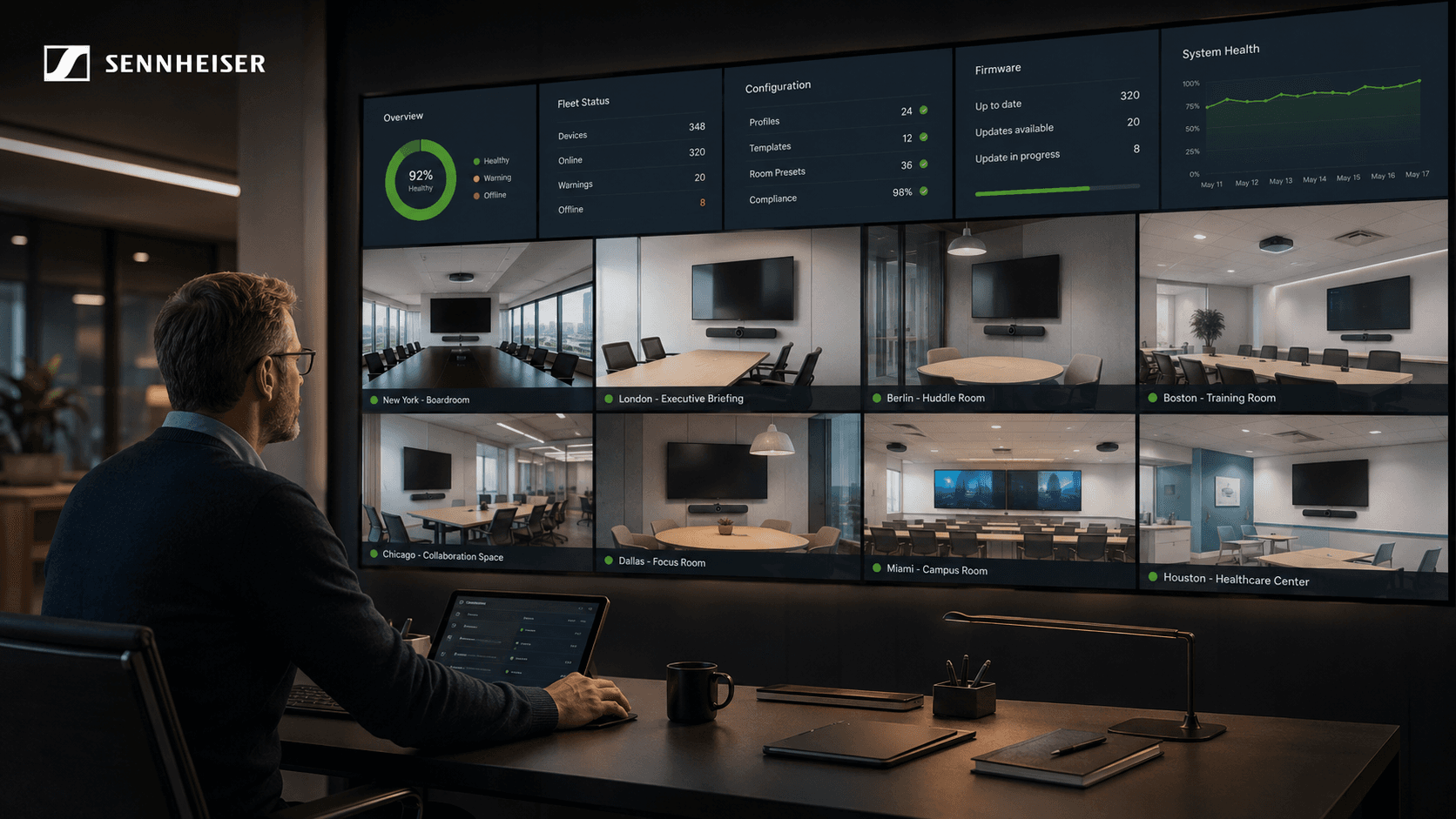
- Recent updates add TCC M Plus to TeamConnect Bar S and M for cloud monitoring to DeviceHub alongside TeamConnect Bar S and M for cloud monitoring, configuration and bulk firmware updates, but it remains a Sennheiser-only public beta.
- The best fit is a Q-SYS-standardized, multi-site estate. Mixed AV environments should grade every other Sennheiser connection separately rather than treating the partner list as one uniform ecosystem.
How Deep Is TeamConnect Ceiling M Plus Integration With Q-SYS?
It’s a native-style integration rather than a loose compatibility claim. In Q-SYS Designer 10.4, TCC M Plus sits in the inventory as a component, while PartnerLink maps audio streams and control data into the design. Q-SYS documents the workflow itself, which gives buyers stronger proof than a partner logo.
With Q-SYS, engineers can work with device status, serial and network information, PTPv2 state, PoE status, stream health, standby behavior, LED settings, beam angles, the priority zone and five exclusion zones. Audio controls include gain, mute, Intelligent Noise Control and TruVoiceLift. That is enough depth to make the microphone inspectable inside the room platform.
Q-SYS also states that no separate microphone plug-in or Dante configuration will be necessary, removing two common commissioning steps.
The first-run setup still needs Sennheiser’s Local Web UI. Installers create credentials, select PartnerLink Q-SYS mode and allow up to five minutes for the mode change. The microphone and Q-SYS Core also need to share a network, and Designer 10.4 or later is required.
After that, Configurator discovers the microphone, the engineer links its hostname to the component, and Q-SYS maps the audio and control blocks. So far though, there’s no “before-and-after” deployment study to reference. The workflow simplification is documented; the labor saving isn’t.
Key Takeaways
- PartnerLink delivers a genuinely deep Q-SYS connection, with documented configuration, audio and health data inside Designer.
- The technical simplification is well evidenced. The business outcome, including minutes saved or fewer support incidents, still needs customer data.
What Does Sennheiser DeviceHub Manage Across Multiple Sites?
DeviceHub gives AV and IT teams a cloud console for supported Sennheiser endpoints across locations. July 2026 documentation covers TeamConnect Bar S, TeamConnect Bar M and TCC M Plus, with monitoring, configuration, role-based access and firmware updates. Its limitation is clear: it doesn’t manage the whole room.
Administrators can organize hardware by location, building, floor and room, monitor health, open supported controls and update several eligible devices at once. A March update also added daily status-report emails for devices in error.
In Sennheiser’s February 2026 DeviceHub launch material, Sainte-Justine Hospital provides useful early evidence. AV Specialist Guillaume Amaurin described reusable onboarding, while IT Specialist Alain Lamontagne called the move from Control Cockpit a “major gain in both time and flexibility.” Still, those comments are vendor-published and unquantified.
On the security side, Sennheiser supports Microsoft Entra authentication, SSO, MFA, TLS 1.2+, and AES-256 encryption at rest. Identity data stays on EU Azure infrastructure, and meeting audio or video isn’t sent into DeviceHub, according to Sennheiser.
Notably, DeviceHub remains a public beta, is cloud-only, and excludes alliance products such as cameras and room controllers. Firmware can be updated to the latest release, including in bulk, but administrators can’t select an older version or downgrade. Strict change-control teams need a separate recovery plan.
DeviceBridge is expected in autumn 2026, initially bringing TCC 2 and TCC M into DeviceHub. That could strengthen the installed-estate story, but production behavior still needs proof.
Key Takeaways
- DeviceHub is a more credible fleet layer now that TCC M Plus support and fuller security documentation are in place.
- Its limits are Sennheiser-only coverage, beta maturity and restricted firmware recovery.
Learn more about how to manage and future-proof AV for your meeting spaces here.
How Deep Are Sennheiser’s Other AV Ecosystem Connections?
Sennheiser’s wider AV ecosystem has a lot of coverage, but depth varies. Q-SYS is the clearest native-style integration. Barco brings certification, Pleneo owns room orchestration, Crestron connects TeamConnect ceiling microphones into DM NAX, and MuxLab has validated compatibility with TeamConnect Bars. Buyers shouldn’t treat those relationships as equivalent.
The crucial test for buyers is what each partner can configure, monitor and update, plus who owns the first support ticket.
| Connection |
Depth |
Buyer gets |
Ownership |
| Barco ClickShare Hub |
Teams-certified bundle |
Hub Core + Bar S; Hub Pro + Bar M; approved USB connections |
Barco owns the room system; Sennheiser owns the bar |
| Pleneo Room Kits |
Room orchestration |
TCC M with RoomHub, Room OS, cameras, speakers and Pleneo Cloud |
Pleneo owns provisioning and management |
| Crestron DM NAX |
Network-audio integration |
TCC M and TCC M Plus are supported DM NAX partner products |
Crestron owns the audio architecture |
| MuxLab |
Validated compatibility |
TeamConnect Bars tested with models 500534 and 500829 |
Each vendor manages its hardware |
From a Microsoft Teams certification perspective, Barco’s current ClickShare Hub support pairs Hub Core with Bar S and Hub Pro with Bar M. Microsoft certification reduces compatibility uncertainty, but management stays split.
Pleneo goes deeper operationally: its February 2026 room kits put TCC M inside RoomHub, Room OS and Pleneo Cloud, with Pleneo owning deployment and room management.
Key Takeaways
- There are plenty of partners in the ecosystem, but buyers still need to ask who controls what once the systems are connected.
- Buyers should classify each connection by configuration depth, firmware path and support ownership before calling it native.
What’s Still Missing From Sennheiser’s Integration Ecosystem?
The biggest missing piece is consistency across platforms. Sennheiser now has a genuinely deep integration model with Q-SYS, but it hasn’t repeated that model elsewhere yet. Buyers still move between PartnerLink, Dante, control modules, certified room designs and validated compatibility depending on the architecture they choose.
Sennheiser designed PartnerLink as a framework for additional partner platforms, but its current documentation lists Q-SYS as the only supported platform. Crestron, Extron and other ecosystem relationships give buyers viable ways to use TeamConnect hardware, but none currently offers the same documented PartnerLink experience where TCC M Plus becomes an object inside the room-design platform.
There’s another issue above the room level. DeviceHub can centralize Sennheiser management, while Sennheiser also exposes a third-party device API for customers building their own monitoring workflows. It still doesn’t manage alliance hardware, however, so it can’t become the common lifecycle layer for microphones, cameras, controllers and room systems. Current firmware controls also allow updates only to the latest release, without selecting an earlier version or rolling back from DeviceHub.
Sennheiser has a convincing model here, but it hasn’t spread evenly across the ecosystem yet. The next big proof point would be PartnerLink-style integration with a second major platform, backed by a customer showing fewer commissioning headaches or less support effort.
Key Takeaways
- PartnerLink needs a second platform. Q-SYS proves the model, but broader adoption would make Sennheiser’s interoperability argument considerably stronger.
- Lifecycle management still splits. DeviceHub improves Sennheiser fleet management, but whole-room monitoring, firmware coordination and cross-vendor ownership remain outside its scope.
Which Buyers Benefit Most From Sennheiser’s Integration Strategy?
The strongest fit is a multi-site organization standardizing TCC M Plus with Q-SYS. Those buyers get a repeatable room design, deeper microphone control inside Q-SYS Designer and DeviceHub visibility across supported Sennheiser endpoints. Mixed estates still gain good audio and useful partner options, but several management and support layers remain separate.
Large Q-SYS customers should look first. PartnerLink removes the separate microphone plug-in, maps streams automatically and keeps useful controls in the room-design environment. The benefit grows when a standard room template is repeated across sites.
Heavily mixed control estates won’t receive the same PartnerLink depth everywhere. Interoperability can be solid while configuration and support remain split.
DeviceHub also deserves caution where change control is strict: it covers three supported Sennheiser device types, excludes third-party room products and can’t roll firmware back.
Ask these before approving a rollout:
- Is Q-SYS already the room standard?
- Will the same TeamConnect design be repeated across many rooms?
- Who owns firmware testing across Sennheiser, Q-SYS and the meeting platform?
- Who takes the first support ticket when the room fails?
Key Takeaways
- Multi-site organizations already standardized on Q-SYS are the clearest winners from Sennheiser’s current TeamConnect integration approach.
- Mixed-platform buyers should judge each partner connection separately and treat DeviceHub as Sennheiser fleet management, not whole-room management.
Is Sennheiser’s TeamConnect Ecosystem Strong Enough to Standardize On?
For Q-SYS-focused estates, yes, it’s definitely strong. PartnerLink changes the commissioning and control model around TCC M Plus, while DeviceHub adds a credible cloud fleet layer. Mixed control environments get a less complete story because PartnerLink currently supports Q-SYS only.
TCC M Plus already carries dynamic beamforming, exclusion zones, camera-tracking support and TruVoiceLift. PartnerLink makes those capabilities easier to operate inside Q-SYS Designer, while Q-SYS handles stream mapping without a separate microphone plug-in or separate Dante configuration.
The big story is operational: Sennheiser is linking business audio hardware to the tools used to deploy, check and support rooms after installation. The technical path is clear; the commercial outcome still needs quantified proof. The next test is whether PartnerLink expands and DeviceHub matures without recreating fragmented management.