Sanas Supervised AI presents a different answer to a familiar contact center question: what should happen to human agents as AI handles more customer conversations?
The answer is not necessarily replacement. Sanas instead proposes a supervisory model where a person monitors several live, AI-led calls and intervenes only when human judgment becomes necessary.
That matters because AI productivity claims often start with automation rates. Contact center leaders need a more demanding measure. They need to know whether an AI-led operating model can increase capacity without damaging customer experience, compliance, or employee accountability.
TL;DR
-
Sanas says one human supervisor can oversee up to four simultaneous AI-led customer calls.
-
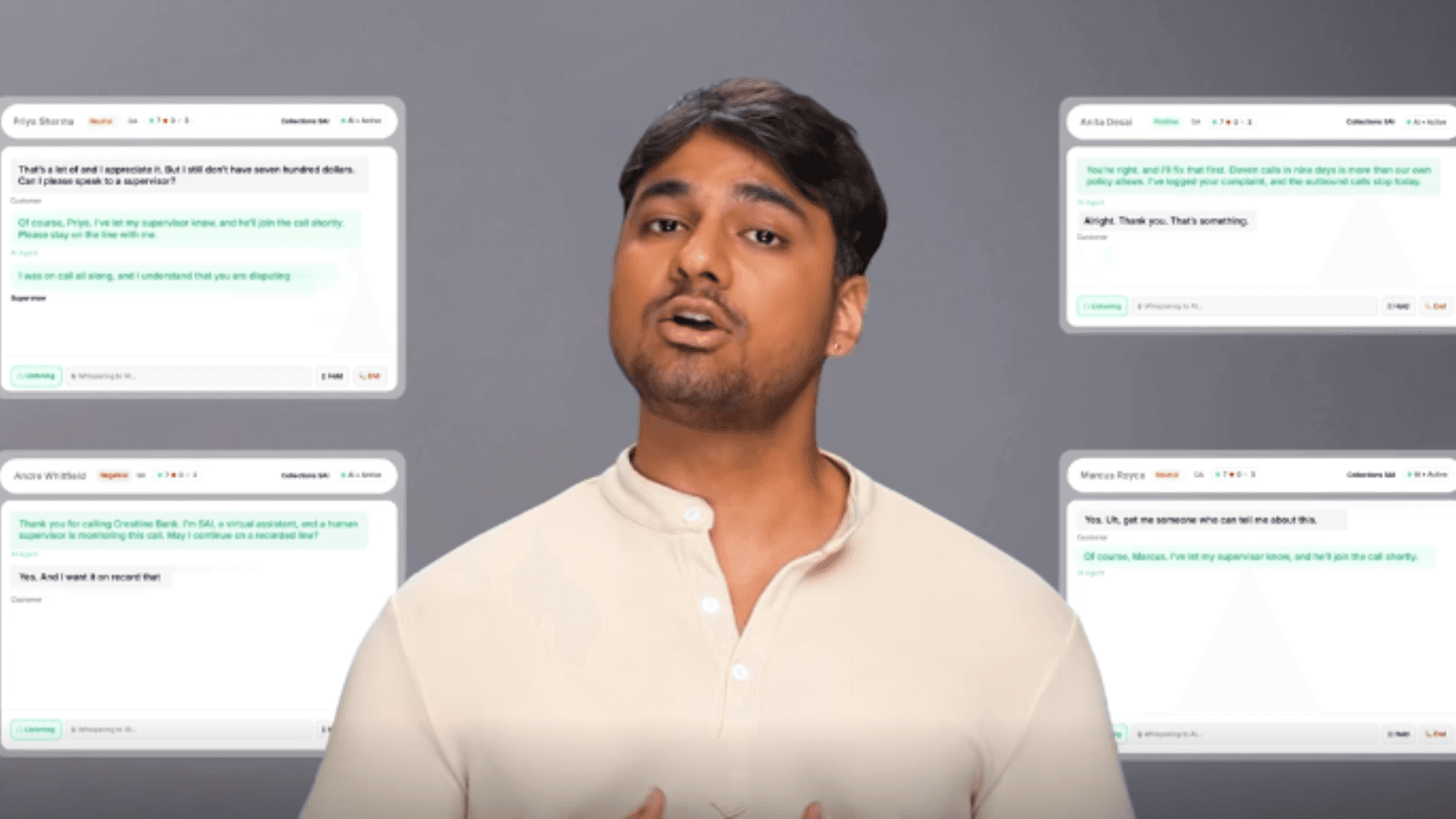
Supervisors can monitor live transcripts, guide the AI privately, take control mid-call, and hand work back without a separate transfer.
-
The model could improve productivity by directing people toward exceptions, but leaders must validate customer outcomes alongside cost and capacity.
-
Sanas has launched the platform by invitation, with broader availability planned for December 2026.
Can One Supervisor Improve Contact Center Productivity?
Potentially, but only if supervisors can manage several AI conversations without losing the ability to recognize and resolve the moments that need human judgment. Sanas says its platform enables one supervisor to oversee up to four live calls from a single console.
This is not traditional agent assist. In that model, one agent still leads one customer conversation while AI provides suggestions or automates individual tasks. It is also not a fully autonomous AI model, where a customer reaches a person only after the system fails.
Sanas positions Supervised AI between those two approaches. The AI conducts the interaction, while the supervisor watches live activity and receives alerts tied to declining sentiment, lower AI performance, a request for a human, or a compliance-related step.
The productivity proposition is clear. A contact center could assign human attention to the most consequential parts of several interactions, rather than require a person to conduct every routine step of every call.
However, the four-call ratio remains a vendor claim and a capacity target, not proof of a universal productivity gain. The right ratio will vary by call complexity, customer vulnerability, regulatory requirements, language needs, and the reliability of the AI system handling the conversation.
Why Does Context Matter When AI Needs Human Help?
Continuous context matters because a human supervisor can act before an AI interaction becomes a failed transfer. Sanas says its model allows a supervisor to listen in, privately guide the AI, take over directly, and return control to the AI within the same customer conversation.
That distinction addresses one of the most frustrating features of conventional escalations: customers often need to repeat information after moving between systems or agents. A supervisor who has followed the conversation should already understand the issue, the customer’s history in the call, and the AI’s actions so far.
In an interview with CX Today at CCW Nashville, Saurabh Sodani, Chief of Staff at Sanas and Product Lead for Supervised AI, said the customer journey should remain consistent even as the provider changes how it delivers support.
Sodani said:
“The customer journey does not change from that point of view. It is how, from the provider point of view, we’re making life easy or making it more flexible.”
That is the operational promise. AI can handle routine work at scale, while human expertise stays close enough to prevent routine work from turning into an avoidable customer failure.
What Is Supervised AI?
Supervised AI is a contact center operating model where an AI agent leads a customer interaction while a human monitors the conversation in real time. The human can intervene, take control, or return work to the AI without moving the customer into a separate interaction.
What Does Supervised AI Change About the Agent Role?
Supervised AI changes the agent role from handling every interaction end to end to supervising exceptions, applying judgment, and managing AI performance. This could create a more senior frontline role, but it also raises the training bar for contact center teams.
Supervisors need more than product knowledge and standard customer service skills. They need to interpret alerts, identify when an AI response is unsafe or unhelpful, manage multiple interaction streams, and intervene decisively without disrupting the customer experience.
Discussing the model with CX Today, Sodani described the aim as augmenting agents rather than removing them from the process.
Sodani said:
“It enables a human to become a superhuman by being able to manage multiple conversations at the same time. How can we use technology to make an agent a super-agent is what it’s all about.”
That vision carries a practical caveat. Organizations cannot assume that a strong individual agent will automatically become an effective AI supervisor. Leaders will need to redesign coaching, quality assurance, performance management, and escalation procedures around the new role.
They will also need to avoid treating “more conversations per person” as the only measure of success. A supervisor who monitors four calls but misses an emerging complaint, a vulnerable customer signal, or a compliance issue has not produced a meaningful productivity gain.
Can Contact Centers Scale AI Without Losing Accountability?
Contact centers can scale AI without losing accountability only if they keep a clearly empowered human close to consequential decisions. Sanas says every AI recommendation in Supervised AI cites its source, while every AI and human action is recorded in an audit trail.
Those features matter most in industries where customer conversations can involve financial decisions, healthcare information, complaints, eligibility, or sensitive personal circumstances. The ability to review what the AI said, what evidence it used, and when a person intervened can support quality assurance and post-incident investigation.
Sanas also says that customers are told they are speaking with AI and that a human supervisor is available. That transparency supports trust, particularly as customer expectations and AI governance requirements become more demanding.
The company’s own launch material cites a 2025 Cisco survey of 7,950 business and technical decision-makers across 30 countries. It found that respondents expected 68% of customer experience interactions with technology partners to be handled by agentic AI within three years, while 89% still emphasized the importance of combining human connection with AI efficiency.
That research does not validate Sanas’s model specifically. It does, however, illustrate why a human-supervised approach could appeal to organizations that want more automation without accepting a fully hands-off model.
Which Metrics Should Leaders Use to Measure Human-AI Productivity?
Leaders should measure human-AI productivity through customer outcomes, risk controls, and workforce performance, not automation volume alone. The number of conversations supervised per person can indicate capacity, but it cannot show whether the operating model is working well.
Contact center teams should track:
-
Supervisor-to-conversation ratio: How many active AI interactions each supervisor can manage safely by queue type and complexity.
-
Intervention rate and reason: How often supervisors step in, and whether the trigger is sentiment, compliance, customer request, AI uncertainty, or another issue.
-
First-contact resolution: Whether the model resolves the customer’s issue without additional contact.
-
Repeat-contact and transfer rates: Whether continuous supervision reduces the need for customers to repeat their problem.
-
CSAT, NPS, and sentiment: Whether efficiency gains hold without degrading customer confidence or satisfaction.
-
Quality and compliance outcomes: Whether human oversight catches errors early enough to prevent avoidable harm.
-
Employee experience: Whether supervisors can manage the cognitive load of concurrent calls over time.
Sodani told CX Today that Sanas views customer experience measures as central to the value proposition, alongside operational capacity.
Sodani said:
“For us, if one human is able to manage four calls, that is what success is. The cost of operations significantly reduces, and from a customer experience point of view, we ensure that NPS or CSAT does not degrade while deploying AI at scale.”
That is the right test, although it remains one that enterprises must validate in their own environments. A lower cost per interaction has limited value if it produces more complaints, repeat calls, compliance reviews, or employee burnout.
Will Supervised AI Prove Better Than Full Automation?
Supervised AI could offer a more practical route to scale than either one-to-one agent assist or fully autonomous customer service. It keeps AI at the center of routine execution while reserving human attention for judgment, exceptions, and accountability.
Sanas has delivered a concrete version of that idea with a platform that lets supervisors govern up to four AI-led conversations. The approach will appeal to enterprises that see value in automation but remain unwilling to let an AI agent operate alone when the customer conversation turns complex.
The next challenge is operational proof. Sanas must show that the model sustains customer satisfaction, improves resolution quality, protects compliance, and gives employees a manageable new role. If it does, the contact center agent may not disappear in the age of AI. Their work may simply become more valuable.
Frequently Asked Questions
What is Sanas Supervised AI?
Sanas Supervised AI is a customer service model that allows a human supervisor to oversee AI-led customer conversations in real time. Supervisors can monitor calls, receive alerts, privately guide the AI, take over when required, and return the conversation to AI without making the customer start again.
How many AI customer calls can one Sanas supervisor oversee?
Sanas says its Supervised AI platform is designed for one human supervisor to oversee up to four simultaneous AI-led customer calls. Organizations should validate the appropriate ratio based on call complexity, risk, and the needs of their customers.
How is Supervised AI different from agent assist?
Agent assist supports a human agent who remains responsible for one customer interaction. Supervised AI allows AI to lead several conversations while a human monitors them and intervenes when judgment, empathy, compliance expertise, or decision-making is required.
Can a supervisor take over a Sanas AI call?
Yes. Sanas says supervisors can listen to a live interaction, privately guide the AI, take control of the conversation, and hand it back to AI once the issue is resolved. The customer remains within the same conversation throughout the process.
When will Sanas Supervised AI be widely available?
Sanas launched Supervised AI by invitation in October 2026. The company says it plans broader availability in December 2026.