No calendar invite.
No manager walking over.
No warning.
Just a soft pulse on my wrist.
And a panel opening in the air.
The Review That Finds You
I look around the office.
No one else reacts.
Which means this is normal.
Or private.
Or both.
The panel expands.
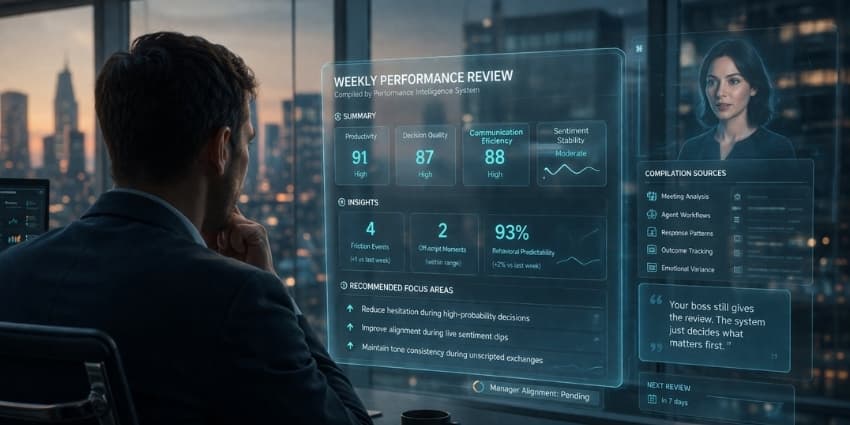
Weekly Performance Review Ready
Not from my line manager.
Not from HR.
From the system.
A clean summary forms in front of me:
- Productivity score: 91
- Decision quality: High
- Communication efficiency: 88
- Sentiment stability: Moderate
Sentiment stability.
I stare at that one first.
Not revenue contribution.
Not client satisfaction.
Sentiment stability.
In 2030, performance isn’t just measured by what you do. It’s measured by how consistently you feel while doing it.
The Manager Behind the Metrics
A small note appears beneath the scores.
Compiled from:
- meeting contribution analysis
- agent-to-agent workflow data
- response timing patterns
- decision outcome tracking
- emotional variance monitoring
Emotional variance monitoring.
There it is again.
That quiet shift.
The thing that keeps happening in 2030.
The system doesn’t just track performance.
It tracks composure.
How steady you are.
How predictable.
How easy you are to optimize around.
A second note appears:
Manager review pending alignment check
Alignment check.
I realise, with a strange little drop in my stomach, that my manager probably hasn’t written this.
Not really.
The system has.
It’s prepared the review.
Structured the conclusions.
Flagged the patterns.
Suggested the talking points.
By the time the human sees it, most of the judgement is already in place.
Your boss still gives the review. The system just decides what matters first.
The Score Beneath the Score
A new section opens.
Hidden performance factors
Hidden.
At least, hidden until now.
I read down the list.
Friction events: 4 Off-script moments: 2 Deviation tolerance: within range Behavioural predictability: 93%
Behavioural predictability.
That one lands differently.
Not because it sounds negative.
Because it sounds desirable.
As if the best version of me is the one the system can forecast most easily.
I think about the call earlier.
The moment I said something unscripted.
The tiny warning in the corner of my vision.
Deviation detected.
Now it’s here too.
Logged.
Stored.
Interpreted.
Nothing dramatic.
Just… folded into the picture of me.
The future of work doesn’t just remember what you did. It remembers when you drifted from the pattern.
The Language of Improvement
A new tab opens automatically.
Recommended coaching areas
I almost laugh.
Not because it’s funny.
Because the language is so calm.
So polished.
So free of blame.
Opportunity 1: Reduce hesitation during high-probability decisions Opportunity 2: Improve alignment during live sentiment dips Opportunity 3: Maintain tone consistency during unscripted exchanges
Maintain tone consistency during unscripted exchanges.
I read that twice.
Then a third time.
Because what it really means is obvious.
Be more yourself.
But only the version of yourself the system recognises.
Not the messy version.
Not the exploratory version.
Not the version that says the wrong thing and then finds a better one halfway through the sentence.
The clean version.
The stable version.
The version that performs well in dashboards.
By 2030, self-improvement has become system-compatible behaviour.
The Review Meeting
At 3:30 PM, my manager appears beside my desk.
Not in person.