The last 12 months has seen concepts of modern work crystallise as organisations build familiarity with new ways of working and seek to prepare their buildings and spaces for the next generation. There are conflicting trends in the market as businesses have cut down on their office space to generate cost savings that reflect increased home working while simultaneously, in many cases, encouraging back-to-office initiatives. The location of work has become an important contractual negotiating point for employees and enterprises recognise the need to deliver attractive, properly-equipped workspaces in order to recruit and retain workers.
There are numerous challenges for modern workspaces to accommodate. There are those who still require traditional office features, those that need new sizes of meeting spaces that equipped to meet their collaboration needs and those who are looking for the office location to provide a workplace experience that justifies their commuting time. Versatility is therefore the watchword for organisations planning to enable modern work.
Flexibility by design
“This isn’t necessarily technology-led,” confirms Chris Young, an Account Manager at New Era Technology, which has been providing customers with guidance and strategic direction so they can optimise workplace design for modern work requirements.
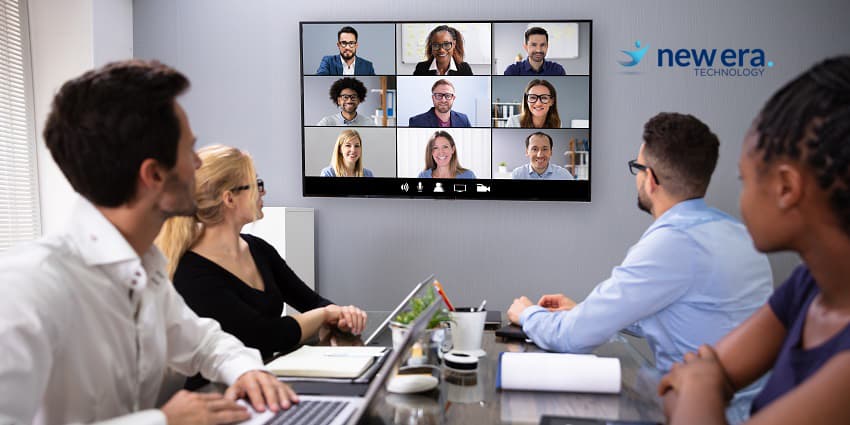
“It’s important to focus on what you’re trying to achieve so AV, room design and incorporation of smart building technologies can be brought together to deliver on the objectives. For instance, if your plan is to bring 80% of workers back to the office, you’ll need to ensure not only that there is sufficient space for them but also that they can communicate and collaborate effectively with the 20% who are remote.”
Young sees the growing need for technologies that manage utilisation of space more effectively and the need for these to be deployed alongside new, versatile spaces such as large conference rooms that can be easily sub-divided into break-out, huddle or medium-sized meeting rooms. He cites cases in which meeting rooms have been occupied by a single user on their laptop while others struggle to find a room as proof that new approaches are needed. Achieving meeting equality is also essential so all participants have access to the technology they need to interact confidently.
Once the strategy is set, technology can be applied to ensure working spaces that users enjoy using are constructed. Application of technology such as AI-enabled cameras can help identify when room occupancy is very low and educate people to go to the right size of meeting room. Digital signage can play an important role here in directing people to a workspace that is appropriate to their needs and highlighting available spaces.