"This Microsoft Teams update is not a feature release; it is a referendum on trust in hybrid work."
This verdict comes from Dr. Kate Barker, a global authority on the future of work and Chief Futurist at NEOM, concerning the latest major update from Microsoft Teams. For the better part of the post-pandemic era, the "where" of work has tended to be defined by a binary status light: green for available, red for busy, grey for offline. The physical reality behind that green dot, whether a bustling headquarters, a beach in Bali, or a kitchen table in the suburbs, remained a matter of "private obscurity." That age is drawing to a close.
This month, Microsoft will enable its Smart Location Detection feature for Teams, a sophisticated update that utilizes the local network heuristics of an employee’s device to broadcast their precise physical context to their organization. First announced in October to a divisive response, it works by analyzing the Basic Service Set Identifiers (BSSIDs) of Wi-Fi access points and triangulating them against corporate floor plans; a laptop metamorphoses into a beacon.
For the C-Suite, this technological leap arguably addresses the single most pervasive friction point of the 2020s: the futility of the commute. Leaders, managers, and workers have all experienced some absurdities of the modern office, where some employees might brave an hour of traffic only to sit in a soundproof booth and attend video calls with colleagues who have stayed home. This is what Dr. Barker termed the "coordination tax" to UC Today:
"Hybrid work has introduced what I describe as a coordination tax: the hidden cognitive and logistical friction of commuting to an office only to remain digitally isolated on video calls. I am already seeing organizations pilot similar location and presence signals across workforces of 50,000+ employees as they attempt to reduce this friction."
The promise is seductive. If the software knows that the marketing team is gathering on the fourth floor of the New York office, it can nudge the rest of the department to commute in. It shifts the paradigm from "return to office" mandates to "return to purpose."
However, as the technological capability to track workers becomes granular, the line between helpful coordination and invasive surveillance blurs. We are transitioning from a phase of trust-based flexibility to one of data-verified presence, a shift that might erode the coordination tax but also carries profound legal, cultural, and operational risks.
- IT Leadership Interview: Why Enterprise AI Fails and How to Scale With HCLSoftware
- IT Leadership Interview: Will AI Revolutionize the Legal Sector?
The Case for Efficiency With Microsoft Teams' Smart Location Detection: The Software-Defined Office
For the Chief Financial Officer and the Chief Operating Officer, the Smart Location update could, in theory, sound the death knell for legacy infrastructure. For a decade, facilities management has relied on a cumbersome patchwork of hardware to understand building utilization. They installed heat sensors under desks, motion detectors in ceilings, and badge-swipe turnstiles at entry points. These systems were capital-intensive, maintenance-heavy, and often siloed from the actual workflow of the employees.
Arguably, Microsoft has effectively democratized the sensor. By converting every laptop and smartphone into a "software-defined sensor," enterprises can now collect rich, real-time data on space utilization without deploying a single new piece of hardware.
"The promise of software-defined sensors, using laptops as contextual indicators rather than relying on costly IoT infrastructure, materially changes the business case for workplace optimization," explained Barker.
Framed in this perspective, it signals the advent of "Intelligent Real Estate." In this model, the building becomes a responsive entity. If the Teams data indicates that the third floor is empty on Fridays, the building management system can automatically adjust the HVAC and reduce lighting, saving on high operational costs. If the data suggests that huddle rooms are consistently overbooked while boardrooms sit empty, corporate real estate leaders can redesign the footprint based on empirical evidence rather than anecdotal guesswork.
Furthermore, there is a distinct compliance advantage for distributed businesses. As workforces dispersed during the hybrid work revolution at the beginning of the decade, tax and labor liabilities multiplied. An employee quietly relocating to a different state or country can trigger a cascade of legal headaches.
Peter Cassat, a partner at CM Law specialising in workers' rights and technology and former General Counsel at Cox Automotive, highlighted the pragmatic necessity of this visibility from a corporate governance perspective to UC Today:
"In some cases, an employer has a need, if not a right, to know from where the employee is performing services. For example, if I find out that the person who said that they're working in Illinois, where our company is based, is actually working 350 days out of Wyoming, where we are not qualified to do business, I have a problem."
For the operational leaders of the Global 500, obscurity is a liability. Visibility is an asset. The "coordination tax" is not just a burden on employee morale but a drag on the bottom line. By leveraging semantic presence, which involves knowing not only that an employee is working but also where and how, organizations can theoretically orchestrate a more synchronized, efficient, and compliant workforce.
The Case for Privacy: The Threat of Surveillance Capitalism & Trust Underpinning Smart Location Detection
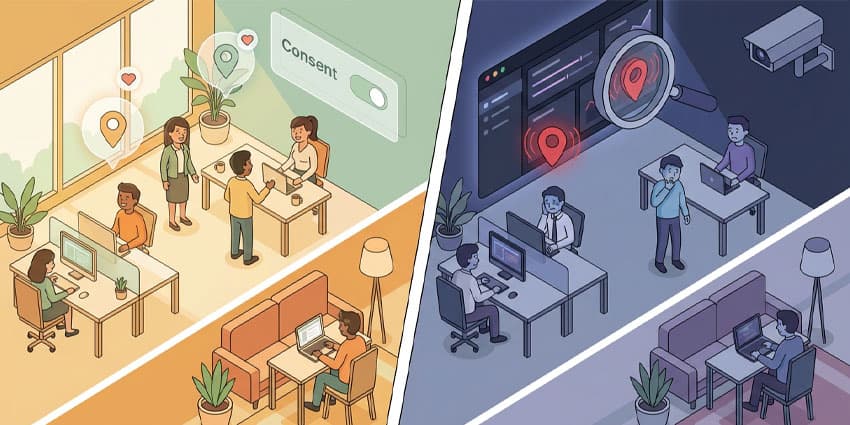
However, for all the potential operational benefits, the calculus is far more volatile for security and HR leaders. Efficiency has a shadow. When an organization transitions from monitoring "status" to monitoring "context," it fundamentally alters the psychological contract between employer and employee.
The immediate concern is the weaponization of data. In the current climate of aggressive Return-to-Office (RTO) mandates, a new phenomenon has emerged of "coffee badging." This is the practice where employees badge into the office building to register their attendance, grab a coffee, and then leave shortly after to work from home. While operational leaders see this as non-compliance, employees see it as a rational response to arbitrary policies.
The fear is that Smart Location Detection will be used not to facilitate collaboration, but to conduct forensic audits of dwell time.
"I think there is a lot of potential for misuse of the information," warned Cassat. He drew a direct line between these new digital capabilities and the historical friction over time-tracking. "This is very problematic for employers that are trying to implement hybrid policies, where you have to be in the office three days a week or two days a week. And so a lot of people feel like, 'Well, I was there for 15 minutes. Does that count?'"