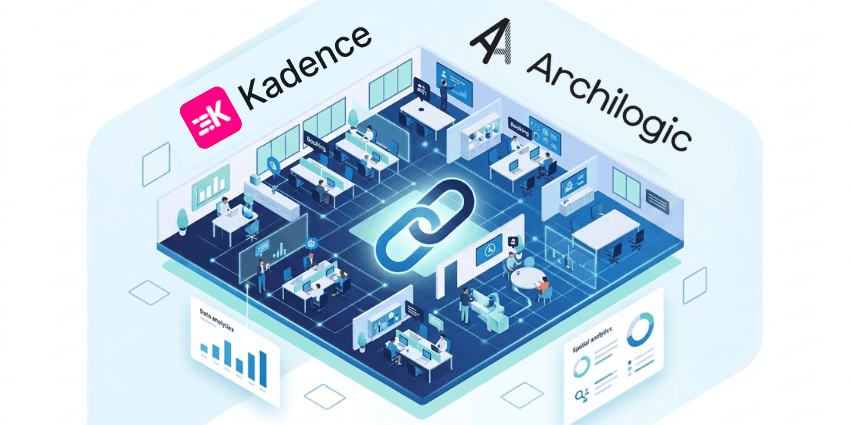
Kadence's new partnership with Archilogic sparks new questions about the future of office optimization. The integration represents the merging of spatial truth with real-time workplace behavior, and what enterprise buyers should look for as they search for a workplace management platform.
The move matters because modern workplace operations now depend on more than desk booking, room scheduling, or static floor plans. Enterprises need accurate spatial data, real-time behavioral signals, and AI-ready workflows that reflect how employees actually use the office.
Archilogic is essentially a mapping tool: it turns a building's floor plans into accurate, digital 3D models that show exactly where every room, desk, and wall actually is. Kadence is the day-to-day management system: it's what employees use to book a desk, and what workplace teams use to see who's actually coming in, plan office layouts, and decide whether to add or cut space.
TL;DR - Why This Partnership Matters
- Spatial Foundation: Archilogic gives the Kadence platform a structured, API-driven spatial data layer for more accurate workplace planning.
- Operational Layer: Kadence connects workplace behavior, booking intent, and execution through WorkOps and SpaceOps.
- AI Readiness: Better spatial data improves the quality of AI-assisted recommendations across the intelligent workplace.
- Enterprise Value: The partnership helps teams move beyond static floor plans and spreadsheet-led space management.
- Buyer Takeaway: The real test is whether the integration reduces handoffs between planning, booking, analytics, and execution.
This breakdown explores where the Kadence-Archilogic integration runs deep, where buyers should probe further, and how the partnership fits into a wider market shift toward data-accurate, AI-ready workplace operations. As CBRE's 2026 workplace research shows, data quality remains one of the biggest barriers to workplace AI adoption.
Related Articles:
Eliminating The Data To Action Gap
Enterprises already have workplace data. The challenge is turning badge reports, booking records, occupancy signals, HR feeds, and floor plans into decisions leaders can explain and act on - not just another dashboard.
Most enterprises do not lack workplace data. They have badge reports, booking records, HR feeds, lease information, utilization dashboards, and floor plans. The problem starts when leaders try to turn those inputs into decisions.
A badge swipe can show that someone entered the building. A booking record can show that someone intended to use a desk or room. An occupancy feed can show that a space saw activity. None of those signals, on its own, explains whether a floor should shrink, a team should move, or a neighborhood design supports collaboration.
CBRE's 2026 workplace research reinforces the urgency. In its article, Data at the Heart of Hybrid: Leveraging AI & Tech to Optimize the Workplace, the property giant found that the top real estate technology strategy goals include portfolio optimization at 80%, improving space data accuracy at 70%, and improving workplace experience at 61%.
Why doesn't more workplace data automatically lead to better decisions?
Workplace data typically arrives from disconnected sources - badge systems, booking platforms, sensors, HR systems - each capturing a different slice of activity. Without a system that reconciles those slices against an accurate spatial model, workplace teams are left interpreting fragments manually, usually in spreadsheets, rather than working from a single trusted view of the portfolio.
In Kadence's announcement of the Archilogic partnership, Dan Bladen, CEO and Co-Founder at Kadence, said:
"Archilogic customers gain an operating layer that helps teams actually run the workplace day-to-day. Kadence customers gain a richer spatial foundation that makes SpaceOps faster and more precise. It's a true 'better together' partnership"
The partnership tries to connect both sides of the workplace equation, consolidating their prowess to upgrade the offering to enterprise buyers.
From Static Floor Plans To Living Ecosystems
Static floor plans cannot keep pace with hybrid work. Enterprises need floor plans, booking workflows, and utilization signals that stay aligned automatically as the workplace changes.
Traditional workplace systems often treat floor plans like records. Teams upload them, reference them, and update them when someone remembers. That model no longer fits hybrid work.
Employees move between home, office, client sites, and flexible workspaces. Teams reorganize quickly. Attendance patterns shift across days, seasons, and business cycles. Static floor plans cannot keep up with that level of movement.
Archilogic's role is important because it creates a structured, API-driven spatial data layer. The Kadence platform can then connect that spatial foundation to live workflows such as booking, move planning, neighborhood management, and office reconfiguration - shifting the workplace from a static record to a living, intelligent workplace.
What data sources matter most for hybrid workplace planning?
UC Today's workplace analytics coverage found that the most useful combination for hybrid workplace planning is booking data, badge or access data, occupancy data, service data, and collaboration data - because each source corrects the others. A room can look busy in booking data and still be failing in practice if attendance and behavior tell a different story.
That is where deeper integration matters. If spatial data and operational data sit in separate systems, workplace leaders still need spreadsheets and manual reconciliation. If they connect, teams can understand the relationship between layout, attendance, booking intent, and real use.
Integration Depth: Where Kadence and Archilogic Fit
| Ecosystem Layer |
What It Adds |
Buyer Value |
| Archilogic |
Structured floor plans and spatial truth |
More accurate planning inputs |
| Kadence WorkOps |
Booking, attendance, and workplace activity |
Better visibility into real behavior |
| Kadence SpaceOps |
Scenario planning, stack planning, and move execution |
Faster, more defensible workplace change |
The biggest test for buyers is not whether the integration looks strong in a press release. It is whether it reduces operational handoffs. A shallow integration might display a floor plan. A deeper ecosystem connection keeps spatial data current, reflects changes in booking workflows, and gives planning tools enough context to recommend better actions.
From Space Management To Experience Engineering
Workplace management now extends beyond allocation. Enterprises need systems that connect employee experience, collaboration, and space accuracy to operational decision-making.
Space management used to focus on allocation - who sits where, which rooms exist, how much office space each department occupies. That view now feels too narrow.
Enterprise workplace leaders must also consider experience, productivity, collaboration, and trust. If an employee books a desk that does not exist, enters an overcrowded floor, or cannot find colleagues, the workplace experience suffers. If a manager cannot explain why a team moved, confidence drops.
How is the workplace experience application category evolving?
Gartner's Workplace Experience Applications market definition shows how the category has widened. Gartner says these applications help employees plan office days, book desks and collaborative spaces, navigate the workplace, and find colleagues, and points to AI, space management, reservations, integrations, wayfinding, and work planning as common capabilities.
That market view supports the Kadence and Archilogic logic. The modern workplace stack needs to connect employee experience with operational intelligence. The Kadence platform's SpaceOps positioning aims to connect planning, scheduling, and execution in one system, while WorkOps handles day-to-day operations such as desk booking, room booking, visitor management, and live occupancy intelligence. Archilogic strengthens the foundation under that system, since better spatial data makes planning more accurate.
Buyer Evaluation Checklist
- Does the platform connect floor plans with live booking and occupancy data?
- Can workplace teams model scenarios without exporting to spreadsheets?
- Can approved changes move into execution without manual rework?
- Can leaders explain why a space decision was made?
- Can the system improve both real estate efficiency and employee experience?
In the partnership announcement, Dominique Burgauer, CEO at Archilogic, explained:
"Spatial data is the missing piece for applying enterprise AI strategies to the physical world. Archilogic fixes that, and by partnering with Kadence, we're extending that foundation directly into daily operations, turning spatial intelligence into measurable business outcomes"
That theory captures the partnership's strategic value. Spatial intelligence only becomes useful when it reaches daily decisions - not when it sits in a separate system from the tools employees actually use.
UC Awards 2026 Categories Announced
UC Today has announced all 25 categories for the UC Awards 2026, recognizing excellence across workplace technology, collaboration, CX, AI, and employee experience.
Explore the full UC Awards 2026 category list
Measuring ROI Beyond Badge Data
Badge data can show presence, but it cannot show whether a workplace works. ROI requires richer signals across space use, employee behavior, layout, and business outcomes.
Badge data can show presence. It cannot show whether the workplace works. A building may look underused on average, but still experience peak-day congestion. A room may look busy in booking data, but suffer from no-shows or poor meeting experiences. That distinction matters as organizations rethink their real estate footprints.
JLL's Global Future of Work Survey found that 65% of corporate real estate decision-makers expect their overall CRE budget to increase by 2030, and more than 60% expect workplace utilization to increase over the next five years. This means workplace leaders will face more pressure to justify space decisions, not less.
What does this look like in practice?
The Kadence platform has a useful proof point in Karger, a medical and scientific publishing company in Switzerland. According to Kadence's Karger case study, the organization supported more than 200 hybrid employees, used workplace analytics to identify occupancy of 30% to 40%, downsized to 1.5 floors, and achieved an 80% reduction in real estate footprint.
Case Study Proof Point
- Karger supported more than 200 hybrid employees with the Kadence platform.
- Workplace analytics identified occupancy of 30% to 40%.
- Karger downsized to 1.5 floors.
- The company achieved an 80% reduction in real estate footprint without compromising productivity.
Adrian Harper, Head of Digital Landscape at Karger, said:
"Kadence gave us that confidence. On a regular basis, we know how many people are coming into the building, and therefore we are not going to be in a position where people come into the office and have no space to work."
That quote highlights a practical point. ROI does not come only from cutting floors - it comes from knowing when a cut will not damage the employee experience. The Kadence and Archilogic partnership could make that decision process more reliable for larger enterprises, helping teams understand not only how much space they use, but how layout and configuration influence the value of that space.
Final Takeaway
The Kadence platform's partnership with Archilogic is not just another integration story. It reflects a broader shift in space management, where enterprise buyers want systems that connect spatial accuracy, behavioral data, AI planning, and operational execution.
But the critical buyer question is not whether the partnership adds another data source. It is whether the combined ecosystem helps workplace teams make faster, clearer, and more defensible decisions about how work happens in the intelligent workplace.
FAQs
What is the Kadence platform?
The Kadence platform helps enterprises coordinate workplace operations, including desk booking, room booking, workplace analytics, space management, and employee coordination across hybrid offices.
What is the Kadence and Archilogic partnership?
The Kadence and Archilogic partnership connects Archilogic's spatial data infrastructure with the Kadence platform's operations and SpaceOps. The goal is to help enterprises link accurate floor plans, workplace behavior, and operational workflows.
Why does spatial data matter in space management?
Spatial data gives workplace teams a structured and accurate view of buildings, floors, rooms, desks, and layouts. This helps organizations make better decisions about booking, planning, moves, consolidation, and employee experience.
How does SpaceOps fit into the partnership?
SpaceOps helps workplace teams plan, model, schedule, and execute space changes. Archilogic can strengthen the spatial foundation that SpaceOps uses to support more precise planning and more reliable execution.
How can this partnership support workplace ROI?
The partnership can support ROI by helping enterprises understand how space is used, model future scenarios, reduce manual planning, improve data accuracy, and make more defensible real estate decisions.