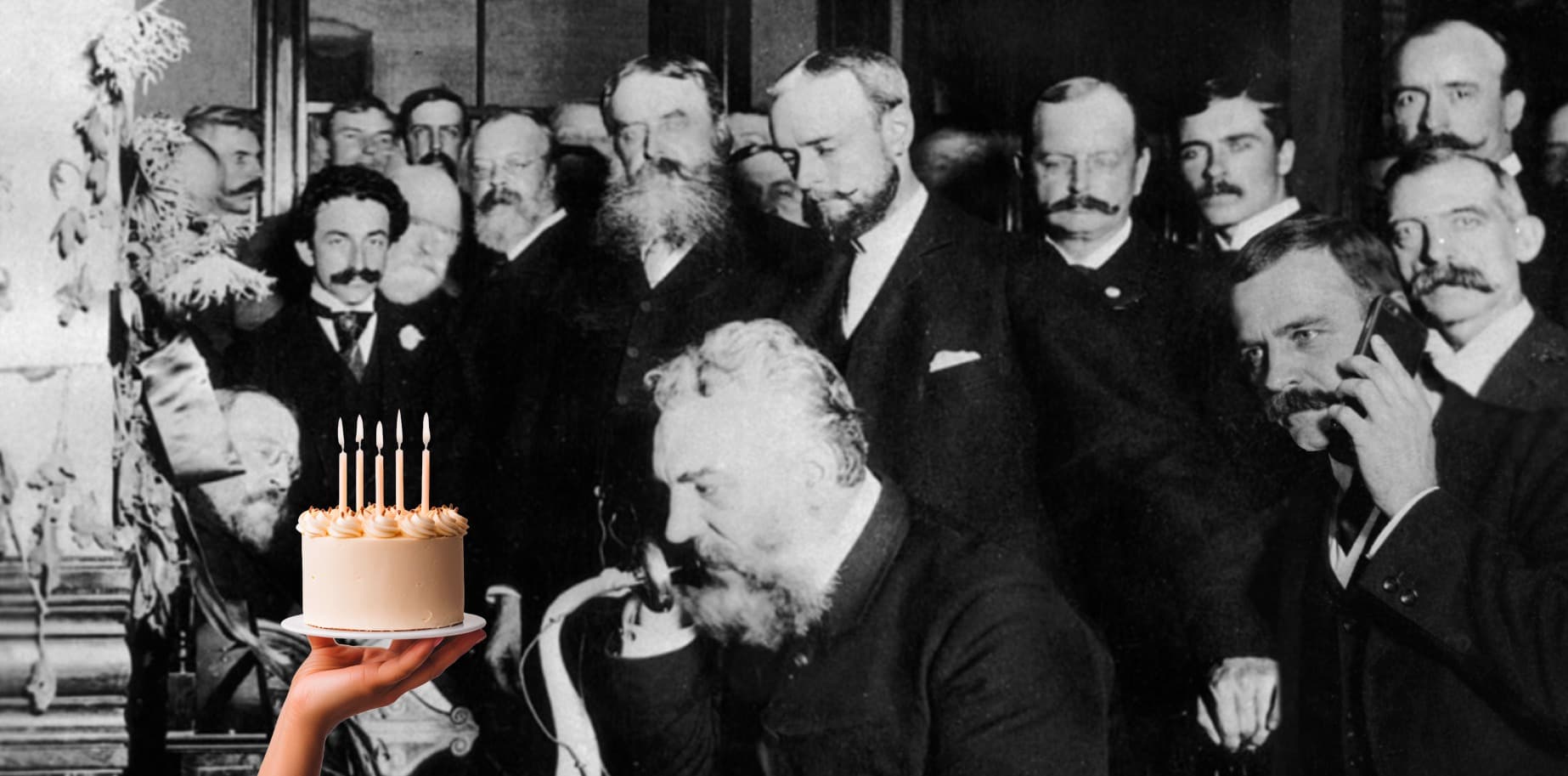
On the 10th of March 1876, Alexander Graham Bell made history with the first successful telephone call, reportedly saying:
“Mr. Watson, come here, I want to see you.”
While simple by modern standards, that moment marked the birth of remote voice communication and ultimately the beginning of a technological journey that would reshape how businesses collaborate.
Nearly 150 years later, the concept that grew from Bell’s invention has evolved into Unified Communications (UC) - a category of enterprise technology that integrates voice, messaging, video conferencing, presence, and collaboration tools into a single platform. These technologies allow employees to communicate seamlessly across devices, locations, and applications, forming the backbone of modern hybrid work environments.
The evolution of Unified Communications reflects broader shifts in enterprise IT: from hardware-based telephony systems to cloud platforms, and now toward AI-powered collaboration experiences. Each era introduced innovations that improved reliability, scalability, and productivity for organisations.
Understanding this timeline is more than a history lesson. It highlights how communication technologies have continually adapted to changing work models and why the next wave of innovation is already underway.
1876: The First Telephone Call and the Birth of Remote Voice
Unified Communications began with Alexander Graham Bell demonstrating the first working telephone in 1876. The invention allowed people to transmit voice over electrical signals through wires, fundamentally changing communication.
The telephone quickly became a transformative tool for businesses. Organisations could communicate instantly with partners, suppliers, and customers without relying on physical mail or telegraphs. This accelerated decision-making and enabled the early foundations of remote collaboration.
In the early decades of telephony, communication infrastructure was largely centralized and manually operated. Switchboard operators physically connected calls between parties, and companies often relied on local exchanges for connectivity.
While primitive compared to modern collaboration tools, these early telephone systems laid the groundwork for enterprise communications.
The 20th Century: PBX, Enterprise Telephony, and Digital Switching
As businesses expanded throughout the 20th century, so did their communication needs. This demand led to the development of Private Branch Exchange (PBX) systems, which allowed organisations to manage internal and external phone calls within their own networks.
PBX systems became the cornerstone of enterprise telephony from the mid-20th century onward. Instead of relying entirely on public telephone exchanges, companies could route calls internally, assign extensions to employees, and manage call flows more efficiently.
These systems introduced several critical capabilities:
- Internal extension dialing
- Call routing and transfer
- Voicemail systems
- Call queues and operator management
Digital switching technologies emerged in the 1980s and 1990s, replacing analog systems and dramatically improving reliability and call quality. Digital infrastructure also allowed businesses to begin integrating communication services with early computing systems.
Although still primarily voice-centric, this era represented an important milestone in the evolution of Unified Communications: enterprises gained control over their communication infrastructure, enabling more sophisticated call management and collaboration capabilities.
The VoIP Era: Convergence of Voice and Data
The next major transformation arrived in the late 1990s and early 2000s with the rise of Voice over Internet Protocol (VoIP) technology. VoIP allowed voice communications to travel across IP networks rather than traditional telephone circuits. This technical shift had massive implications for enterprise IT.
For the first time, voice and data networks could converge onto a single infrastructure. Instead of maintaining separate systems for telephony and IT networking, organisations could route voice calls through the same internet-based systems used for email and applications.
This convergence enabled several major innovations:
- Softphones replacing traditional desk phones
- Integration between telephony and business applications
- Video conferencing and instant messaging platforms
- Early unified messaging systems
During this period, vendors began introducing platforms designed specifically to combine multiple communication channels. These solutions laid the foundation for modern collaboration ecosystems.
Products like Microsoft’s enterprise communications platforms and emerging conferencing solutions began integrating messaging, voice, and presence into single environments - an early step toward the Unified Communications platforms that would later power services such as Microsoft Teams and enterprise collaboration suites.
The Cloud UCaaS Revolution
While VoIP unified networks, the next leap forward unified deployment models. Throughout the 2010s, enterprises began shifting communication systems from on-premises infrastructure to the cloud through Unified Communications as a Service (UCaaS) platforms.
UCaaS providers host communication services in the cloud, allowing organisations to access telephony, messaging, meetings, and collaboration tools through subscription-based platforms. This dramatically reduced the need for complex hardware deployments and on-site maintenance.