For the past three years, AI in unified communications generally meant one thing: a summary at the end of the meeting. Transcription, action items, a recap in your inbox an hour later, and so on. It saved time, but it didn't change how meetings worked.
At Infocomm 2026, the major UC platforms are making the case that it should. When Microsoft's Ilya Bukshteyn takes the stage in Las Vegas on 17 June for his session "Exploring the Future of AI-Powered Collaboration and Connected Workplaces," Microsoft's pre-show framing makes clear the company is no longer talking about AI that captures what happened in a meeting. It is talking about AI that participates in one: surfacing documents mid-conversation, assigning action items in real time, and coordinating room systems based on what is happening around the table.
That shift runs through the keynote programme, the education track, and the show floor at this year's event.
Read our pre-event guide for Infocomm 2026 here.
What "Agentic AI" in UC Actually Means
Agentic AI, as it applies to UC platforms, means systems that do not wait to be prompted. Rather than responding to individual requests, they anticipate and complete tasks within a workflow as a meeting or call develops. In practice, that is an AI layer that does not wait for the call to end before it acts.
Gartner has predicted that 40% of enterprise applications would be integrated with task-specific AI agents by the end of 2026, up from less than 5% in 2025. The firm maps a five-stage progression: embedded assistants in 2025, task-specific agents in 2026, collaborative agents within applications by 2027, cross-application AI ecosystems by 2028, and by 2029, Gartner expects half of all knowledge workers to be building and managing agents themselves. The show lands at the move from stage one to stage two.
Microsoft, Zoom, and Cisco: Where Each Platform Stands
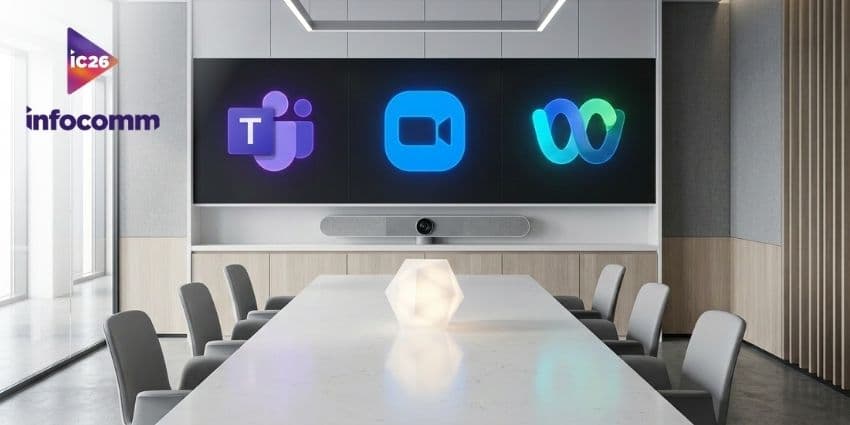
All three major UC platforms arrive at Infocomm 2026 with agentic AI central to their story, each at a different stage of delivery.
Microsoft
Microsoft's position draws on data from its 2026 Work Trend Index, published in the weeks before the show. Based on trillions of anonymised Microsoft 365 productivity signals and a survey of 20,000 workers across 10 countries, it found that 49% of Copilot conversations now support cognitive work including analysis, problem-solving, and strategic thinking. Among what Microsoft classifies as "Frontier Professionals," 80% report producing work they could not have completed a year earlier, compared to 58% of all AI users. The report also identifies what it calls a "Transformation Paradox": individual workers are moving ahead with AI faster than the organisations around them, with only 13% of firms actively rewarding AI-driven workflow reinvention.
Zoom
Zoom arrives with its agentic move already shipped. AI Companion 3.0, expanded in March 2026, introduces workflow orchestration across Zoom Workplace, Zoom Phone, and Zoom CX, with custom AI agents, ten new secure connectors, and the ability to turn meetings, calls, and customer interactions into completed outcomes rather than lists of follow-up tasks. Monthly active users more than tripled year-over-year in Q4 FY26. The Infocomm session, "Zoom: AI-First, Human-Centered Workspaces," brings that to an enterprise AV and IT audience that may not have tracked the March Enterprise Connect announcements.