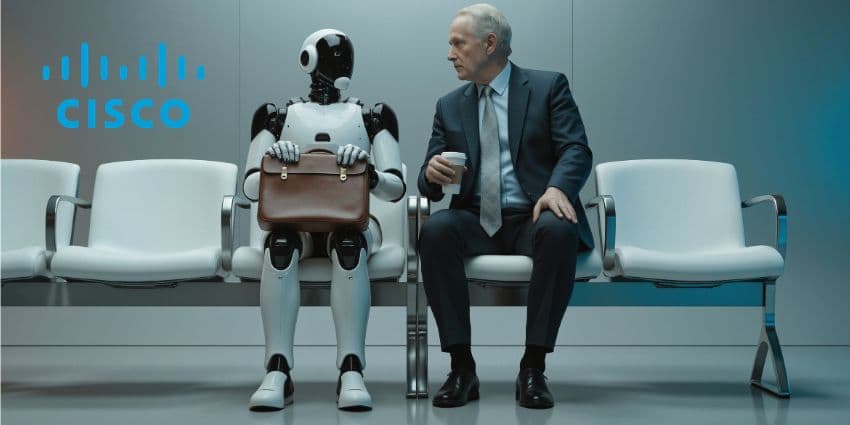
Cisco has announced it will deploy a personal AI agent to each of its 90,000 employees before the end of July, in what represents one of the largest enterprise AI rollouts in corporate history.
The networking giant says every worker will receive access to a dedicated AI assistant capable of handling day-to-day tasks, answering questions, and intelligently routing requests to the most appropriate AI model.
The announcement, however, arrives against a backdrop that has complicated its reception, raising questions about how Cisco's remaining workforce will embrace the new tools the company is investing heavily in.
What Cisco Has Actually Built
The system is more than a standard chatbot deployment. It adapts to the type of request it receives. Rather than routing every query through an expensive frontier model, Cisco's platform dynamically selects the AI model best suited to each task. It uses a lighter, faster model for simple requests and a more capable one when greater complexity is required. This allows the company to control usage costs while still giving users access to more powerful models when needed.
The company says it built most of this infrastructure in-house, favoring an on-premises approach that gives it greater control over both cost and data security.
The finance function has already served as an internal proving ground. Cisco's AI tools now generate the bulk of first-draft MD&A sections, and the company has developed systems that analyze competitor earnings calls and model the specific questions analysts are likely to ask. Its longer-term ambition is a unified AI dashboard that synthesizes performance data across products, regions, and customer segments while predicting future performance and recommending actions.
Stuart Cole, Founder of Voceva AI, believes this type of deployment signals the new era of work we are entering.
"Cisco has announced that it will be giving every employee their own AI agent. Each employee will have access to a personalized assistant capable of handling tasks, answering questions, and routing requests to the most efficient AI model," he says.
"This is a smart move that every employer, no matter how small the company, could do for its staff."
Cole's point about universality is well made, and it gets to something important. The architecture Cisco has built is not exclusive to a company of its size. The model routing logic, on-premises cost controls, and task-specific delegation are design principles that can scale down. But his observation also raises a question that Cisco's announcement comes hot on the heels of: AI-related layoffs.