Cables, connectors, ports – in a highly tech-dependent world, multiple formats can confuse and frustrate.
It seems it’s one cable for this, another for that; one type of connector works here, but a different one is needed there.
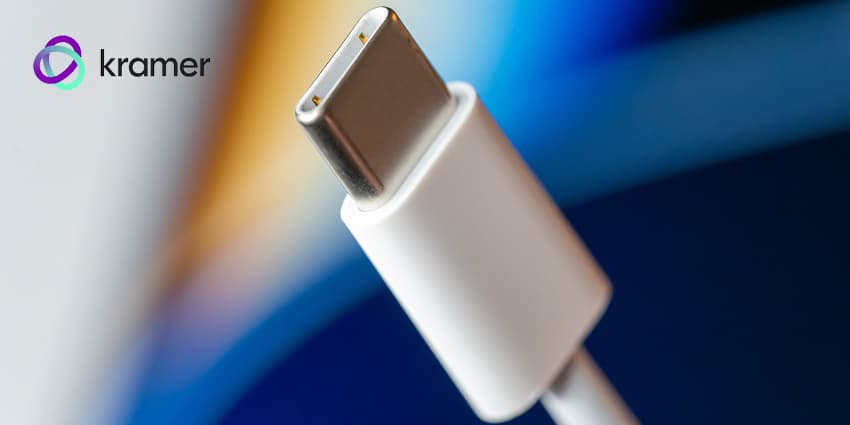
Thankfully, standardisation IS now spreading. The USB-C format has evolved rapidly, and hardware manufacturers have responded accordingly. The latest iteration - USB-C 3.2 - goes another step towards eradicating that annoying (and counter-productive) multiplicity. However, when it comes to professional audio and video, it is about SO much more than simply having one connector that fits all devices.
Upgrading to USB-C 3.2 also enables organisations to leverage game-changing new cable smarts that can simultaneously carry an audiovisual signal, data, AND power – in huge volume, at high speed, and for long distances.
Not only does that enhance the art of the technologically-possible, it also delivers a stellar new user experience.
“It’s definitely an advantage for users to now have a standard, symmetric connector in their hand that works with all devices and which enables them to literally plug and play, but the real revolution is in the backend capability that comes with the new protocol,” says Yishai Mescheloff, Vice President of Product Management at leading global AV technology provider Kramer, whose extensive range of USB-C 3.2-enabled products are at the cutting edge.
“USB has been around for years and was originally used for exchanging data between keyboard, mouse, flash drive and so on at a speed of around 480 megabit per second. In 2008, USB 3 increased that speed to five gigabits per second.
Lately, 3.2 has doubled that to 10 gigabits per second as well as bringing new capability to not only send data but also rich audiovisual content and A/C input power. So, with this very small connector you can not only charge your cell phone but, depending on your cable, you can also use a docking station ‘hub’ to send data and video to a display monitor whilst at the same time powering up your laptop, MacBook, and even the monitor itself. One connector and one cable does it all. For users, there is no more sitting in a meeting room and seeing a USBC cable coming from the table but having no idea if it is connected to the network and can handle data, video and power; or at what capacity and speed. Instead, everything just works.”
Another enhanced feature of Kramer’s new professional-grade USB-C connectors is a clever, patented locking mechanism which differentiates them from less secure connectors designed for the consumer market.
It can be business-critical for pro AV hardware connected to a switcher or a router on a rack or in a computer to fail because a USB connector has become loose or dislodged. Kramer connectors have special patents which ensure they remain locked in place.