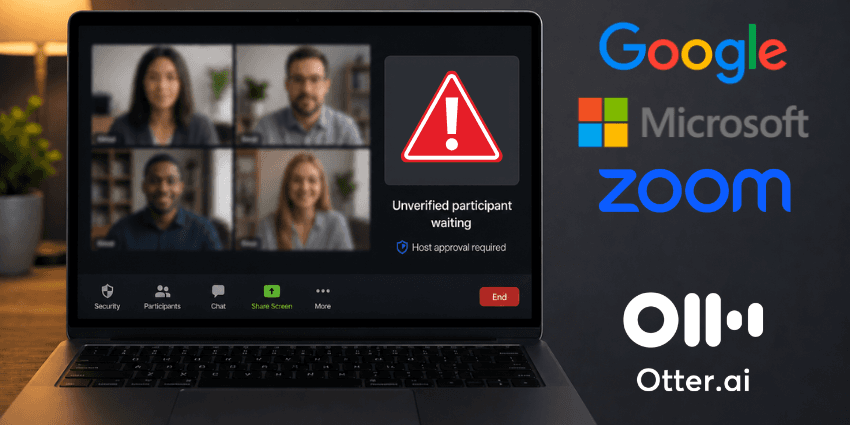
A cluster of lawsuits against Otter.ai has pushed third-party AI notetakers to the top of every IT risk register, and Microsoft, Zoom and Google are quietly rewriting their meeting platforms in response.
Microsoft Teams Introduces Default Bot Detection
The most visible move comes from Redmond. On 13 March 2026, Microsoft published Message Center notice MC1251206, announcing that Microsoft Teams will detect external third-party meeting bots, label them “Unverified” in the meeting lobby, and require the organizer to admit them explicitly. The feature is on by default.
Targeted Release is scheduled for mid-May 2026, with general availability for worldwide and GCC tenants in early to mid-June.
“Bots may access meetings without the knowledge or consent of the meeting organizer or the hosting tenant, which can create data security, privacy, and compliance risks.”
– Microsoft 365 Message Center notice MC1251206, 13 March 2026
The practical consequence is that any third-party notetaker, Otter included, will need to show its credentials at the door. Admins can also set policy to auto-block external bots at the tenant level.
Zoom AI Companion Already Requires Host Consent
Zoom has been further along this path. Its AI Companion requires host or co-host initiation, shows a visible sparkle indicator when active, and prompts individual participants to agree. Administrator controls allow Zoom AI Companion to be disabled in third-party meetings.
Zoom chief executive Eric Yuan told Fortune in October 2024 that the company was “the first vendor” to commit publicly to not using customer meeting content to train AI models without explicit consent, a position Zoom has held since an August 2023 terms of service controversy.
Google Meet and Tenant-level Controls
Google Meet’s “Take notes for me” feature, powered by Gemini, similarly requires a host or co-host to initiate it. An on-screen pencil icon and banner appear. Google Workspace administrators can gate the feature by organizational unit or group. Google says the captured data stays within the customer tenant and is not used for advertising training.
Native vs Standalone: The UC Split
The practical effect is that UC platforms are splitting cleanly into two camps. Native AI, offered by the host platform itself, is being re-architected to pass the consent test. Standalone AI bots, which sit outside the platform and join as guests, are being pushed further into the cold.
Irwin Lazar, principal analyst at Metrigy, put the competitive logic succinctly: