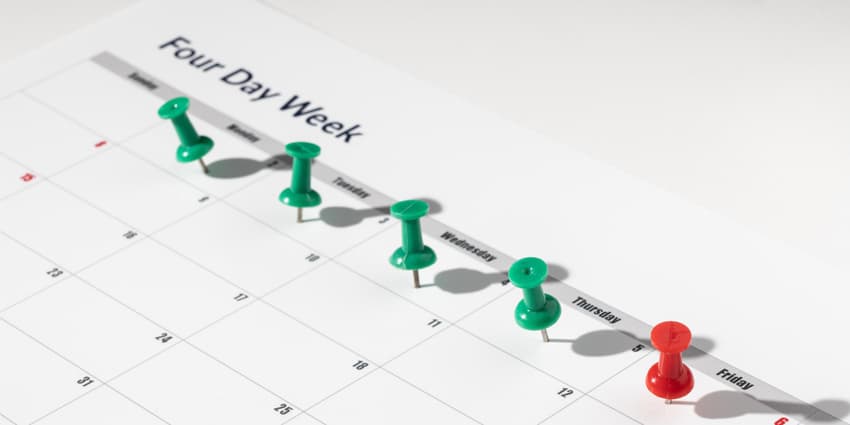
With AI, 4-day work weeks could soon become the norm.
Interest in the 4-day work week has been growing for some time now. Employees are looking for more flexibility, and work/life balance. At the same time, business leaders are discovering that 4-day weeks actually improve productivity, engagement, and talent acquisition strategies.
However, despite numerous successful trials, companies still struggle to update their work schedules. AI could be the solution. Promising organizations effective ways to improve productivity and efficiency, AI is helping teams accomplish more with less.
Many AI innovators, like Zoom’s Eric’s Yuan, believe artificial intelligence will be the key to making the 4-day work week achievable for every company. He’s not alone either, various other analysts and leaders have suggested that with AI, the standard 40-hour work week will become a thing of the past.
The Rise of the Four-Day Work Week
The 4-day work week has seen a significant surge in popularity over the last few years. We even introduced this model at Today Digital, and have seen incredible results so far. Back in 2022, the rising demand for flexible work and work-life balance actually encouraged countless UK-based companies to trial four-day weeks themselves.
The pilot program’s results spoke for themselves, highlighting a 92% success rate, improved job retention rates, and enhanced physical and mental health among employees.
Throughout the world, many organizations have discovered the benefits of a shorter working week, and employees have become increasingly receptive to the idea too. One study found that 75% of employees would actually rather work for four ten-hour days, than five eight-hour days.
Studies released by companies already employing the new schedule have overwhelmingly shown positive results, from improved productivity to reduced operational costs and lower employee stress levels. Now, demand for a 4-day work week is increasing again, thanks to a few key factors:
Growing Resistance to Traditional Workplace Routines
Shortly after the pandemic, flexibility in the workplace was all the rage. But lately, many companies have been reverting back to old-fashioned work schedules, encouraging staff to return to the office full-time. This shift has been met with significant resistance.
In one study into firms mandating returns, 42% of the organizations experienced higher levels of attrition, and 29% said they were struggling to recruit new staff. Embracing AI and the 4-day work week could give companies an alternative way to offer schedules that improve work-life balance, when flexible and hybrid work options aren’t appropriate.
New Findings: Fridays Are Unproductive
It’s easy to assume that having employees in the office more frequently would lead to higher results. However, the reality is that human beings only have so much energy, and focus to dedicate to their work. In the last couple of years, it’s become evident that a lot of staff members generally work less efficiently and productively on Fridays.
In fact, one report found that Friday afternoon is when employee productivity reaches its lowest point. Shifting to a 4-day work week could mean that business leaders can make the most of their employee's skills on the days they’re more likely to be productive.
Positive Results from 4-Day Work Week Trials
As mentioned above, although many companies have yet to implement four-day work weeks consistently, many have engaged in trials. The world’s largest four-day trial resulted in most of the participants choosing to make the policy permanent.
Businesses have discovered that reducing the length of the working week actually improves productivity, performance, and engagement. It even helps to enhance company culture, promoting positive employee wellbeing and reducing burnout and stress.
AI and the 4-Day Work Week: How AI Helps
Thanks to the rise of AI, the 4-day work week almost seems like an inevitability. Not only are leaders like Zoom’s Eric Yuan drawing attention to how AI can help to streamline work schedules, but countless other organizations are drawing attention to the impact of AI on work routines.
One report discovered that 29% of companies with 4-day work weeks are already using AI extensively. Additionally, among the companies leveraging AI to improve employee productivity and efficiency, 93% say they’re considering implementing shorter working weeks.
Some AI-driven companies have already shared their results with the world. Earthly, a climate tech company, shared that it believes the evolution of generative AI solutions has made its four-day work week more efficient than ever. The company had implemented its new shorter working week a year before adopting AI, and says the transformation has been phenomenal.
Analysts also believe AI and the 4-day work week will go hand-in-hand in the years ahead. One report from Autonomy found that AI could reduce the hours employees need to work in the UK by 10% for around 88% of companies.
How will AI Enable the 4 Day Work Week
Ultimately, AI enables the 4-day work week by empowering teams to accomplish more in less time. It reduces the number of repetitive tasks staff members need to complete daily, freeing them up to focus on more valuable processes, and eliminating inefficiencies.
With cutting-edge AI technologies, companies can streamline the path to the 4-day work week by:
Handing Repetitive Work Over to the Bots
Probably the most significant way AI powers the 4-day work week, is by reducing the amount of work human employees actually need to do. AI is excellent at eliminating the need for team members to work on time-consuming tasks, like transcribing calls or entering data into a system.
Research from McKinsey even found that with generative AI, automation could reduce the hours people work each day by around 30%. The right AI tools can handle everything from scheduling to customer support, approvals, and various mundane administrative tasks.
With fewer repetitive tasks to complete, employees can spend more of their time on valuable processes. This means they can work fewer hours, and the hours they contribute to their company will lead to better results from strategic, creative tasks.
Using AI as an Efficiency Guide
Aside from simply “taking over” repetitive tasks, AI can act as a guide to augment the performance of employees in the tasks they actually need to do. Solutions like Microsoft Copilot can offer real-time insights that make employees more productive. They can rapidly surface the information employees need to complete projects, reducing the time they spend searching for insights.