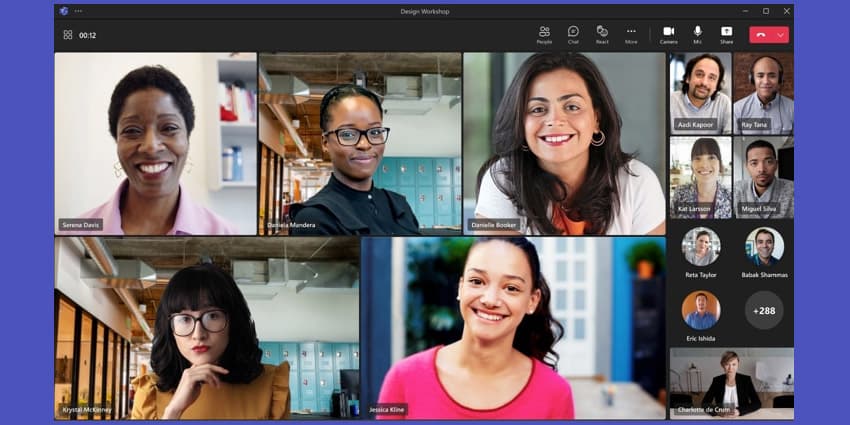
Teams has seen explosive growth over the past two years, rocketing to 270 million monthly active users and becoming a central hub for businesses around the world.
The platform’s popularity is clear to see, but behind the scenes, Microsoft has witnessed an interesting change in buying behaviour – revealed by analysis of its own web traffic.
In the pre-pandemic world, the vast majority of traffic coming onto Microsoft’s website were people interested in the Microsoft 365 productivity suite, with a relatively small percentage of traffic being people searching for Teams.
However, this has flipped in a world of hybrid work and greater flexibility, according to Alessandro Podda, Senior Product Marketing Manager for Teams GTM at Microsoft.
Teams is now the main priority for customers browsing the Microsoft website.
“There was an initiation of a change in the way people prioritize the tools they used for work,” he said.
“This shift was strengthened through the pandemic for obvious reasons, but in the past, the focus was always on the productivity tools – Excel, Word, PowerPoint – and the communication tool was priority two or three. Now it is completely the opposite.
“Productivity was the priority during a time when people went to the office, and by doing so were guaranteeing a level of communication. But now, people are valuing the flexibility of working from different places.
“It’s not to say that productivity tools are no longer important, but the need for Teams comes from not being able to run a business effectively if you don’t have it.”
Microsoft has responded to this trend by giving businesses more flexibility in how they purchase Teams. Teams Essentials is a fully-fledged Teams subscription that is, crucially, unbundled from the broader Microsoft portfolio.
Previously, businesses would have had to choose between a feature-limited free version of Teams or a full Microsoft 365 subscription, including the likes of Word, PowerPoint, and Excel. Teams Essentials gives companies a full, standalone experience at a lower price.
The crucial benefit here is that businesses can adopt Teams without having to rip out their existing productivity stack or buy a full Microsoft 365 license despite only wanting Teams.
Some businesses may still be tied to bespoke systems but also want the flexibility of a cloud-based collaboration platform for when employees are on the go. Teams Essentials means they can keep their on-prem servers or Exchange solutions while also modernizing their communication tools.
Podda said that Microsoft is seeing Teams Essential’s sweet spot being businesses with up to 200 employees – particularly law firms, accountancy firms, and consultancies.
It’s also a sound option for frontline workers, who are sometimes overlooked when it comes to corporate communications. Team Essentials means these employees can be given the tools they need to feel connected to a business without having a range of surplus products as part of their license.
Channel Opportunity
The nature of Teams Essentials makes it a lucrative solution for channel partners. Despite the boom in public cloud adoption, many businesses are not ready to take one giant leap – and Teams Essentials means they don’t have to.