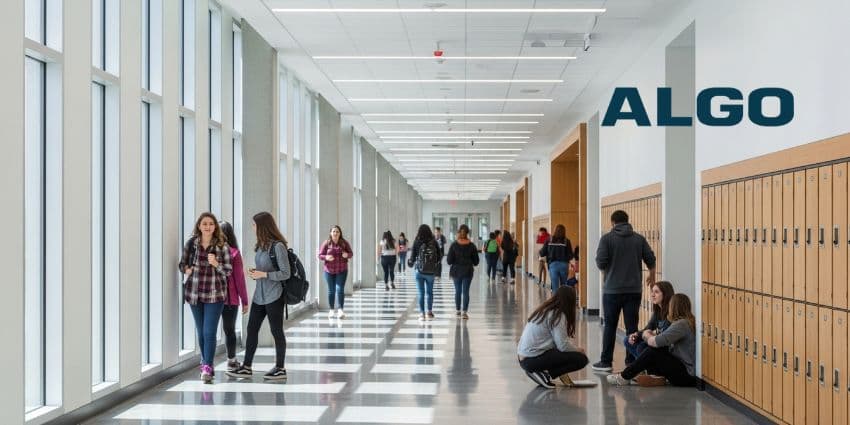
When planning for campus growth, school leaders and IT teams face difficult decisions about their communication infrastructure. Invest too heavily in outfitting today’s campus and the system may soon be outgrown; wait too long and institutions risk falling behind on essential compliance capabilities.
The real issue is the infrastructure underneath. Most campus communication systems were never designed to grow, so once analog wiring goes in, it rarely comes out. The result is institutions that are effectively locked into whatever capability they had on installation day.
- Meeting Alyssa’s Law: Why IP-Based Solutions are Crucial for School Emergency Communication
- The Campus Communication Gap: Why Your School PA System Can’t Work in Isolation
Why Analog Infrastructure Cannot Keep Up
The problem begins with how analog systems are physically built. Every speaker is connected through copper wire, meaning any extension of the system requires new cable runs, installation crews, and a disruption to the building it’s installed in.
This undertaking breeds apprehension in educational organizations, and apprehension breeds inaction. Ryan Zoehner, CEO at Algo, identifies exactly where that leaves institutions:
"If you invested in a closed, non-IP, non-open system, then you may be stuck."
That stagnation has real consequences. Safety regulations don't stand still, and when new requirements emerge, IT teams managing a rigid analog system have no easy path to keep up, leaving institutions exposed on both the operational and compliance front.
How Algo's IP Endpoints Change the Equation
IP endpoints remove the limitations of copper by moving from wires to network connectivity. This means what once required large-scale recabling to expand the communication infrastructure now merely requires reconfiguration, making scaling a fundamentally different kind of decision.
Where institutions are ready to modernize fully, Algo can replace legacy hardware with devices built for UC integration. Algo IP solutions provide the flexibility, simplicity, and centralized management that growing schools require. Where existing infrastructure still has life in it, Algo can bridge the analog to IP gap without forcing a costly and time-consuming rip and replace.
Beyond the ability of IP endpoints to scale is their capability to adapt to the environments they are placed in. As Bryan McCarthy, VP of North America Sales at Algo, explains: