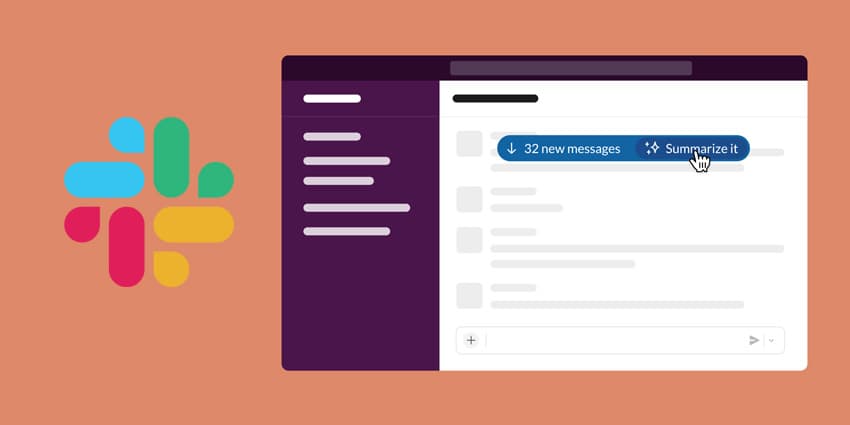
With the rising popularity of ChatGPT, it’s no surprise that many companies are rushing to create their own conversational AI tools. One of the latest releases is Slack GPT, which brings generative AI to Slack to help provide conversational summaries, help with writing, and customer insights.
So, what is Slack GPT, and how can businesses use it? Let’s explore and see what Slack’s latest offering provides.
What is Slack GPT?
Slack GPT, as the name suggests, is a solution that brings conversational, generative, artificial intelligence (AI) like that of ChatGPT to Slack. Built through a partnership with OpenAI, Slack GPT is an AI integration designed to improve productivity and provide new customer insights while letting users decide what AI features they want to use.
Like ChatGPT, Slack GPT is designed to understand language and context, enabling it to gather, organize, and present information. This can be used for both reading and drafting messages, as well as gathering customer insights and case summaries.
Slack users can integrate AI language models using partner-built apps, including OpenAI’s ChatGPT, Anthropic’s Claude, or Salesforce’s Einstein GPT. Slack also announced that later this year, users will be able to use a Workflow Builder to add generative AI prompts to their workflows without needing any coding.
Slack has also stated that the AI will not use data delivered over Slack for training purposes, so conversations will remain secure.
AI-Powered Unified Communications
Slack is not the first communications platform to use ChatGPT and other generative AI in its platform, as businesses have been steadily integrating AI into their platforms.
Microsoft, for instance, recently announced that it’s bringing ChatGPT to Microsoft Teams, and has added ChatGPT features to its Bing search engine and Edge browser. Google, similarly, has its own AI, titled Bard, which has recently begun rolling out. Other companies, like GoTo, are also integrating ChatGPT or developing their own AI to improve their communications and support experiences.
However, all this begs the question: what does AI bring to unified communications?
One key benefit of AI in UC is the ability to use machine learning and natural language processing to automate tasks and assist callers. Many UC providers have begun integrating AI to create virtual assistants that can help schedule meetings, draft messages, or make calls, as well as provide transcripts and summaries for calls.
For companies that offer contact center solutions as part of their unified communications platform, AI is also helpful for assisting agents and customers, such as through chatbots that can help with self service, or automatic assistants for agents based on customer queries.
Generative AI solutions like ChatGPT are not truly “intelligent.” Instead, they draw on massive sets of data to identify patterns, then use those patterns and data to create new content. This is why AI can also provide inaccurate information, while still presenting it confidently; there is no internal thought process or fact-checking. This is why companies using AI must make sure to properly train the AI using company data, and have a human available for fact-checking and approval before anything important goes from the AI to the customer.