
This is a guest post by Dominic Kent. The views are his own.
We’ve been told what the future of work looks like. But what happens if businesses invest millions building toward a future that never actually arrives?
Before going any further, this isn’t a post declaring that Microsoft has definitely got it wrong. Far from it. Microsoft has an impressive track record of innovation, and I believe AI and autonomous agents will fundamentally change how businesses operate.
This is simply a question of what if?
-
What if the future doesn’t unfold quite as Microsoft predicts?
-
What if the way businesses ultimately use AI looks very different from the vision being presented today?
It’s a question that every business should be asking, regardless of its technology provider. Because there’s a difference between embracing innovation and betting the future of your business on one particular vision of it.
Microsoft has a pretty impressive track record.
From Office and Exchange to SharePoint, Azure, and Microsoft Teams, its technology has fundamentally changed how businesses operate. It has consistently pushed the boundaries of what workplace technology can do, often bringing together capabilities that previously required multiple products and vendors.
Its investment in AI is no different. Copilot and the emerging agent ecosystem represent some of the most significant developments in enterprise technology for years.
But even Microsoft doesn’t get everything right.
Remember when we were going to:
-
Hold meetings in the metaverse?
-
Replace video conferencing with virtual reality headsets?
-
Represent ourselves as avatars in virtual meetings?
These weren’t just ideas discussed at technology conferences. They were presented as the future of work. Businesses were encouraged to explore them, invest in them, and consider how they might transform the way their employees collaborated.
Yet most businesses still meet in much the same way they did before.
I’m not suggesting these technologies were bad ideas. Some have found legitimate applications. But the widespread transformation that was predicted never really happened.
Which brings me to Copilot.
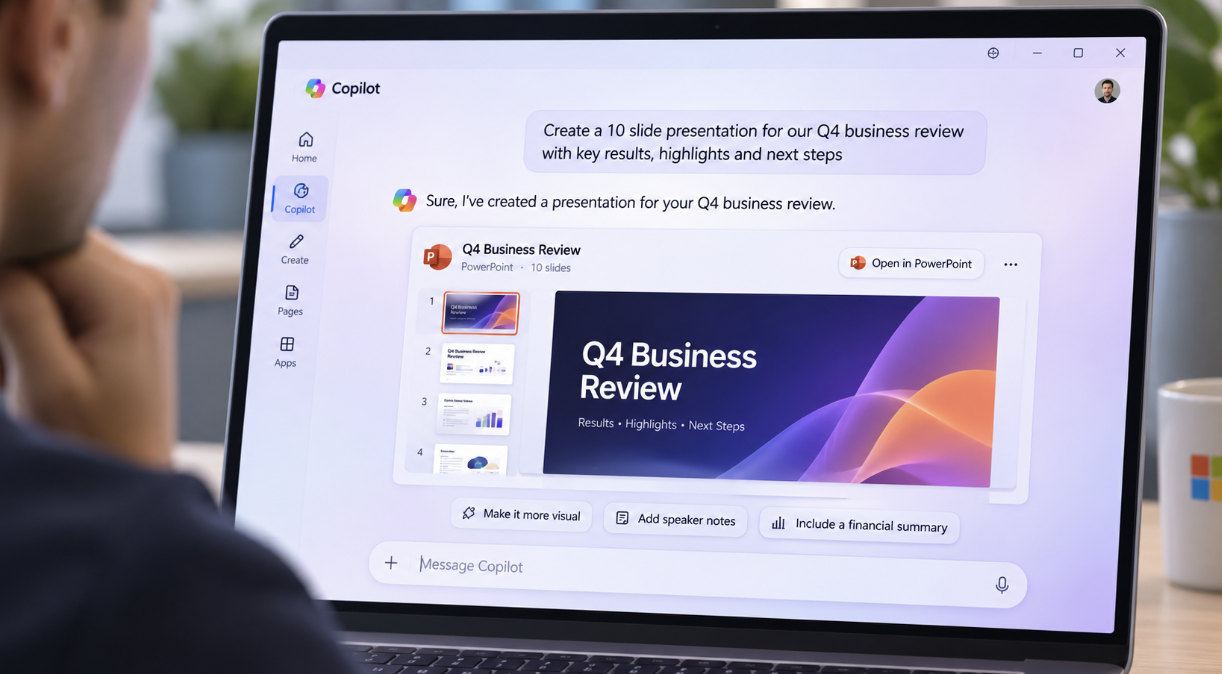
Microsoft is increasingly presenting a future in which agents do the work, Copilot becomes the primary interface for employees, and traditional applications become something we interact with through AI rather than directly.
It’s an exciting vision. There are genuine opportunities here.
But what if Microsoft has got it wrong?
Not necessarily about AI itself, but about how people will use it, how much autonomy businesses will give it, and whether a Copilot-first world is actually where we want to end up.
What Happens When You Build Your Business Around Someone Else’s Vision?
There’s a difference between adopting a technology and fundamentally redesigning your business around it.
A business might introduce Copilot to help employees write documents, summarize meetings, analyze information, and automate repetitive tasks. If it works, great. If it doesn’t, employees can go back to doing things the way they did before.
But imagine a business that goes much further.
It rebuilds its processes around autonomous agents. It invests in agent development, integrations, governance, and training. It changes employee responsibilities, restructures teams, and encourages people to delegate work rather than carry it out themselves.
It also moves toward a Copilot-first interface, where employees are expected to access their information, applications, and business processes through a conversational AI experience.
That’s a much bigger commitment.
The business is no longer simply using Microsoft’s technology. It’s building its operating model around Microsoft’s prediction of how work will happen in the future.
And that introduces some significant risks.
1. What Happens if the Interface Isn’t Better?
One of Microsoft’s biggest ambitions is to make Copilot the starting point for work.
Rather than opening Word, Excel, PowerPoint, or other business applications, employees increasingly interact with Copilot and ask it to perform tasks on their behalf.
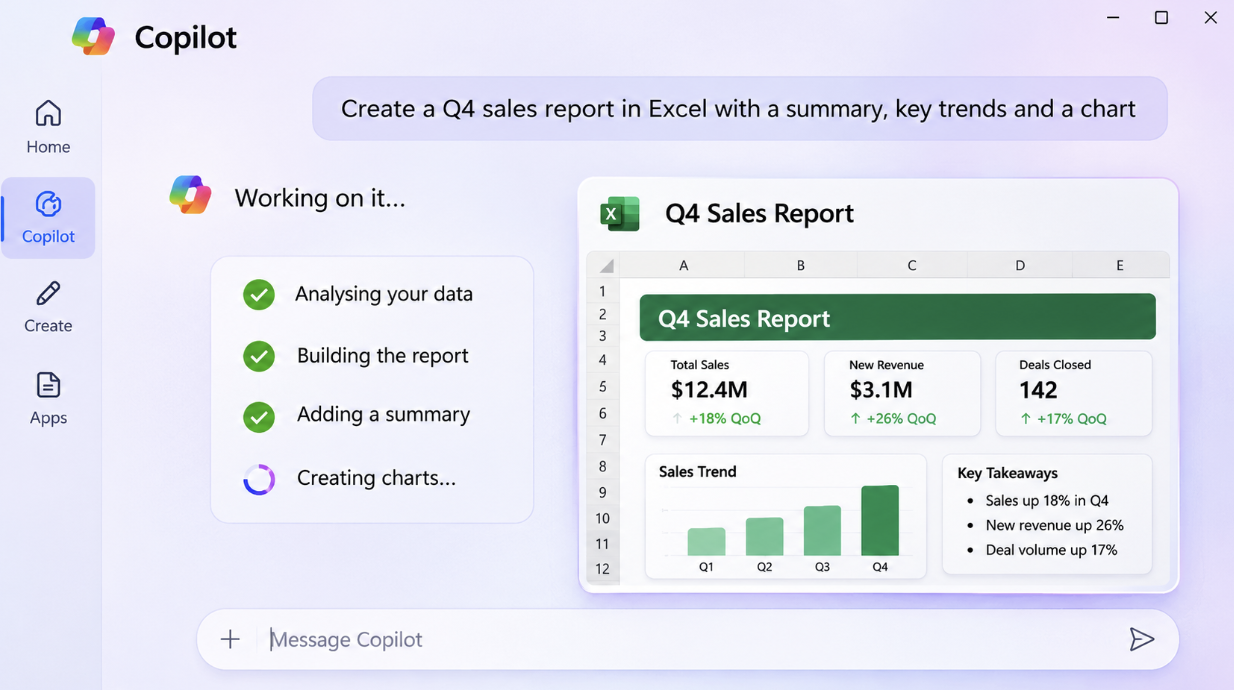
The appeal is obvious. Why navigate multiple applications when you can simply describe what you want to achieve?
But is a conversational interface always the best interface?
Think about Excel. It’s an incredibly powerful application because people can interact directly with data, manipulate formulas, build models, and explore information visually.
Now imagine having to explain every interaction to an AI.
Sometimes that’s easier. Sometimes it isn’t.
The same applies to PowerPoint, Dynamics, and countless other business applications.
There is a danger that we introduce an additional layer between employees and the tools they need, creating friction in the name of removing it.
Consider the consequences:
-
An employee knows exactly what they want to do but has to explain it to an AI.
-
A simple task that takes five seconds in an application becomes a conversation.
-
The AI misunderstands an instruction and makes an incorrect change.
-
Employees lose visibility of what’s happening behind the interface.
-
Troubleshooting becomes more complicated because the employee doesn’t know which application, agent, or process caused the problem.
There’s also the question of choice.
Will employees still be able to access applications directly, or will businesses increasingly encourage, or even mandate, a Copilot-first experience?
We shouldn’t confuse a conversational interface with a better interface.
2. What Happens When Your Employees Lose the Ability to Do the Work?
This is potentially one of the biggest long-term consequences of an agent-first strategy.
If agents increasingly write reports, analyze data, manage customer interactions, create presentations, and execute business processes, what happens to the underlying skills?
Think about how organizations have changed over the past few decades.
We’ve automated processes, introduced software, and removed manual tasks. That’s generally been a good thing.
But there is a difference between using technology to make people more productive and removing the need for people to understand how the work is done.
Imagine a business where junior employees never learn how to build a financial model because an agent does it for them.
Managers stop understanding the detail behind reports because they simply ask Copilot for a summary.
Salespeople become reliant on agents to prepare customer proposals. Project managers delegate planning and reporting to autonomous systems.
Employees become increasingly skilled at instructing technology but potentially less capable of carrying out the underlying work themselves.
-
What happens when the agent gets it wrong?
-
What happens when the technology is unavailable? (Can anyone say outage?)
And what happens when the business wants to move to another platform?
Does the organization still have the skills and knowledge to operate independently?
There’s a risk that we create businesses that are more productive in the short term but less capable in the long term.
There’s a risk that we create businesses that are more productive in the short term but less capable in the long term.
— Dominic Kent
3. What Happens When an Agent Gets It Wrong?
There’s a fundamental difference between an AI assistant producing an incorrect answer and an autonomous agent taking an incorrect action.
An assistant might give you a poor recommendation. You can ignore it.
An agent might send an email, update a customer record, approve a transaction, change a financial forecast, or trigger an automated workflow.
And it might do all of those things without an employee reviewing every individual action.
The risk isn’t simply that AI makes mistakes. It’s that those mistakes can be acted upon, repeated, and potentially propagated across multiple business systems before anyone notices.
Consider what happens when an agent has access to sensitive information, financial processes, customer records, and other connected applications.
A mistake that might once have affected one employee could now affect an entire business process.
The more autonomy we give agents, the more important it becomes to control what they can access, what they’re allowed to do, and where human approval is required.
4. Who Is Actually Accountable?
This is where things get particularly interesting.
If an employee makes a mistake, we generally know where accountability sits.
But what happens when an agent makes a decision?
-
Is it the employee who instructed it?
-
The manager who approved its deployment?
-
The IT department that configured it?
-
The business owner who designed the process?
-
Or the technology provider?
Microsoft is clearly aware of this challenge.
Its approach includes giving agents their own identities, assigning accountable human owners, and providing administrative controls.
At Ignite 2026, Microsoft announced further developments around agent identities and governance, including Agentic Users in Teams. Agents can have their own identities and owners, and become identifiable participants in team channels and meetings.
Rob Scott, in his LinkedIn commentary and reporting for UC Today, highlighted the significance of this development.