The Death of Single-Vendor Lock-In?
The UC Awards 2025 results have delivered a clear verdict: the era of single-vendor platform dominance is officially over. What we're witnessing isn't just another award ceremony celebrating innovation—it's the formal recognition of an industry-wide revolution that's quietly dismantling the traditional "one platform to rule them all" approach that has dominated enterprise communications for decades.
Zoom's extraordinary sweep of four major categories—"Most Innovative Product," "Best UC Platform," "Best UCaaS Provider – Americas," and "Best Contact Center Solution"—combined with NUWAVE Communications' victory in "Best Service Management Platform", tells a story that goes far beyond simple product excellence. These wins represent the validation of a new paradigm: multi-vendor orchestration is not just the future, it's the present reality for enterprises that want to thrive in today's hybrid work environment.
The Single-Vendor Dream That Became a Nightmare
For years, the promise was seductive: choose one vendor, implement one platform, manage one relationship, and all your communication challenges would disappear. Microsoft Teams would handle everything. So would Cisco. Or RingCentral. Or any number of comprehensive UCaaS providers promising end-to-end solutions.
The reality? Enterprise environments are messier, more complex, and more strategically diverse than any single vendor can accommodate. Different departments have different needs. Regional offices require local compliance. Acquired companies bring their own technology stacks. Legacy systems can't simply be ripped and replaced overnight.
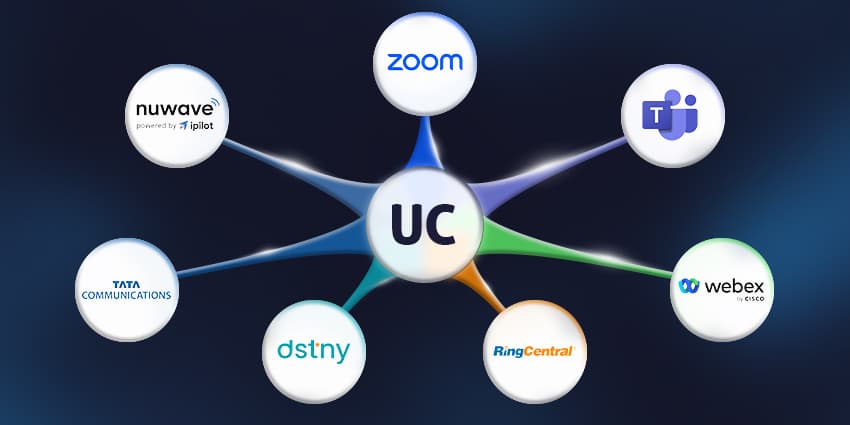
"Most UC projects stall at migration. Rather than forcing customers to choose a platform or manage multiple siloed tools, iPILOT was purpose-built to unify Microsoft Teams, Webex, Zoom, and legacy PBX environments under a single service management experience." — NUWAVE Communications, UC Awards 2025 Winner
Examining the latest UC trends, this isn't a technology problem, it's more of a business reality problem. And the most innovative companies are finally building solutions that embrace this complexity rather than fight it.
How UC Awards Winners Are Leading the Orchestration Revolution
The 2025 UC Awards winners demonstrate three critical trends that signal this fundamental shift:
Platform Interoperability Over Platform Dominance
Zoom's unprecedented four-category sweep is particularly telling because it represents a platform that has evolved beyond pure video conferencing to become a comprehensive orchestration hub. Rather than trying to replace every communication tool in an organization, Zoom has focused on seamless integration with existing workflows, applications, and even competing platforms.
This strategy directly contrasts with the traditional approach of demanding complete platform adoption. Instead, Zoom recognizes that enterprises need solutions that work within their existing ecosystems, not instead of them.
Service Management as the New Competitive Battleground
NUWAVE Communications' win in the "Best Service Management Platform" category highlights perhaps the most significant trend: the emergence of dedicated orchestration platforms designed specifically to manage multi-vendor UC environments.
NUWAVE's iPILOT platform represents what I believe is the future of enterprise communications management. Rather than forcing organizations to standardize on a single vendor, iPILOT provides a unified control plane that can orchestrate Microsoft Teams, Webex Calling, Zoom Phone, and legacy PBX systems simultaneously.
The business impact is staggering: partners using iPILOT report 75% reduction in deployment timelines, 20-35% year-over-year revenue growth, and up to 40% reduction in operational overhead through automation. These aren't incremental improvements—they're transformational outcomes that single-vendor approaches simply cannot match.
Embracing Vendor Diversity as Strategic Advantage
The most innovative organizations are discovering that vendor diversity isn't just a problem to be solved, it's a competitive advantage to be leveraged. Different vendors excel in different areas. Microsoft Teams dominates in enterprise productivity integration. Zoom leads in user experience and reliability. Cisco excels in network infrastructure and security.
Rather than forcing a lowest-common-denominator choice, orchestration platforms enable organizations to leverage the best capabilities from each vendor while maintaining unified management, compliance, and user experience.
The Economics of Orchestration
The financial argument for multi-vendor orchestration is becoming impossible to ignore. Traditional single-vendor approaches often require: