For years, the technology industry has tried to convince organisations that the future of enterprise communication is a straight line – from legacy on-premises infrastructure to the cloud.
The logic was simple: modernise, consolidate, move on. But somewhere between the promise and the reality, something went wrong.
"Technology follows your strategy and the outcomes you're trying to drive – versus trying to shoehorn your strategy around technology," says Eric Hanson, CMO at Mitel.
"Start with the user and work backwards from there." It sounds straightforward. But for most organisations, it represents a fundamental departure from how communication strategy has been built for the past decade.
Workers are still juggling an average of seven disconnected tools. Frontline employees are using WhatsApp to serve customers because the sanctioned systems are too slow or too clunky. IT leaders believe they are delivering the right technology; the people using it disagree.
And now, with AI accelerating the pace of change, the gap between what organisations provide and what workers actually need is wider than ever.
The problem was never about where technology lives. It was always about whether it addresses the workers’ needs.
The False Binary
The cloud-versus-on-premises debate assumed that modernisation was a destination – that organisations just needed to make the leap and everything else would follow.
What it failed to account for was the sheer diversity of the modern workforce and the complexity of the environments in which people actually work.
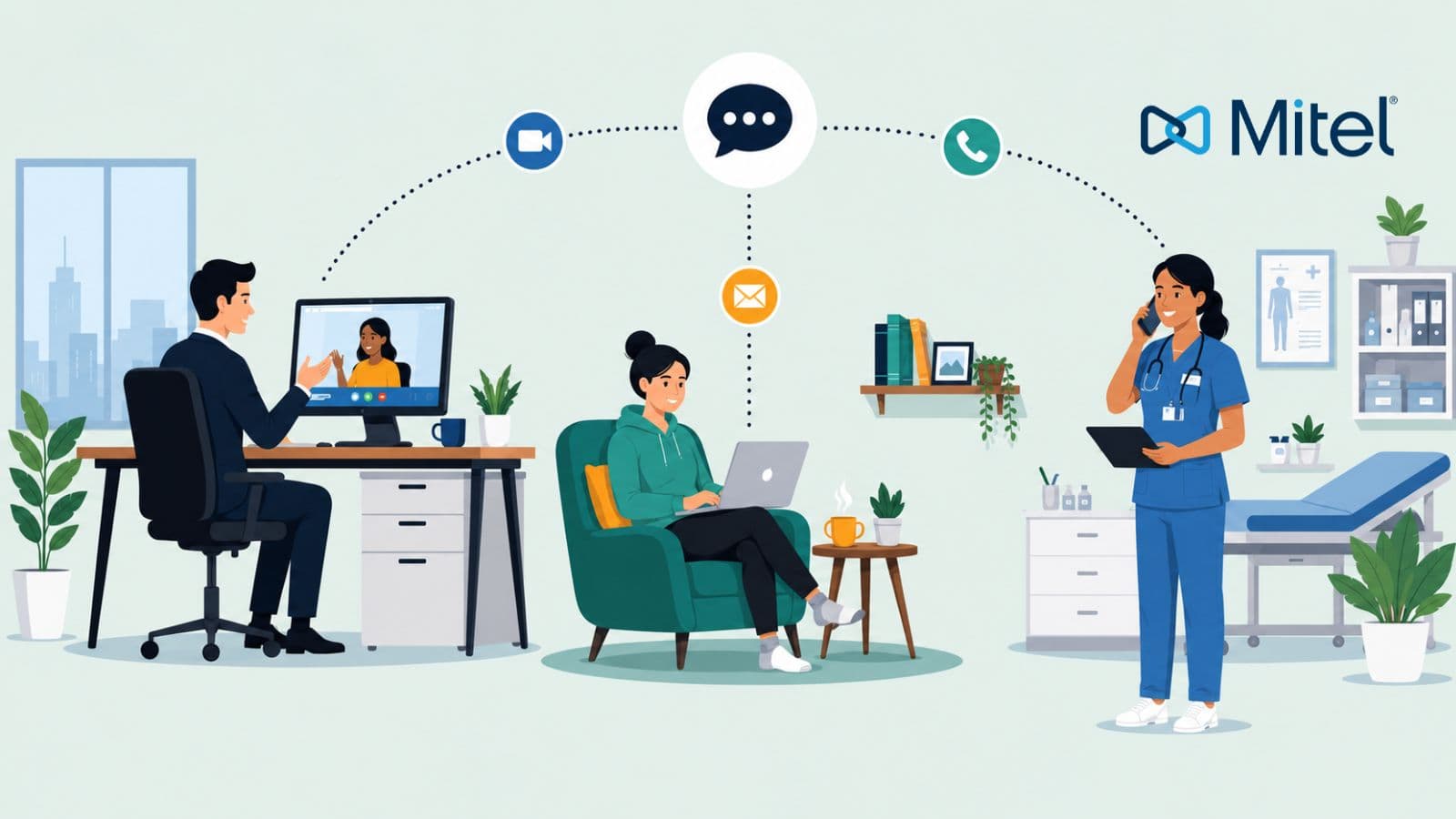
A knowledge worker in a city office and a nurse managing patient care on a hospital floor have fundamentally different communication needs.
A one-size-fits-all approach was never going to serve all of them well. The result is a workforce that has been quietly compensating for years, finding its own workarounds and increasingly going off-grid when the official tools fall short.
As Hanson puts it, "the number one barrier to investing in innovation seems to be this sprawl and the locked-in nature of what they have in place today" – actively crowding out the investment in AI and modernisation that business leaders say they urgently need.
Hybrid Is Not a Compromise – It Is the Architecture
The shift that is now underway is not a retreat from modernisation. It is a more honest reckoning with what modernisation actually requires.
Eighty-seven percent of IT decision-makers already rely on hybrid infrastructure for their communication tools – not because they failed to commit to the cloud, but because the reality of their organisations demanded flexibility that no single deployment model could provide.
Hybrid infrastructure, done well, is not a halfway house. It allows organisations to modernise at the pace that makes sense for their business, maintain the control and resilience that regulated or mission-critical industries demand, and deliver purpose-built experiences for every worker profile – without forcing a trade-off between flexibility and governance.
Mitel's recent product moves reflect exactly this logic. Mitel Edge brings intelligent communications architecture on-premises for organisations in critical industries where data sovereignty and resilience are non-negotiable.
Mitel WX provides a common application framework that meets workers where they are – from a simple soft phone to a fully integrated, workflow-embedded experience on the device of their choice.
Together they represent a clear strategic bet: that the future of enterprise communication is not a single model, but a coherent framework that adapts to the organisation, not the other way around.
Technology Should Follow Strategy
For too long, communication strategy has been shaped by the capabilities and limitations of available technology.
Organisations have built their workflows around their tools rather than building their tools around their workflows. Hanson is clear on what the answer looks like in practice.
"Really understanding the most critical workflows and business processes that those individuals need to execute, and then ensuring that communications are deeply embedded in that workflow and not a distraction. When you get it right, the technology should sort of go away, if you will."
That requires organisations to ask harder questions than they are used to asking. What does communication actually look like for a frontline worker in a high-pressure moment? What happens when the sanctioned tools are too slow, too complicated, or simply not available? What is the real cost – in productivity, in security exposure, in service quality – of getting those answers wrong?
Voice Is Not a Legacy Technology
Nowhere is the misalignment between industry assumption and workforce reality more apparent than in the role of voice. For years, the prevailing narrative has been that voice is a legacy channel – something to be maintained for now but gradually superseded by video and messaging. Hanson is direct in pushing back. "For far too long, the perception of voice as a technology has been that it's not strategic until it doesn't work."
The data backs him up. Seventy-nine percent of workers rely on voice in urgent, high-stakes situations. And when Mitel's partners surveyed their own customers on communication preferences, the results were unambiguous. "One of the largest retailers in France did a survey of their customers and asked what is the primary communication modality that you prefer. Ninety percent indicated voice first. And yet we think that everything is about what we're doing right now – a video conference type of experience. But that really doesn't mean that's the best experience for the 80 percent of the workforce that sits on the front lines."
Voice is not a legacy technology to be quietly retired as organisations modernise. It is the channel that matters most when it matters most – and any infrastructure strategy that treats it as an afterthought is building on shaky ground.
The Organisations That Will Come Out Ahead
The communication experience gap is not going to be solved by another platform migration or another round of tool consolidation. It will be solved by organisations that take seriously the distance between what they provide and what their workers actually need – and put in place the infrastructure, the governance, and the intent to close that gap.
Hybrid infrastructure is the framework that makes that possible. Not as a compromise between old and new, but as a deliberate, strategic choice to build communication environments that are fit for purpose for every worker, in every environment, at every moment that matters.
The organisations that will come out ahead are not the ones that picked the right deployment model. They are the ones that never stopped asking whether their tools were actually working for the people who depend on them.
The full State of Workforce Communication report is available at mitel.com.