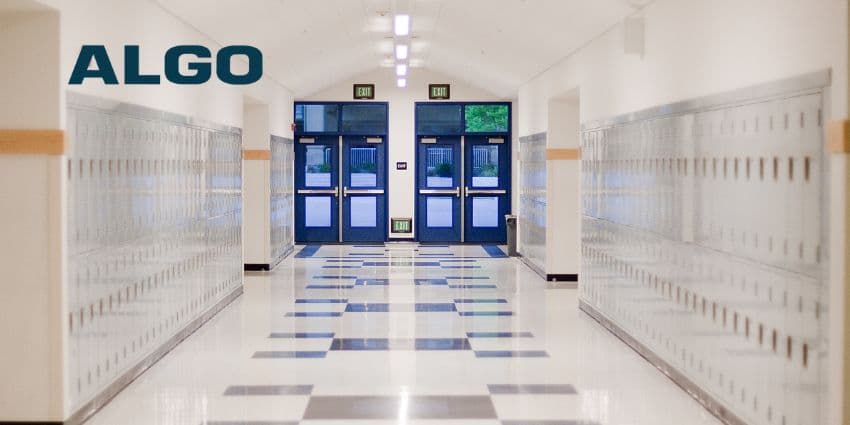
Effective communication across a school campus isn't a nice-to-have, it’s essential. Relaying schedule changes, updating staff on room changes, and coordinating responses to emergencies are all necessary to keep a school running safely and efficiently.
Understanding this, many K-12 schools and colleges now use UC platforms like Microsoft Teams or Zoom so staff can remain in contact with each other. This works effectively for anyone sitting at a desk, but in an education environment that is not a given.
For teachers, most of the working day is spent standing at the front of a classroom, moving from room to room, or supervising break periods. This means they are away from the school's communication system for large parts of the day. It is a challenge that IT and infrastructure teams are increasingly being asked to close when it comes to mobile workers.
To keep life safety communication open with teachers who are not at their desks, schools rely on a different layer: the PA system. Administrators can push announcements such as schedule changes, assembly reminders, and safety alerts so teachers hear them throughout the school. This enables deskless staff to receive updates, but not respond to them.
- Meeting Alyssa’s Law: Why IP-Based Solutions are Crucial for School Emergency Communication
- Why Compliant IP Endpoints Are Essential for Scaling Industrial Operations
When Announcements Only Flow One Way
Consider a staff member supervising the lunch hall when an incident breaks out. With a one-way PA system, there is no way to relay information to other staff members and trigger a coordinated response. The information stays trapped at the point of origin, and the issue can escalate without support.
As Bryan McCarthy, VP of North America Sales at Algo, explains, this restricted information flow is a crucial flaw when it comes to safety:
"When you think about safety and emergency situations, these systems have to work together. When they're separate, you're just not going to get the outcome you're looking for."
The effective response to an incident depends on how quickly information can be relayed from the area of origin to other staff members, and a one-directional PA system simply cannot facilitate that.
Bridging that gap means integrating the PA system with the organization’s UC platform so communication can be initiated, received, and routed through a shared environment. This allows staff to connect to the same system regardless of their location in the building, and the transition begins with IP.
How Algo's IP Endpoints Close the Loop
Rather than running a separate PA infrastructure alongside a UC platform, Algo's IP endpoints connect physical communication devices, like speakers, intercoms, or pagers, directly to Microsoft Teams or Zoom, extending the reach of the school's communication beyond screens and into the physical spaces of the campus.
That connection enables deskless staff to now communicate through whichever endpoint is closest, reaching back-office colleagues on the same UC platform without needing to be at a desk or near a laptop.