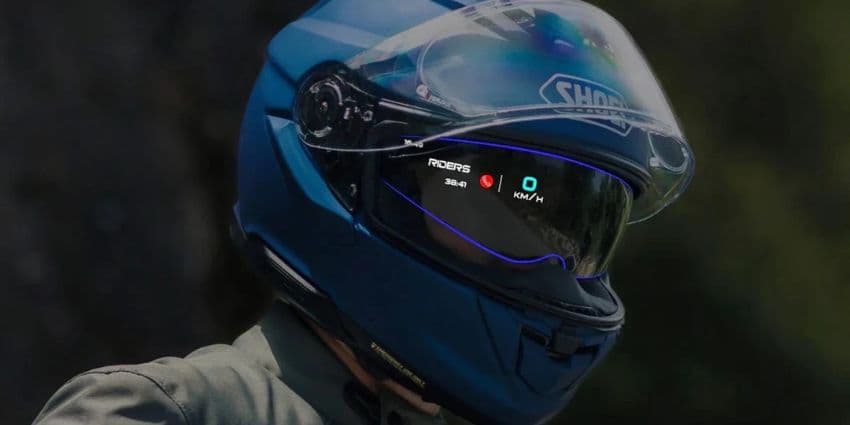
Japanese manufacturer Shoei has unveiled its GT-Air 3 Smart: a full-face helmet with a heads-up display (HUD) and integrated communications which may extend beyond motorcycling.
The helmet’s AR capabilities, safety certification, and hands-free communication could stretch to enterprise settings – from logistics and manufacturing to field service and frontline operations.
The devices hint at the future of wearable XR in professional contexts, where real-time data and safety are equally critical.
AR in Motion: From Roads to Worksites
The GT-Air 3 Smart uses a nano-OLED HUD embedded into the visor. It projects navigation, calls, and alerts at a distance of three metres.
For motorcyclists, this improves situational awareness.
In industrial or logistics settings, similar displays could overlay instructions, equipment status, or safety warnings directly into a worker’s field of view.
Early studies suggest that AR overlays reduce reaction times by more than 30 percent.
In warehouses, factories, or construction sites, a helmet HUD could reduce cognitive load. It allows staff to act on information without diverting attention to handheld devices.
The combination of the integrated HUD and long battery life – over 10 hours – makes continuous operation feasible for professional shifts.
Beyond AR, the helmet features a universal intercom system with mesh networking for offline or online operation.
It supports voice assistants such as Siri and Google Assistant and incorporates active noise cancellation.
In noisy industrial environments, this allows teams to coordinate in real time without handheld radios. As a result, both efficiency and safety improve.
Market Context and Enterprise Potential
Shoei’s entry into smart helmet technology comes amid growing interest in AR for workplace efficiency.
Competitors include Sena, whose Phantom helmet integrates Bluetooth intercoms, and Cardo, which provides similar communication features at a comparable price point.
Both lack AR HUDs, which highlights Shoei’s differentiation.
Other early entrants, like Skully and CrossHelmet, experimented with AR displays and cameras. However, issues with production scale and safety certification limited adoption.