Salesforce has launched a completely rebuilt version of Slackbot that automates tasks previously requiring multiple app switches and manual effort.
Available now for Business+ and Enterprise+ customers through a phased rollout, the new Slackbot AI agent can draft documents, schedule meetings, surface information from conversations, and pull data from connected systems using natural language commands. The company positions it as a productivity solution to the growing problem of "agent sprawl"—employees juggling multiple AI tools without a unified interface.
Slackbot: From Passive Summarization to Active Automation
Slackbot has been part of Slack since the platform launched in August 2013, handling scripted responses to preset questions and setting reminders through /remind commands.
A major upgrade to the platform came in winter 2023 when Slack AI entered pilot, adding features like thread summarization and channel recaps. By February 2024, these tools were generally available, but they were passive. Users clicked "Summarize" or "Search Answers" to get information, then had to act on it separately.
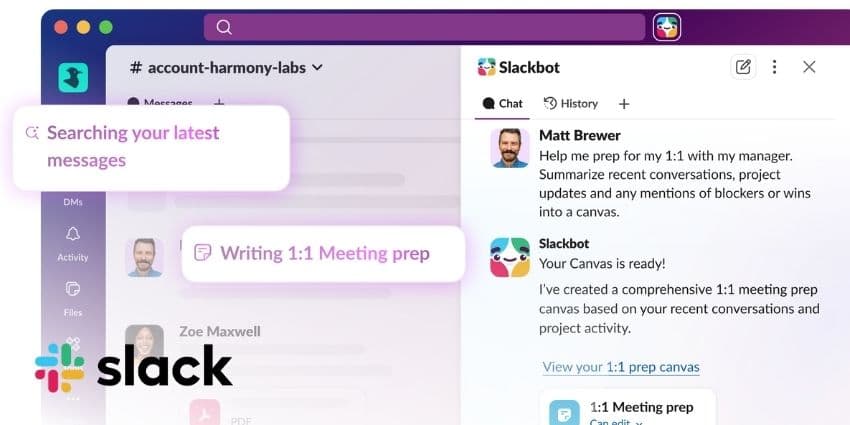
What's different now is that Slackbot can complete tasks without handing work back to the user. Ask it to draft meeting notes from a discussion and it produces a document you can refine. Tell it to schedule a meeting and it checks calendars and sends invites. Request information about a project and it searches across channels, files, and connected systems.
How Slackbot Enables Productivity Gains
Sinan Deriş, Head of Beast Games Marketing at MrBeast, reported that Slackbot saves him "at bare minimum, 90 minutes a day." He cited a specific example: asking it to create a canvas for a meeting.
"In 17 seconds it's better than I could ever do. It tells me next steps, saving time and money."
The productivity gains come from three areas: eliminating context-switching between apps, automating repetitive document creation, and surfacing information without manual search.
For information retrieval, the Slackbot AI agent uses natural language queries to search across conversations, files, and connected systems. Instead of remembering which channel discussed budget decisions or which document contains project timelines, employees ask directly. The agent respects permission controls, only accessing information users are authorized to see.
For content creation, it drafts meeting notes, project updates, and briefs through conversational refinement. Users provide rough direction, then iterate until the output matches their needs.
For task management, it handles scheduling by checking calendars, surfaces priorities, and sets reminders. For Salesforce customers, it can pull CRM data to generate customer briefings that combine account history with recent Slack discussions.
Solving Agent Sprawl Through Orchestration
The automation strategy goes beyond individual productivity features. Salesforce is positioning Slackbot as an orchestration layer for multiple AI agents.