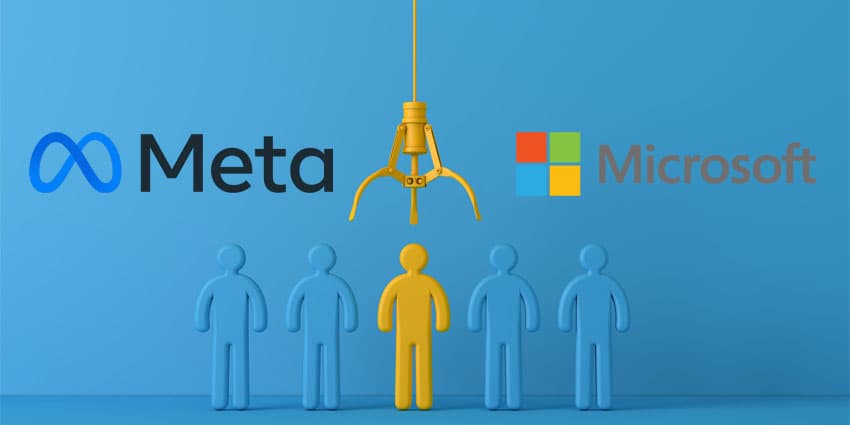
Microsoft has hired former Meta executive Jason Taylor for its AI supercomputing team.
Taylor will assume the role of Corporate Vice President and Deputy CEO at Microsoft and will report to Kevin Scott, Microsoft CTO.
"I’m super excited to welcome Jason Taylor to Microsoft, who starts today reporting to me as CVP & Deputy CTO for our AI supercomputing efforts," Scott said on LinkedIn.
Scott also namechecked Taylor's new executive colleagues in Microsoft's AI projects:
Having led a large portion of infrastructure at Meta and chaired the Open Compute Project Foundation, among many other things, Jason has spent the better part of his career taking on impossible computing challenges. I’m thrilled that he’s chosen to join Microsoft and work alongside Scott Guthrie, Rani Borkar, Noelle Walsh, Girish Bablani and our partners at OpenAI to build the next set of systems that will push the frontier of AI forward for us all."
During his tenure at Meta from 2009 to 2022, Taylor held the position of Vice President of Infrastructure, overseeing AI, data, and privacy infrastructure. He was also responsible for managing the company's server budgets. Additionally, Taylor served as the chair of the Open Compute Project Foundation from 2015 to 2017, as Scott outlined — an organisation advocating for open-source designs in data centres.
"There’s recently been a bunch of speculation about our supercomputing plans, most of it amusingly wrong," Scott added on LinkedIn, hinting at what Taylor's remit might entail. "But it is true that this work is mind-boggling in its ambition and complexity. It takes a special kind of team to pursue a goal that requires the assumption you’ll be able to solve a bunch of previously impossible problems, and our Azure supercomputing teams have done that with each successive system we’ve built."
Microsoft's Copilot Story In 2024
Unless you've been living under a rock, you'll have likely noticed Microsoft's gargantuan push into AI over the past 12 months, as spearheaded by its flagship productivity assistant, Copilot. However, its AI push has accelerated with even more momentum since 2024 kicked off.
As part of Microsoft’s campaign, in which it described its ambition for 2024 to be the “year of the AI PC”, a new Copilot key will ship on various new PCs and laptops designed by Microsoft’s partners. The key will grant instant access to Windows Copilot with a single button press.
The key will be positioned between the “Alt” and left arrow keys on the new keyboards and marks the first change to the PC keyboard since the Windows key was added in 1994.
In other major Copilot news, Microsoft launched Android and iOS apps for the service in January. The Copilot mobile app is functionally similar to OpenAI’s ChatGPT mobile version, encompassing a clean interface in which users can write prompts to ask questions, summarise text, draft emails, blogs and documents. Users can also produce images by leveraging its DALL-E 3 image creator technology.
In January, Microsoft also removed the seat minimum for Copilot for Microsoft 365, opening up its business-targeting AI-powered productivity tool to enterprises of any size.