

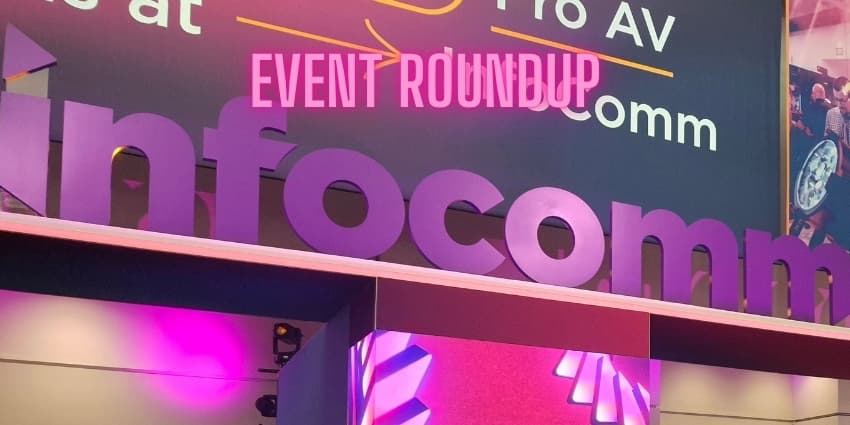
As someone who's spent years watching the evolution of unified communications and collaboration technology, I knew InfoComm 2025 would be different. Walking the floors in Orlando, Florida, as UC Today's official media partner, I witnessed something remarkable—the moment when audiovisual technology stopped being just about bigger screens and louder speakers, and started being about creating genuinely intelligent workplace experiences.
If you're an IT leader or workplace strategist trying to navigate the convergence of AV and UC, this event offered a clear glimpse into where we're heading. And frankly, it's more exciting than I expected.
Beyond the Screens: Finding UC's Place in the AV World
Let me be honest—half the InfoComm expo floor wasn't immediately relevant to our UC Today audience. The industrial-strength broadcast equipment, massive digital displays, and advertising-focused solutions felt worlds away from the collaboration challenges we typically discuss. But here's where it gets interesting: the other half of the show was entirely about bringing teams together.
What struck me most was the sheer volume of meeting room vendors, collaboration display manufacturers, and hardware specialists focused specifically on hybrid workspace solutions. These weren't the traditional UC vendors selling UCaaS or contact center platforms—instead, they were the companies building the physical infrastructure that makes Microsoft Teams, Zoom, and Google Meet actually work in real spaces.
Dave Michels from TalkingPointz captured this shift perfectly when he told me that InfoComm 2025 was defined by "two forms of convergence." The first, he explained, is how "AV is transforming from devices to applications. The AV industry has been device-centric, but these devices are becoming applications."
"IC25 was about two forms of convergence. The first one is how AV is transforming from devices to applications. The AV industry has been device-centric, but these devices are becoming applications. This means more software smarts (on device or in the cloud) and more IP networking (wired and wireless)."
This observation resonated deeply with what I saw on the show floor. We're witnessing the death of that box of AV cables we all have at home. Analog connections have given way to HDMI, but even those digital standards are being replaced by standard networking. Everything is becoming software-driven, IP-enabled, and cloud-connected.
The Intelligence Revolution: Making Spaces Work Smarter
The dominant theme at InfoComm 2025 wasn't just connectivity—it was intelligence. Every vendor I spoke with was showcasing how AI is transforming their solutions from reactive tools into proactive workplace enhancers. This isn't the future of work anymore; this is the modern workplace reality, and it's happening now.
The challenge for IT leaders has evolved beyond simply getting video into meeting rooms. Now the question is: how do you make those spaces intelligent? How do you move from connecting people to actively increasing their productivity?
What I witnessed at InfoComm was the emergence of truly smart meeting rooms—spaces that leverage AI to understand context, anticipate needs, and optimize experiences automatically. These aren't just rooms with better cameras and microphones; they're intelligent environments that can recognize when a meeting is about to start, automatically adjust audio and video settings based on the number of participants, and even provide real-time insights to improve meeting effectiveness.
I watched demonstrations of meeting rooms that could automatically adjust lighting based on participant count, audio systems that could isolate individual speakers in crowded spaces, and collaboration displays that could predict and prepare for the type of meeting about to take place. Some systems showcased AI-powered features like automatic framing that keeps speakers in view, noise cancellation that adapts to room acoustics, and even meeting analytics that help organizations understand how their spaces are being used and how productive their meetings actually are.
But perhaps the most impressive demonstration of intelligent workplace technology came when I experienced Google Beam with HP Dimension firsthand. This wasn't just another video conferencing upgrade—it was a glimpse into how immersive technology can fundamentally transform remote collaboration. The experience was so convincing that for a moment, I genuinely believed I was in the same physical space as my remote colleagues. The combination of spatial audio, realistic visual presence, and intuitive interaction created something that transcended traditional video calls and entered the realm of true telepresence.
This kind of breakthrough experience represents exactly what the convergence of AV and UC can achieve when done right. It's not about incrementally better cameras or clearer audio—it's about creating technology that makes distance irrelevant and makes remote collaboration feel as natural as being in the same room.
This is productivity-focused technology at its finest—technology that doesn't just connect people but actively makes their collaboration more effective and engaging.
Microsoft Everywhere: The Platform Play in Physical Spaces
Dave Michels made another crucial observation: "I saw Microsoft everywhere at IC25. I certainly saw a lot of Microsoft Teams, as well as the new Microsoft Device Ecosystem Platform (MDEP)." While Microsoft wasn't directly exhibiting, their presence was undeniable through the ecosystem of integrators and device manufacturers building around their collaboration platform.
"I saw Microsoft everywhere at IC25. I certainly saw a lot of Microsoft Teams, as well as the new Microsoft Device Ecosystem Platform (MDEP)."
This represents a fascinating shift in how workplace technology gets deployed. Rather than IT teams buying directly from Microsoft, they're working with specialized partners who understand both the software platform and the physical space requirements. The Microsoft Device Ecosystem Program (MDEP) is enabling this convergence, allowing hardware manufacturers to create Teams-certified solutions that work seamlessly across different room types and sizes.
A perfect example of this ecosystem innovation was Barco's showcase of their ClickShare Hub for Microsoft Teams Rooms, built directly on MDEP. What impressed me most about Barco's approach was how they've created a truly modular room system that adapts to different meeting scenarios rather than forcing organizations into one-size-fits-all solutions. The ClickShare Hub represents exactly the kind of intelligent, flexible technology that IT leaders need—it can transform any space into a Teams-enabled collaboration environment while maintaining the broadcast-quality audio and video experiences that users now expect.
What's particularly exciting is how this ecosystem approach is enabling more flexible, customized workplace solutions. Executive teams can have bespoke collaboration spaces, while line-of-business teams get solutions tailored to their specific workflow needs. The modular nature of solutions like Barco's ClickShare Hub means organizations can scale and adapt their collaboration infrastructure as their needs evolve, rather than being locked into rigid configurations.