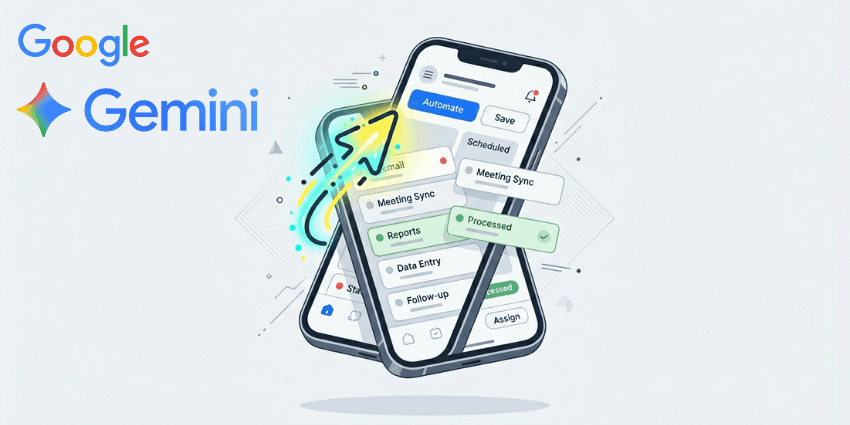
Google has crossed a line that AI assistants have been edging toward for years. With Gemini task automation, the company's AI can now open applications, navigate their interfaces, and complete multi-step tasks on your behalf, all while you get on with something else. The early use cases are deliberately mundane, but the technology behind them is anything but.
Rolling out from March 3 as part of Google's 2026 Pixel Drop, it went live on the Samsung Galaxy S26 series from March 11, with Pixel 10 users next. The beta is currently limited to the US and Korea, with more countries and regions set to follow.
What is Gemini Task Automation and how does it work?
Long-press the power button, give Gemini a natural language instruction: "book me a ride to the airport," "reorder my last DoorDash meal", and Gemini takes over. It launches the relevant app inside a "secure, virtual window" and navigates it autonomously: tapping, scrolling, filling fields. The automation runs in an isolated environment processed in the cloud; the rest of your device remains entirely out of reach, and users must explicitly opt in before the feature activates.
A live notification narrates every step, and you can view progress, take control, or stop at any point. Before any final action, such as placing an order or confirming a booking, Gemini pauses and hands that last step back to you. That human-in-the-loop checkpoint reflects something Google has been explicit about. As CEO Sundar Pichai put it at the AI Impact Summit in February: "Trust is the bedrock of adoption."
In beta, task automation covers food delivery (DoorDash, Grubhub), grocery ordering, and rideshare (Uber): a narrow starting point while Google gathers feedback ahead of a broader rollout.
Why this is a turning point for the future of work
The significance isn't the DoorDash integration. It's what the architecture demonstrates: an AI that reads a live app interface it wasn't trained on, navigates it in real time, makes contextual inferences, and hands off at the moment of commitment. That's not a chatbot. That's an agent, and agents are what the next phase of workplace AI looks like.
Map those capabilities onto everyday knowledge work: logging a call in a CRM, updating a helpdesk ticket, rescheduling a meeting across calendar and video tools. These multi-step tasks are where working time quietly disappears. The data from organisations already deploying Gemini-powered agents makes the opportunity concrete. Telus has 57,000 staff saving 40 minutes per AI interaction, while Danfoss cut order response times from 42 hours to near real-time by automating 80% of transactional decisions.