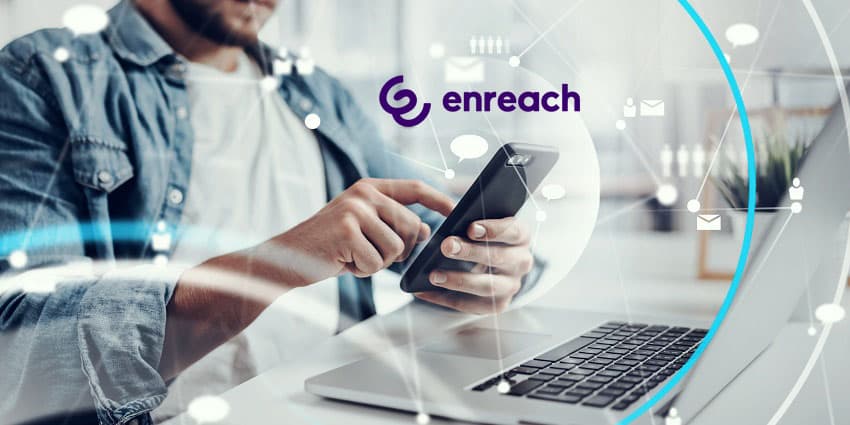
Fixed-mobile convergence (FMC) has given mobility a starring role at the centre of all communications. Mobility is enabled to the extent that mission critical activities previously thought of as exclusively enabled by fixed communications are now handled on mobile devices using attractive apps. Use cases extend from contact centre agents who now routinely log-in from home via an app on their mobile devices to mobile workers that utilise their smartphones to access tools such as augmented reality. The fundamental enabler is high-speed, secure, reliable and ubiquitous cellular networks, notably 5G and LTE, but this landscape has also been catalysed by the pace of innovation in mobile app development.
Excitingly, this presents a significant opportunity for service providers of all types to add value and augment their portfolios with a range of mobile-first applications, tools and services. “The big evolution is the smartphone itself,” confirms Bertrand Pourcelot, the CEO of Enreach for Service Providers.
“It has access to a large amount of data both professional and personal - we have our whole life in our smartphones, it’s intuitive, very smart by definition and it comes with embedded application management and combination capabilities.
The ability to have two numbers, personal and professional, on the device and decide which one to present as well as control reachability, makes it ideal for many enterprise use cases.”
Pourcelot sees mobility, alongside traditional communications technologies and infrastructure, as a means for service providers to support their enterprise customers with a rich portfolio of applications and services but he is well aware of caution among adopters. “People tend to oppose over-the-top (OTT) apps on smartphones in contrast to GSM network-driven fixed-mobile convergence. What you need is a smart OTT mobile app that is aware of the full GSM network-driven FMC landscape because, to succeed, you need the best of both worlds. This ‘smart’ FMC is also a nice differentiator or complement to MS Teams when integrated.”
“The challenge has been that organisations want the business-grade capabilities of traditional environments but the ability to answer customer queries in a mobile app,” he adds. “The conflict was that companies couldn’t do both but, if you add the ability to do so, you can determine what fits in which domain and build a good use case across both. Our offer is of a UCaaS app that has built-in FMC integration and awareness.