OpenAI has launched its new “company knowledge” feature for ChatGPT Business, Enterprise, and Education users, potentially signalling something more ambitious than just another AI-powered productivity upgrade.
It's pitched as a bid to turn the world’s most famous chatbot into an enterprise intelligence layer, one capable, in theory, of understanding not just language, but the context in which an organisation operates. For IT and business leaders alike, the implications possibly stretch beyond just prompt engineering. They suggest a viable future in which AI isn’t a tool beside the workflow, but the lens through which all work is viewed.
The Search Problem Inside Every Business
Every company faces a paradox: it has too much information but too little knowledge. Messages, documents, and tickets live in separate silos, such as Slack, SharePoint, Google Drive, and GitHub, rarely speaking the same language. The result is wasted time, duplicated effort, and poor decisions.
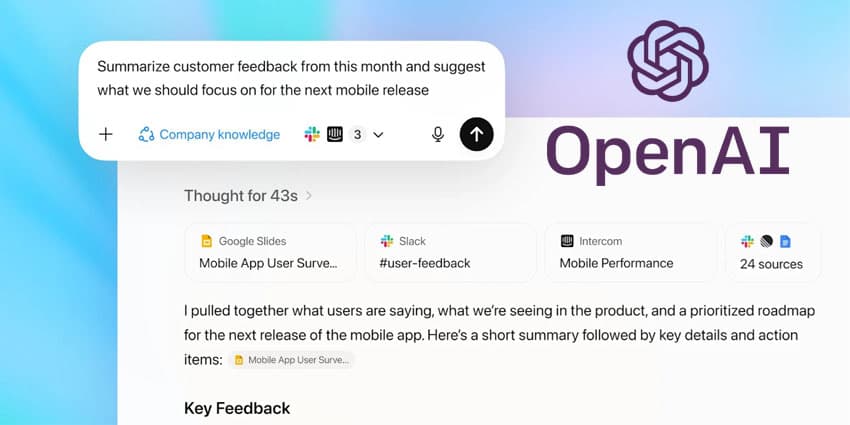
OpenAI’s answer is company knowledge, a GPT-5-powered capability that can scour all those sources simultaneously and return a single, contextualised answer, complete with citations to the original data. According to OpenAI, this makes ChatGPT “a conversational search engine” for the workplace.
In practice, a manager could ask: “Where did we land on next year’s goals?” and receive a synthesis of Slack threads, Google Docs, and emails, all linked back to the source.
OpenAI's feature announcement blog wrote:
“Every response includes clear citations so you can see where the information came from and trust the results."
Governance: The Trust Equation
For CIOs and CISOs, trust is non-negotiable. OpenAI stresses that Company Knowledge respects existing permission frameworks. ChatGPT can only access data that each user is authorised to view. Administrators can also manage which apps are connected, apply group-level permissions, and monitor conversations through the Enterprise Compliance API.
Equally important, OpenAI says it never trains its models on customer data by default. That assurance, combined with encryption, SSO and SCIM controls, and IP allow-listing, is designed to meet enterprise-grade compliance expectations.
Still, cultural trust remains a hurdle. Many firms are reluctant to give any external AI visibility into internal communications. For early adopters, transparency about data flow and clear ROI metrics will be key to internal buy-in.
A Foundation for AI-Native Workflows
Under the hood, Company Knowledge is powered by a variant of GPT-5, trained specifically to reason across multiple internal data sources simultaneously. That’s what allows it to “think while it searches,” resolving conflicting details or time-based queries such as “show our Q1 performance discussion.”
For digital workplace managers and architects, this could signify a new layer in enterprise infrastructure. The AI knowledge plane that can sit above traditional UC and content management systems. It’s not hard to imagine this layer evolving into a decision engine that drafts plans, summarises meetings, or orchestrates workflows across collaboration tools.