The future of workplace AI may not begin with another chat window.
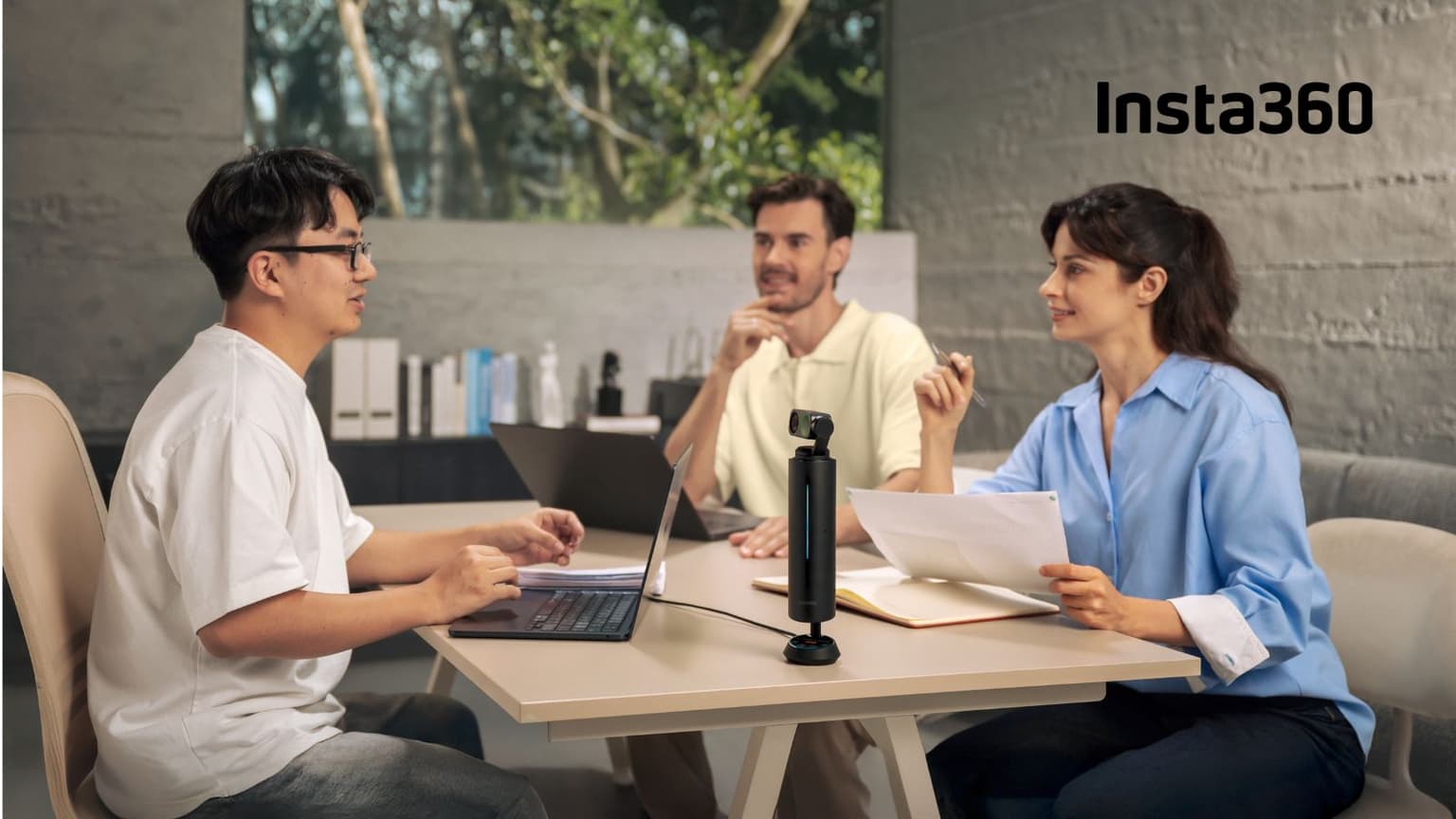
It may begin with someone speaking across a meeting-room table, asking a question out loud, and receiving an answer through the device already sitting in the middle of the room.
That is the direction behind a recent demonstration involving Microsoft MVP Michael Gannotti, who connected Insta360 Wave to a conversational AI setup involving Grok. Wave captured voice input, while its speaker played the AI’s response back to the user.
The demonstration was not a mainstream enterprise deployment, and it should not be treated as one. But it raised a more interesting question about where AI agents could show up next: not only on screens, but through the collaboration hardware people already use every day.
Insta360 is positioning Wave as part of that possible shift. The device is still a speakerphone, designed to capture voices and play meeting audio. But the company also sees it as an intelligent audio endpoint that could connect physical workplace conversations with AI tools.
Luoling Zhang, Product Manager for Wave at Insta360, said, “Wave can serve as a tool for interaction between people and AI.”
That may sound like a subtle change in positioning. In practice, it points to a much bigger ambition for the speakerphone category.
From Voice Input to Workplace Context
The first use case is straightforward. A user can connect Wave to a computer and use it as the microphone and speaker for an AI service. Instead of typing a detailed prompt, they can speak naturally to the tool and hear the answer through Wave.
“Instead of writing a long prompt to tell AI the context and background information, you can simply talk to AI through Wave,” Zhang said.
For individual users, that could make AI interaction feel more immediate. For meeting rooms, it could offer a shared voice interface where teams can ask questions, request information, or engage an assistant without passing control of a laptop between participants.
But Wave’s bigger role may lie in what happens after the conversation.
The device can record meetings and send the material to Insta360 InSight for transcription and summaries. Those outputs can become part of the context used in a wider AI workflow, helping an assistant understand what was discussed, what decisions were made, and which follow-up actions were identified.
“Wave is a recorder, so we can record real-world information – meetings and conversations that happen in the workspace,” Zhang said.
“We can turn this into real-world work background information: the context.”
That is the distinction Insta360 is trying to make. A conventional speakerphone helps people participate in a meeting. An AI-enabled endpoint could also help preserve, organize, and reuse the information generated by that meeting.
The Gannotti Demonstration Offers a Glimpse
Gannotti’s demonstration gives that idea a practical form.
Using Wave’s microphone and speaker capabilities, he created a setup in which he could speak to Grok and receive spoken responses through the device. Zhang said the demonstration showed how collaboration hardware could become an interface for AI agents rather than remaining solely a tool for remote meetings.
“Wave served as a physical AI assistant,” she said.
The underlying AI service, the software integration, the handling of voice data, and the security controls will all vary by implementation. A proof of concept can demonstrate what is technically possible without resolving the governance and management questions that come with large-scale adoption.
Even so, the demonstration suggests that collaboration endpoints could be assessed differently in future. Microphones and speakers have historically been peripherals for calls. In an AI workflow, they could become the input and output layer for tools that need to listen, respond, and understand the context of work taking place away from the screen.
Privacy Cannot Be Bolted on Later
That possibility brings a significant responsibility for IT teams.
Meeting recordings and AI-generated summaries can contain sensitive customer information, commercial decisions, employee views, and personal data. Once that information becomes available to AI tools, organizations need to know precisely who can access it, where it is stored, and how long it is retained.
For European buyers, the questions will inevitably include GDPR compliance, consent, encryption, deletion rights, third-party processors, and international data transfers.
Zhang said customers regularly ask how recordings and AI-generated material are stored and processed, whether content is used to train AI models, and how long files are retained. Insta360 says Wave supports encryption in transit and at rest, alongside access controls, and abides by GDPR-rules.
Those assurances are a starting point, not the end of the assessment.
IT leaders should establish whether recording is enabled by default, how meeting participants are notified, where transcripts are held, and whether an associated AI service creates further data-processing obligations. They should also distinguish between processing carried out on the device and processing handled through cloud services.
“On-device AI” can mean different things depending on the feature. Buyers should confirm the technical architecture rather than assume that transcription, summaries, and agent interactions are all handled locally.
A New Test for Collaboration Hardware
Insta360 sees Wave developing across three fronts over the next 12 to 24 months: wider adoption in meeting spaces, deeper integrations with conferencing and enterprise platforms, and more AI-oriented use cases.
The company expects Wave to serve settings ranging from individual workspaces to larger rooms, where multiple devices can be connected to extend audio pickup. It also wants to develop API-based integrations that make the hardware more useful within existing workflows.
Ultimately, Zhang said, Insta360 wants to establish Wave as “an intelligent audio endpoint” linking real-world workplace conversations with AI-powered work.
That is a wider ambition than the traditional speakerphone market has typically demanded. Audio quality, reliability, compatibility, and ease of use will remain the fundamentals. But as AI moves into everyday collaboration, another question may become just as important: can the hardware in the room help turn conversation into useful, governed context?