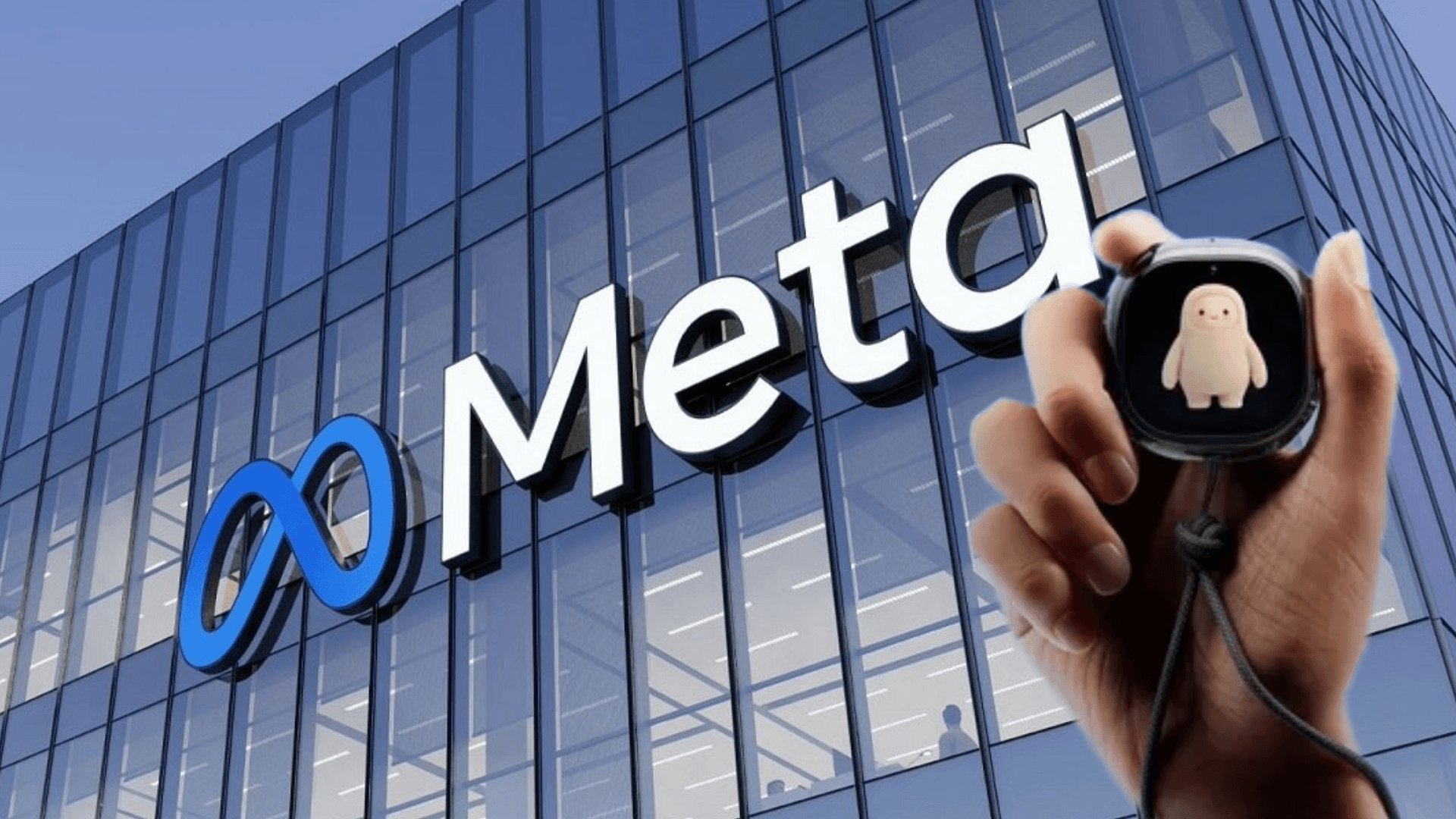
Meta Connect 2026 was ostensibly a consumer hardware event. But Mark Zuckerberg’s unveiling of Muse Charm, a fingerprint-activated, keychain-sized device that provides phone-free access to Meta’s Muse artificial intelligence (AI) agent, offers a more consequential clue for enterprise technology leaders.
The device itself is not an immersive workplace product. Meta says only a small number of prototypes currently exist, with a targeted December release. Yet the thinking behind it is highly relevant to extended reality (XR), the collective term for virtual reality (VR), augmented reality (AR) and mixed reality (MR): computing is becoming more useful when people do not have to stop what they are doing to reach it.
For years, the immersive workplace conversation has centred on headsets, virtual meeting rooms and three-dimensional collaboration. The next phase may be less about putting people inside digital environments and more about putting intelligent, task-capable assistance into the environments where people already work. Meta’s Muse ecosystem, spanning an app, planned smart-glasses support and a proposed wearable accessory, is an early, consumer-led example of that shift.
TL;DR
Muse Charm is a planned consumer device, but its phone-free, voice-led interface offers a useful model for the future immersive workplace.
The strategic opportunity is not a keychain in itself; it is an AI agent that can preserve context as employees move between laptops, physical sites, collaboration platforms and spatial devices.
For enterprises, the decisive issues are integration, identity, visual-data governance, human approval and whether the agent works across existing workflows rather than becoming another isolated interface.
Why does Muse Charm matter beyond consumer AI hardware?
Muse Charm is designed to be a fast route into Meta’s personal AI agent. Users tap a fingerprint sensor, speak to Muse and can show it what is around them. Its small display presents a customisable avatar, while the device is intended to support real-time voice and visual interaction without requiring a person to unlock a phone or open an application.
“We packed the whole Muse experience, including the whole real time, voice and avatar stack, into something that fits on a keychain and is always available to talk to you,” Zuckerberg said at Meta Connect, as reported by Technology Magazine. He added that, for people not wearing glasses, it would be “by far the fastest way to talk to your Muse and show it what’s going on around you.”
That final point is where the XR relevance begins. The device is not merely an alternative screen. It is designed around situational access: the user can invoke an agent while moving through the world and, potentially, share visual context with it. Smart glasses promise the same model in a more directly spatial form, with contextual information and communication available without asking a worker to reach for a handset or break concentration.
This is a different proposition from the first generation of workplace VR. Rather than asking employees to enter a virtual environment for a specific activity, the objective becomes to let digital intelligence appear at the precise moment and place it is needed.
What is an immersive workplace?
An immersive workplace uses XR technologies to bring digital content, collaboration and guidance into a worker’s physical or virtual environment. Its value is not limited to virtual meetings. It can include remote expertise, spatial design review, training, field guidance and context-aware communications delivered through headsets, smart glasses or other connected interfaces.
Could AI agents solve one of XR’s biggest adoption problems?
Immersive workplace technology has often faced a usability paradox. XR can make information more intuitive and collaborative, particularly in fields such as engineering, manufacturing, healthcare and frontline service. But it can also introduce friction: a headset must be charged, worn and launched; a virtual application must be entered; and participants may have to leave familiar communications and productivity tools behind.
An agentic interface could change that equation. Agentic AI refers to software that can pursue multi-step tasks on a user’s behalf, rather than simply generating an answer. A spatial agent could, in principle, retrieve a procedure, create a work order, transcribe an observation, call a remote specialist, document an inspection or summarise a shift handover while a worker remains engaged with the physical task in front of them.
That does not make the headset or smart glasses irrelevant. It makes them more useful. The display becomes one part of a broader interface system, while voice, visual context and AI reasoning handle the transition between physical work, communication and business workflows.
Meta has not announced these enterprise XR functions for Muse. Its present use cases are personal: handling email, booking travel, filling out forms, making purchases and pursuing individual goals. Still, its stated ambition provides an important signal. In Meta’s launch announcement, the company described Muse as an agent that can continue working after the user closes the application, returning when it needs an approval or when circumstances change.
That type of continuity is exactly what immersive work requires. A frontline employee should not have to recreate the same context in a headset, smartphone, PC and collaboration application. The relevant task, information and communications history should travel with them — within clear organisational controls.
Key takeaway
The immersive workplace will not succeed simply by making work more visual. It will succeed when employees can move between physical, screen-based and spatial work without losing task context. AI agents could become the connective layer that makes that continuity possible.
What could a spatial AI agent actually do at work?
The credible near-term opportunity is not an autonomous avatar wandering through a virtual office. It is a tightly scoped assistant that reduces the administrative and communication burden around real work.
In industrial settings, a worker using smart glasses could ask an agent to surface the correct maintenance procedure based on an asset in view, capture evidence for a compliance record or escalate a fault to a remote expert. In design and engineering, participants in a mixed-reality review could ask an agent to retrieve the latest specification, log a decision or turn verbal feedback into assigned actions. In healthcare training, a spatial assistant could guide a learner through a simulation and create a record of where further practice is required.
These are potential use cases, not released Muse capabilities. They also depend on deep integrations into unified communications (UC), collaboration, identity and line-of-business systems. The value of an immersive agent comes from its connection to the work, not from its avatar or form factor.
That is where early AI hardware experiments provide a caution. The Humane AI Pin has been discontinued, while products such as Rabbit R1 and the friend pendant have tested consumer interest in standalone AI companions with mixed results. The lesson is not that dedicated AI hardware cannot work. It is that convenience hardware alone does not overcome weak workflows, incomplete integrations or unclear reasons to change user behaviour.
For the immersive workplace, the same standard should apply. A device or agent should earn adoption by helping workers complete a high-value task with less interruption, not by adding another endpoint for IT teams to manage.
What makes an AI agent spatial?
A spatial AI agent can use the context of a physical or immersive environment — such as a user’s location, field of view, task, nearby equipment or virtual objects — to provide relevant assistance. That capability raises the stakes for privacy: visual, audio and location data need stricter boundaries than ordinary text prompts.
Why are smart glasses more important than the keychain?
The Charm is useful as a design signal because it is deliberately frictionless. But Meta’s planned expansion of Muse to its AI glasses is likely to have greater implications for immersive work.
Smart glasses can place an agent at the intersection of voice, environment and communication. In theory, a worker could ask for information while keeping their hands free, capture what they see for remote support, receive time-sensitive guidance or share visual context with a colleague. That model could be valuable in roles where laptops are unavailable or inconvenient, including field service, logistics, facilities, manufacturing and clinical environments.
According to ABC News, Meta said at Connect that Muse would come to its smart glasses in the coming months. The company also announced Muse Realtime Avatar, which supports real-time conversation through a user-selected AI avatar. It is not yet clear how Meta will translate these consumer features into professional, multi-user or enterprise-managed environments.
That gap matters. Workplace smart glasses need more than conversational ability. They need identity assurance, device management, accessibility, durable hardware, secure connectivity and a clear way to distinguish personal assistance from company-sanctioned action. They must also fit into existing communications architectures, including calling, messaging, meetings and contact centre workflows.