Would you work in a fully virtual world?
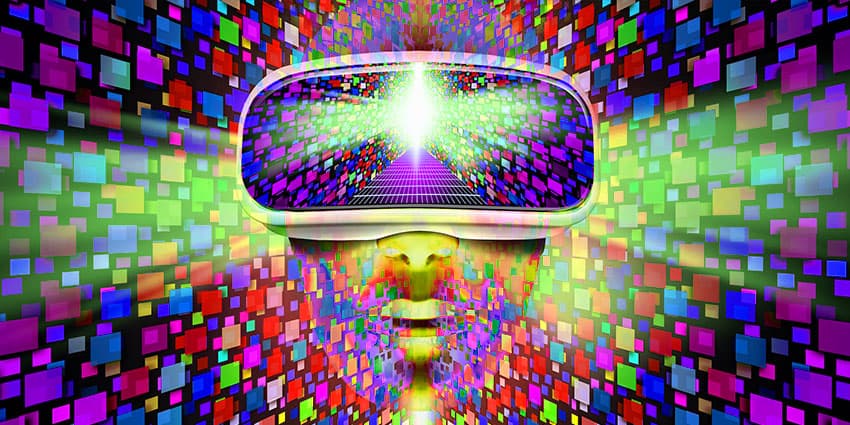
Now that the metaverse is almost here, this is no longer a hypothetical question. The metaverse offers an immersive VR space where you can perform virtually any activity you would do in the office. From multi-participant meetings to watercooler chats, from yoga day to impromptu brainstorming sessions, the metaverse has it all.
Yet, reactions to the possibility of work in the metaverse are mixed. A recent US poll found that 27% of employees are excited about the idea of AR/VR in the workplace; 29% said that they are not looking forward to it at all. Meanwhile, 31% are neutral, even as 83% of senior business executives believe that immersive tech investments will increase.
In other words, a metaverse-ian work reality may not be far away, but adoption could be patchy and problematic. Let us explore this further.
What Does Work in the Metaverse Look Like?
The metaverse refers to an immersive 3D space where users can perform interactions similar to the real world.
In a way, the metaverse already exists through platforms like Decentraland and AltspaceVR, which allow users to create multiple VR rooms or spaces for different purposes. But this is different from the vision for the metaverse as put forward by Facebook and academic theorists. A true metaverse wouldn’t be just another virtual environment among many – it would be a single, converged platform built on interoperability across existing worlds.
This has major implications for professional use cases. The metaverse could have entire office campuses and cityscapes where employees can congregate or even complete independent tasks. The VR environment would allow things like 3D simulation, infinite whiteboarding, teleportation, 3D data modelling, and much more.
Particularly, in the wake of the recent rise of remote work, the metaverse takes on a different dimension.
Unified Communications and Remote Working Get High Touch
Most remote work practices are low touch in nature. We focus on making the most of asynchronous communication, and video calls are a far cry from the intimacy of real-world meetings. In fact, they can have counterintuitive effects. Studies show that employees feel significant stress when they have to look at themselves on video for extended periods of time. Video calling creates unhealthy levels of cognitive workload popularly known as Zoom fatigue. The metaverse changes all of this by introducing an immersive space that enables interactions almost as organic as in the real world.
The spatial audio capabilities of VR allow us to hear sound based on where the speaker is sitting. Desktop streaming technology lets us type in VR and have it recorded in our real-life workstations. Photorealistic avatars help us interact with our diverse workforce more naturally than in-video calls or email. In short, every aspect of unified communications gets a high-touch overhaul when we work in the metaverse.
Career Opportunities in the Metaverse
Interestingly, the metaverse doesn't just allow us to do our existing jobs in a new way. It also opens up new career opportunities that exist only inside the metaverse economy. Some examples include: