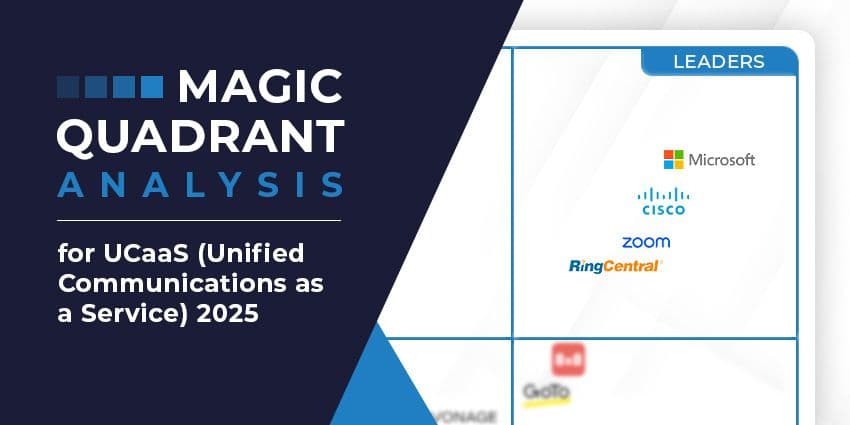
The cloud-based Unified Communications as a Service (UCaaS) market continues to mature, with collaboration and AI taking centre stage, according to Gartner’s 2025 Magic Quadrant.
The report evaluates 11 providers, categorising Cisco, Microsoft, RingCentral, and Zoom as Leaders, with Visionaries including 8x8, Dialpad, and GoTo, and Niche Players such as Google, Sangoma, Vonage, and Wildix.
Gartner notes that UCaaS adoption is being driven by the need for simpler management, enhanced collaboration, and reduced total cost of ownership (TCO) compared to legacy on-premises UC systems.
Strategic planning assumptions from the research suggest that by 2028, 90 percent of organisations will rely on cloud office platforms for enterprise telephony, up from 30 percent in 2025, and spend on traditional telephony platforms will fall by half.
Leaders: Consolidating Collaboration and AI
Cisco Webex continues to lead with a broad portfolio encompassing telephony, messaging, collaboration, meetings, devices, and contact centre. Gartner highlights Cisco’s strong AI integration, including AI-driven audio enhancements, meeting summaries, gesture recognition, and immersive video features.
While Cisco’s offerings suit large multinational organisations and regulated industries, SMB clients sometimes prefer lower-cost alternatives with simpler licensing.
Microsoft Teams remains the UCaaS solution of choice for organisations already invested in Microsoft’s ecosystem. With Teams Premium and the Queues app, Microsoft provides lightweight telephony and voice-only call centre features.
Gartner notes Teams’ geographic reach, especially in cloud-difficult regions, as a differentiator, alongside a growing portfolio of AI capabilities, such as context gathering, meeting transcription, and predictive insights. However, the lack of a fully integrated contact centre and limited advanced telephony admin features remain areas for improvement.
RingCentral delivers integrated telephony, messaging, meetings, and contact centre capabilities through its RingEX and RingCX offerings. Gartner observes strong adoption among organisations seeking feature-rich telephony and CCaaS-lite integration, with a wide array of third-party app integrations.
Challenges cited include service and support navigation and pricing complexity, highlighting the need for clearer licensing and contract management.
Zoom, increasingly positioning itself as a collaboration-first UCaaS provider, combines meetings, messaging, telephony, and contact centre capabilities. Its bundled AI features, including automated intent discovery, message translation, and real-time agent guidance, enhance productivity and workflow efficiency.
Gartner notes that Zoom has achieved high adoption in highly regulated sectors, including government, healthcare, and financial services, and has expanded into adjacent areas such as Zoom Calendar, Docs, Mail, and workforce management. While Zoom’s user experience is generally praised, Gartner emphasises that organisations using Zoom primarily for meetings may encounter additional complexity when navigating its growing suite of functionalities.
Visionaries and Niche Players: Innovation and Specialised Focus
Vendors like 8x8, Dialpad, and GoTo continue to explore AI-enabled telephony and contact centre integration, aiming to differentiate themselves in a commoditized market. Gartner highlights that these providers are investing in agentic AI capabilities, virtual assistants, and automated conversation summaries, though their adoption in large-scale, multinational deployments remains limited.
Niche Players such as Google, Sangoma, Vonage, and Wildix largely focus on SMBs or specific geographic regions. Google’s UCaaS offering, integrated with Workspace, benefits from AI features like real-time translation and meeting recaps but has slower innovation cycles.
Vonage emphasizes its Fusion platform, combining UCaaS, CCaaS, and AI, streamlining operations for midmarket enterprises. Wildix and Sangoma concentrate on customer-facing roles, lightweight CCaaS integration, and vertical-focused deployments, particularly in healthcare, retail, and finance.