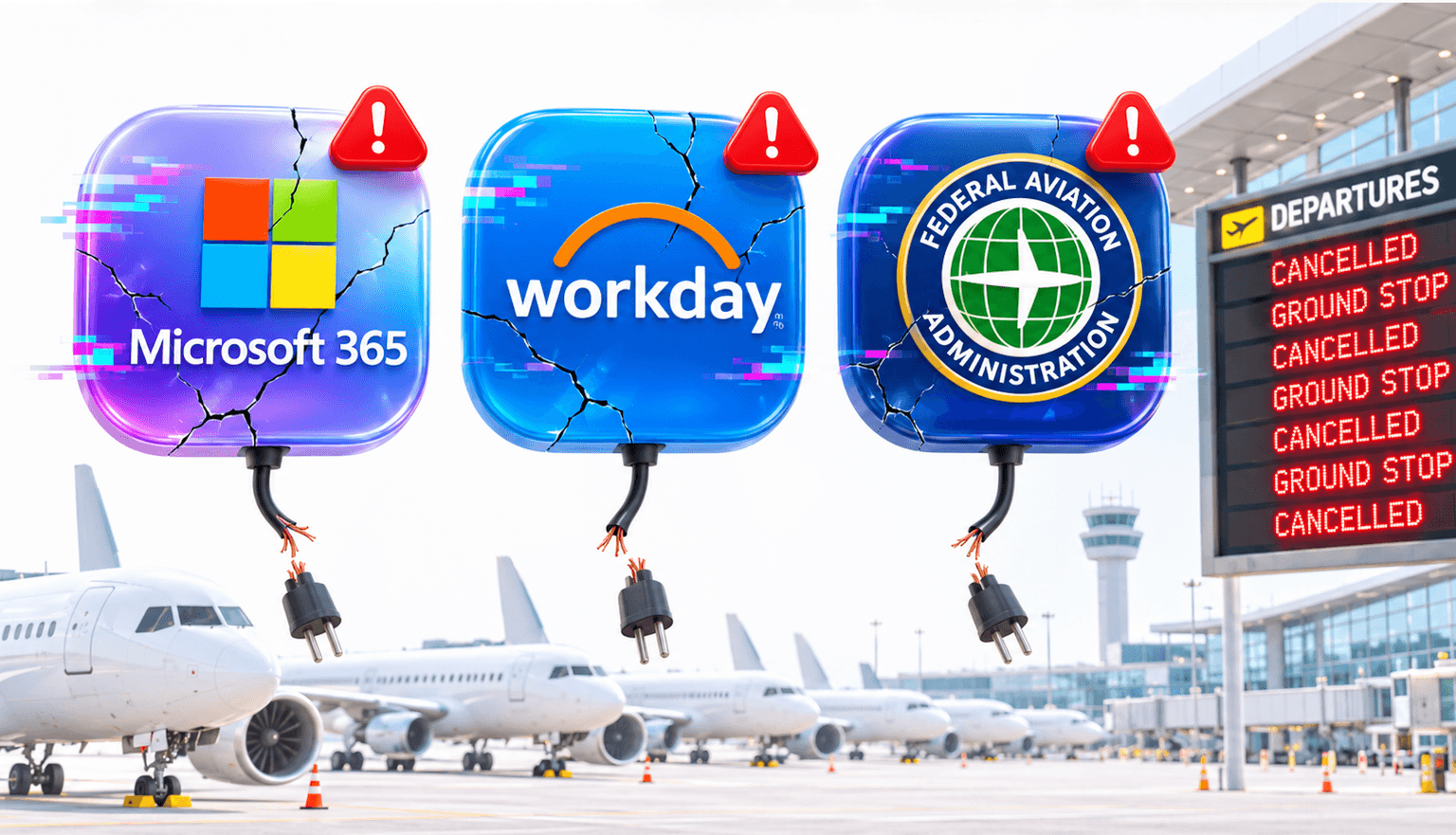


It has been an extraordinary few days for systems most people assume will simply be there when they need them.
Microsoft 365 users lost access to Outlook, calendars and other mailbox-dependent services. Workday customers then faced disruption to timekeeping, payroll and benefits after a disaster-recovery issue. JPMorgan Chase customers experienced online banking problems after a software bug, while a router problem prompted a nationwide FAA ground stop.
Different systems, same result: people could not work, travel or move money. And none of it started with a cyberattack.
"With AI now woven into work, home, and school, one failure quickly ripples through every supporting and adjacent workflow," John DiLullo, CEO of incident management platform PagerDuty, told UC Today.
"Resilience is built before the outage, not during it. Organisations that recover fastest pair the right technology with preparation, so they can detect issues instantly, automate their responses where possible, and mobilise the right people in the darkest moments following an incident."
When Essential Systems Go Down
Microsoft said its Microsoft 365 disruption was linked to a technical issue from an earlier network-capacity upgrade, not AI agents or a cyberattack. The incident affected Exchange Online and the services that rely on it, including email and calendars.
Microsoft said it had restored service to remaining affected customers and regions and has promised a post-incident report.
JPMorgan Chase said a software bug in an on-premises hardware system caused a temporary technical issue. The bank said the problem was not cyber-related and that it was working to restore services.
The disruption affected Chase customers trying to use online accounts and had knock-on effects for people attempting transactions with Chase through other financial institutions. Customers at other banks reported problems, while Zelle payments involving affected institutions were delayed.
Workday's outage began after disaster-recovery services unexpectedly connected to production databases, creating data inconsistencies. Affected customers were placed into maintenance mode, disrupting access to timekeeping, payroll and benefits systems. The company said services were restored.
The FAA offered the connectivity case study. A nationwide ground stop began after instability affected air traffic-control communications and radar data feeds.
Transportation Secretary Sean Duffy said workers were replacing copper lines with fibre at a remote facility in El Dorado, Arkansas, when a router began broadcasting data across the network. A router at a recently upgraded site in Amarillo, Texas, also began flooding the system, according to Duffy.
Officials have disabled broadcasting capability across all 69 comparable routers while the investigation continues. The Arkansas and Texas routers are being examined at an L3Harris lab in Florida, with FAA and FBI involvement.
"Once we shut the ability to broadcast down on the routers, the issue is resolved," Duffy said. "So we're going to take a hard look at it."